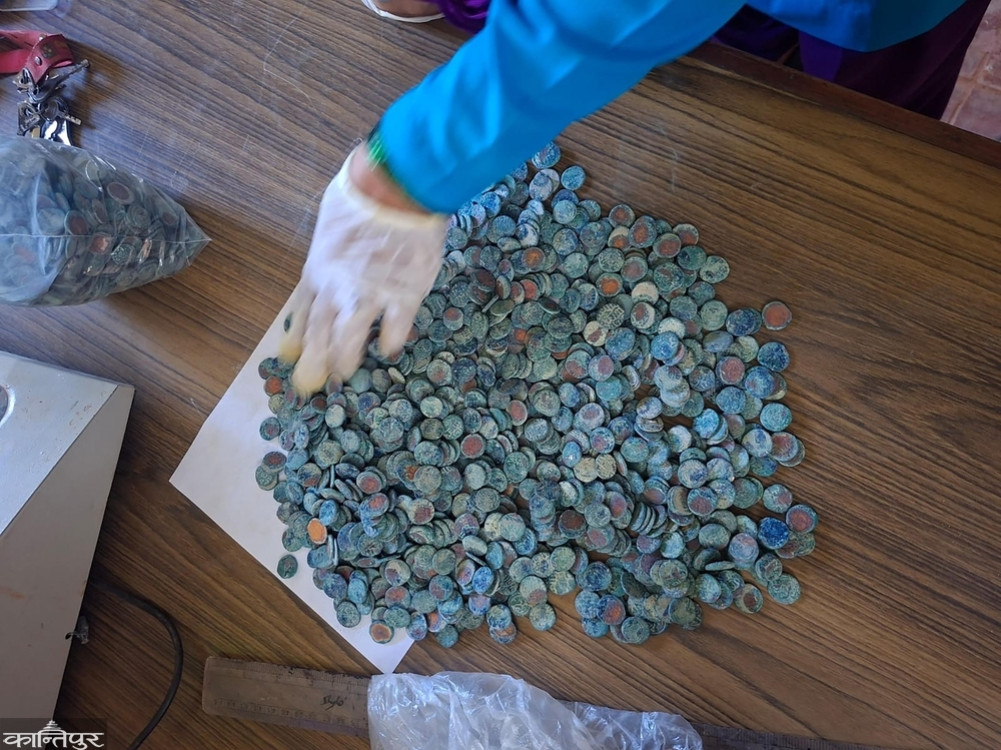
Researchers have estimated that the copper coins and the karuwa weighing about 7 kilograms found in Kapilvastu date back to the reign of Alauddin.
We use Google Cloud Translation Services. Google requires we provide the following disclaimer relating to use of this service:
This service may contain translations powered by Google. Google disclaims all warranties related to the translations, expressed or implied, including any warranties of accuracy, reliability, and any implied warranties of merchantability, fitness for a particular purpose, and noninfringement.
An ancient copper vessel containing copper coins has been found while digging an embankment in Babhani, Ward 5 of Kapilvastu Municipality. A total of 2,314 copper coins were discovered inside the vessel. The total weight of all the coins is 7 kilograms and 34 grams.
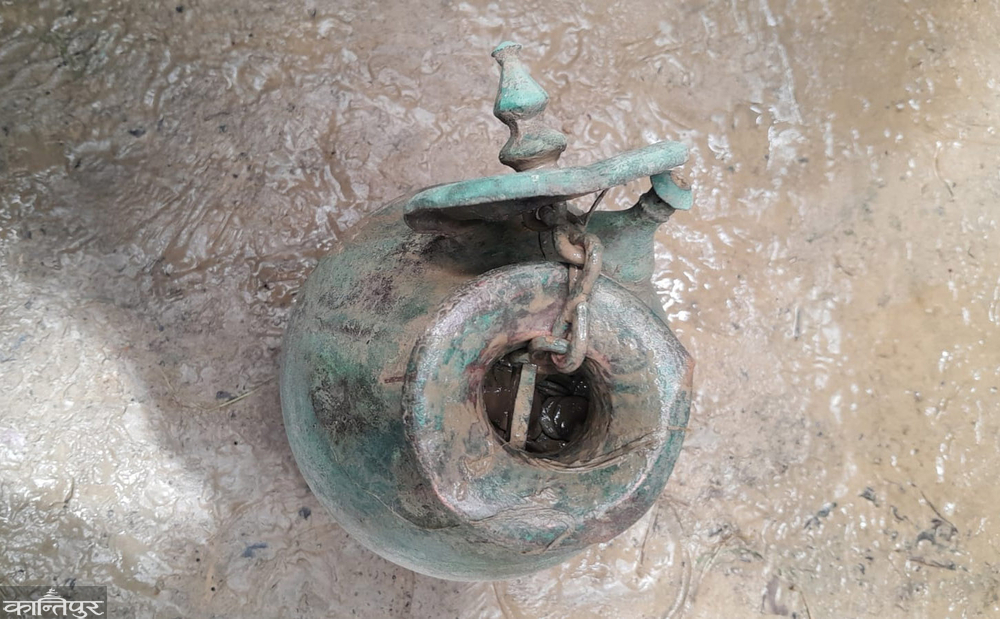
The vessel with the ancient copper coins was found while Ramraj Yadav, a local resident, was digging an embankment in his field. About a week and a half ago, after finding the vessel and the copper coins, Yadav gave them to his neighbor Rohit Kori. After Kori kept the vessel and coins for a week, word spread throughout the village.
After rumors spread that archaeological artifacts must not be kept at home and that there would be legal action if they were not handed over to the government, Kori took the vessel to the edge of the village pond and left it there. Upon receiving information that the vessel was at the pond’s edge, Ward Chairperson Direp Kumar Chaudhary informed the police.
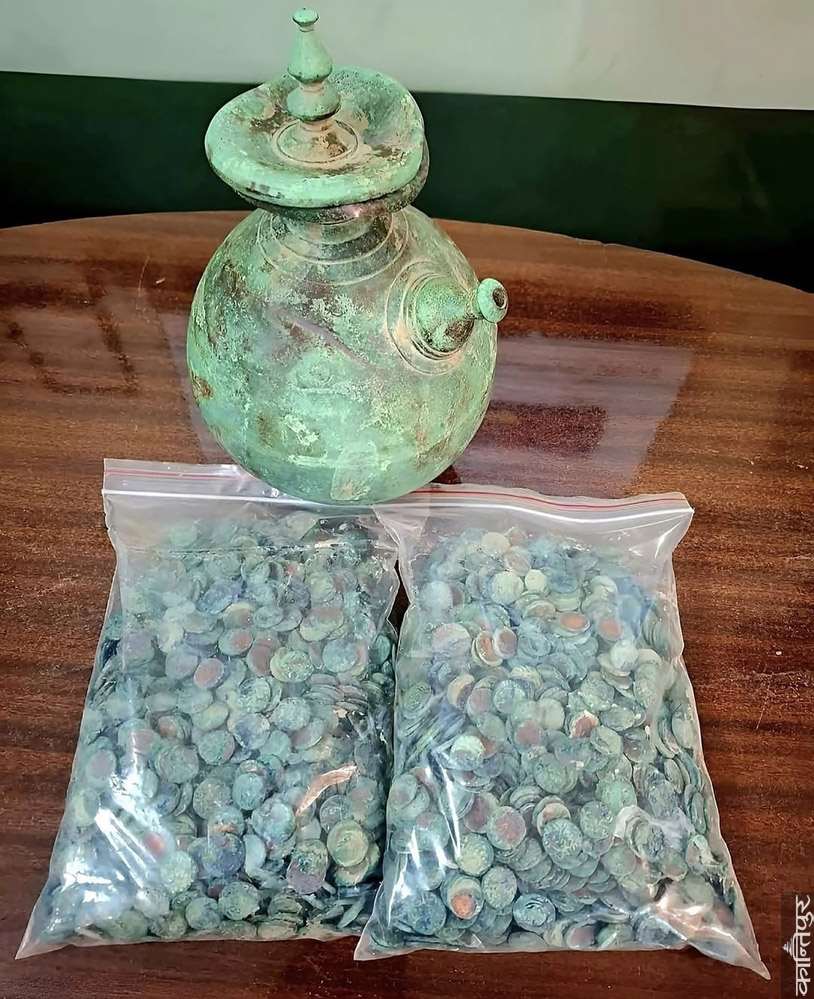
On the 4th of Saun, the police arrived and took the vessel with the coins to the District Police Office. Inspector Deepak Kunwar of the District Police Office said that it was very difficult to remove the coins because they were stuck together inside the vessel. He said that staff from the Kapilvastu Museum were called to extract the coins from the vessel. Kunwar explained that, having been buried in the soil for years, the coins had rusted and changed color, altering their appearance.
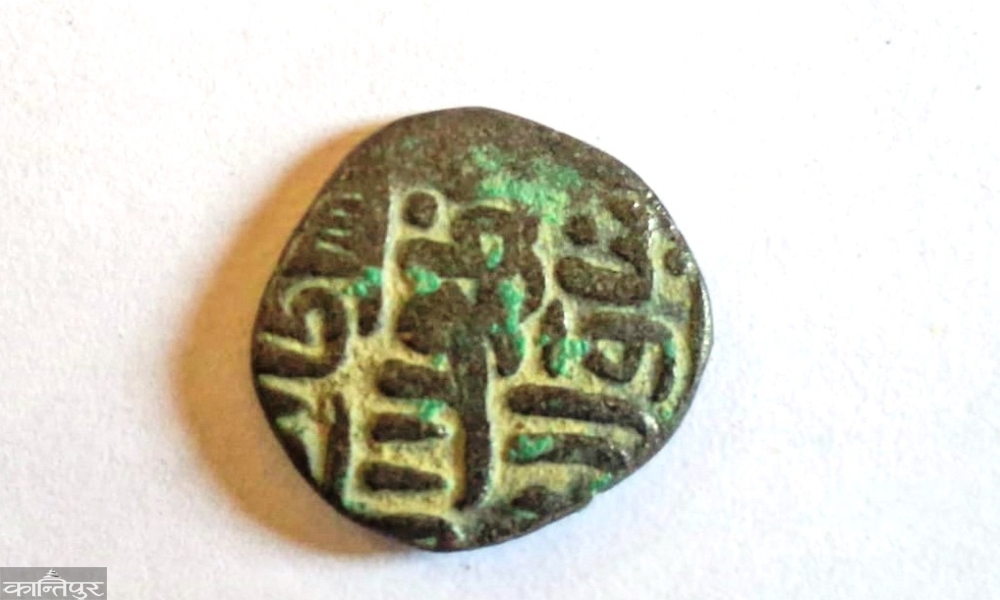
On the 5th of Saun, the police handed over the vessel with the coins to the Kapilvastu Museum. Upon measurement and inspection at the museum, the diameter of the coins ranged from 1.4 to 1.8 centimeters. Similarly, the weight of each coin ranged from 3.13 to 3.26 grams. The vessel itself has a diameter of 23 centimeters and a height of 52 centimeters.
According to Kapilvastu Museum Chief Shanti Sherma, preliminary estimates suggest that the coins date back to the reign of Sultan Alauddin, who ruled Delhi, as indicated by the Arabic and Persian script on them. Historical records show that his reign lasted from 1297 to 1316. This suggests that the coins could be from the 12th or 13th century. “The Department of Archaeology has also been informed, and further study and research are underway,” she said. She added that the archaeological vessel and coins are being safely stored at the museum and will be preserved in consultation with the Department of Archaeology. She also mentioned that, based on the department’s advice, the items could be put on display at the museum.
Senior archaeologist Basanta Bidari said that since ancient Kapilvastu (Tilaurakot), the capital of the Shakya dynasty, was located along a major trade route during the Buddha’s era, these coins may have been in circulation during the Mughal period. At that time, Kapilvastu was at the center of the Uttarapath trade route, so it is possible that the coins were left behind by traders passing through the area.
There was a trade route from Devdaha and Lumbini in Rupandehi, ancient Kapilvastu (Tilaurakot), Rajgir in India, Vaishali, Kushinagar, Shravasti, Haryana, and Punjab, all the way to Taxila in present-day Pakistan. “Traders used to travel along this route with ox carts,” he said. “The coins found now may have been brought by traders at that time.”
About 700 meters north of the site where the vessel was found lies the important archaeological site of Babhanikot. The fort, which covers about 450 bighas, contains three mounds. Fragments of old bricks can be seen scattered around the area. Despite being an important historical and archaeological site, the lack of study and research means that the true facts about Babhanikot have not come to light. “The Department of Archaeology has even put up a board stating that it is an archaeological site,” said Ward Chairperson Chaudhary, “but due to a lack of conservation efforts, it is being destroyed day by day and is falling victim to encroachment.”
Himal Upreti, Chief Archaeological Officer of the Lumbini Development Trust, said that there are only 136 identified historical, cultural, and archaeological sites on the other side of the Banganga River in Kapilvastu. “There are still many places that have not been explored. The site where the coins were found could be one of them,” he said.