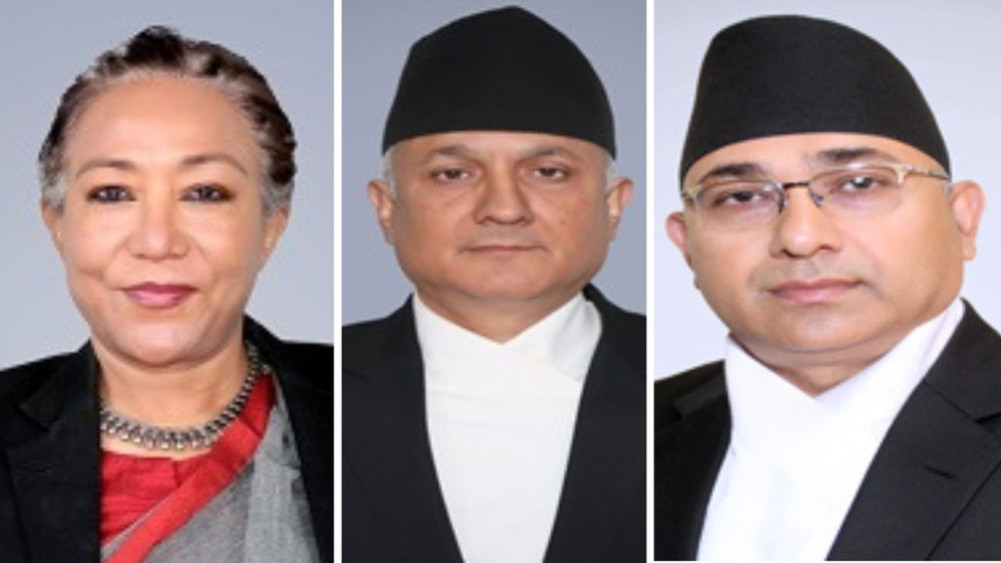
A joint statement by Amnesty International, Human Rights Watch, and ICJ said: Credible reports have been received that Supreme Court Justices Sapana Pradhan Malla, Kumar Regmi, and Hari Phuyal have been subjected to political pressure to resign, and that they have been threatened with impeachment if they refuse to do so.
We use Google Cloud Translation Services. Google requires we provide the following disclaimer relating to use of this service:
This service may contain translations powered by Google. Google disclaims all warranties related to the translations, expressed or implied, including any warranties of accuracy, reliability, and any implied warranties of merchantability, fitness for a particular purpose, and noninfringement.
Three international human rights organizations have claimed that the Government of Nepal has engaged in activities that threaten the independence of the judiciary. Amnesty International, Human Rights Watch, and the International Commission of Jurists (ICJ) have expressed concern that the Government of Nepal has taken steps that endanger judicial independence.
Issuing a joint statement from Geneva, they stated that they had received reports of political pressure being used to restructure the Supreme Court by forcing sitting judges to resign or by impeaching them.
The organizations also claimed that last Baisakh, instead of amending the Constitutional Council Act through the necessary parliamentary process as required by Nepal’s Constitution and the principle of rule of law, the government inappropriately amended it through an executive ordinance.
The joint statement said, “These organizations have received credible reports that political pressure was exerted on three Supreme Court judges—Sapana Pradhan Malla, Kumar Regmi, and Hari Phuyal—to resign, and that if they refused, they were threatened with impeachment. The organizations are not aware of any such publicly stated allegations that would fulfill the constitutional grounds for impeachment under Nepal’s Constitution.”
The organizations expressed concern over the amendment to the Constitutional Council Act, which changed the quorum and voting provisions of the Constitutional Council, the body responsible for recommending appointments to key constitutional positions including the Chief Justice.
“The Constitutional Council already had a majority of political officeholders, and this amendment will further increase the risk of undue political influence in judicial appointments and weaken international standards relating to judicial independence and the rule of law,” the statement said.
“The independence of the judiciary is a cornerstone of the rule of law and an essential safeguard for the protection of human rights,” said Ian Seiderman, ICJ’s Senior Legal and Policy Director. “Any reform of Nepal’s justice system must strengthen—not weaken—the independence, impartiality, and integrity of the courts.”
The statement also noted that the recent appointment of Manoj Kumar Sharma as Chief Justice has further heightened concerns. “Appointing him while three senior judges were still in office marks a departure from Nepal’s long-standing practice of appointing the most senior Supreme Court judge as Chief Justice. Although there were complaints regarding the nomination, the Parliamentary Hearing Committee approved his appointment without any meaningful public scrutiny of those complaints.”
They also stated that the suspension of three senior Supreme Court judges while the court is considering extremely important and far-reaching constitutional issues will have a significant impact on the structure and functioning of the court.
“Public confidence in the judiciary depends not only on the competence and integrity of judges but also on the transparency, impartiality, and independence of judicial appointments,” said Meenakshi Ganguly, Deputy Asia Director at Human Rights Watch. “Judicial appointments or dismissals that appear politically influenced undermine confidence in the administration of justice and weaken the rule of law.”
The organizations said that while judicial reforms may be necessary to strengthen the administration of justice in Nepal, such reforms should strengthen, not weaken, judicial independence, transparency, accountability, and the rule of law.
“The purpose of judicial reform is not to create institutions that are more vulnerable to political pressure, but rather to build stronger, more independent institutions that earn public trust,” said Isabelle Lasse, Deputy Regional Director for South Asia at Amnesty International.