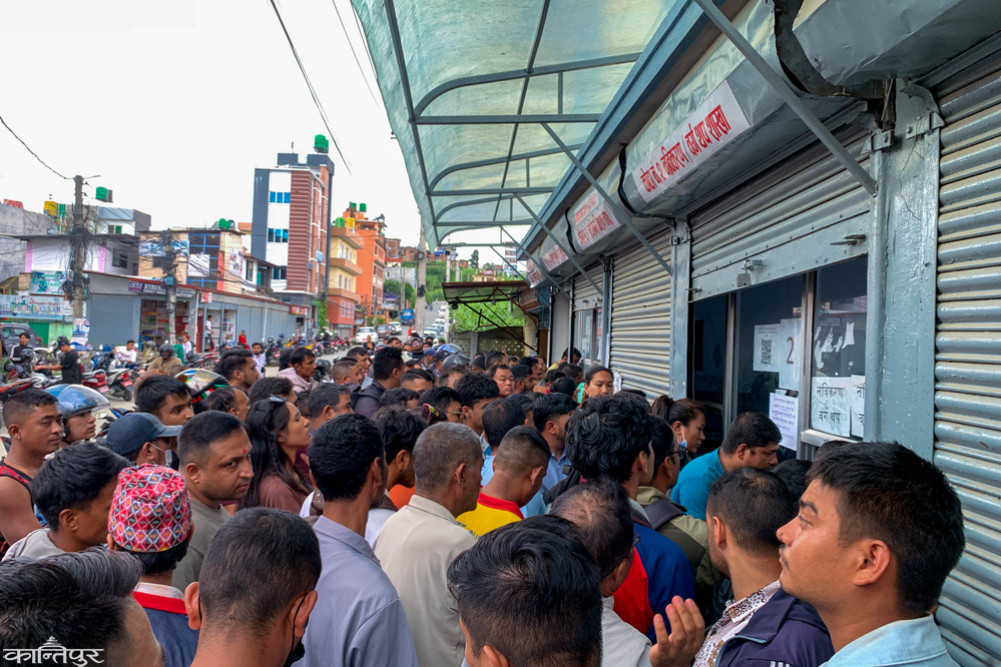
Although many services such as applications, electronic records, digital maps, e-services, and electronic withholding systems are offered online in government offices, service recipients are facing problems as the online systems in the Land Revenue, Transportation Management, National Identity Card and Registration Departments, and municipalities are being disrupted.
We use Google Cloud Translation Services. Google requires we provide the following disclaimer relating to use of this service:
This service may contain translations powered by Google. Google disclaims all warranties related to the translations, expressed or implied, including any warranties of accuracy, reliability, and any implied warranties of merchantability, fitness for a particular purpose, and noninfringement.
The Kathmandu Metropolitan City's 31st Ward Office in Shantinagar has been bustling with elderly people for the past two days. With the start of the new fiscal year, elderly people have been reaching the ward office to renew their social security allowance ID cards. 85-year-old Savitri Devi had arrived at the ward office at 11 am on Monday with her distraught husband. When she inquired about renewing her ID card, the staff replied that the 'system is down'.
Savitri Devi stayed at the ward office all day, hoping that the 'system' would work. She would occasionally ask the staff, 'Is the system open now?' The staff would reply, 'It's not open, mother.' When the system did not open even by 3 pm, her response was, 'What kind of system is this, that it will not open even after such a long time?' It was the second day she had reached the ward office to renew her old age allowance. She had also reached the ward office last Friday to renew her ID card.
Narvada Devi Sharma, 78, who came from Old Baneshwor with her two daughters, spent about four hours at the ward office on Monday. It was difficult for her to walk due to knee problems, so waiting all day was difficult. ‘We sat there thinking it would be okay,’ she told Kantipur. ‘After sitting for four hours, they turned away saying it wouldn’t be today. When should we come again!’ She cannot come to the ward alone. She has to arrange a time for others to come here.
Online services have been started in government offices, putting forward the concept of ‘Digital Nepal’. Services like online forms, electronic records, digital maps, e-services, and electronic withholding systems have been started. It is expected that this will increase transparency, eliminate middlemen, and eliminate the need for service recipients to visit the office. The 100 action plans made public by the Rashtriya Swayamsevak Sangh (RSS) government for governance reforms also include digitization and increasing the use of information technology systems in government bodies. In practice, service recipients are facing more problems as the system itself is blocked. There have been frequent problems with the digital system in offices where a large number of service recipients come to, such as the Land Revenue, Transport Management, National Identity Card and Registration Department, and municipalities.
The Ministry of Women, Children and Senior Citizens has instructed all local levels to ensure that beneficiaries who have collected biometric details are present in person and renew their identity cards to ensure social security allowance by mid-Ashar. The circular issued by the ministry has asked that the allowance be renewed by verifying the beneficiaries through fingerprints or facial recognition. Even though the ministry has instructed not to do mandatory biometrics, local levels have done mandatory biometrics. Many elderly people have complained that when they reach the ward office for identity card renewal, they are made to wait for hours and are turned away without work, saying that they do not have biometrics.
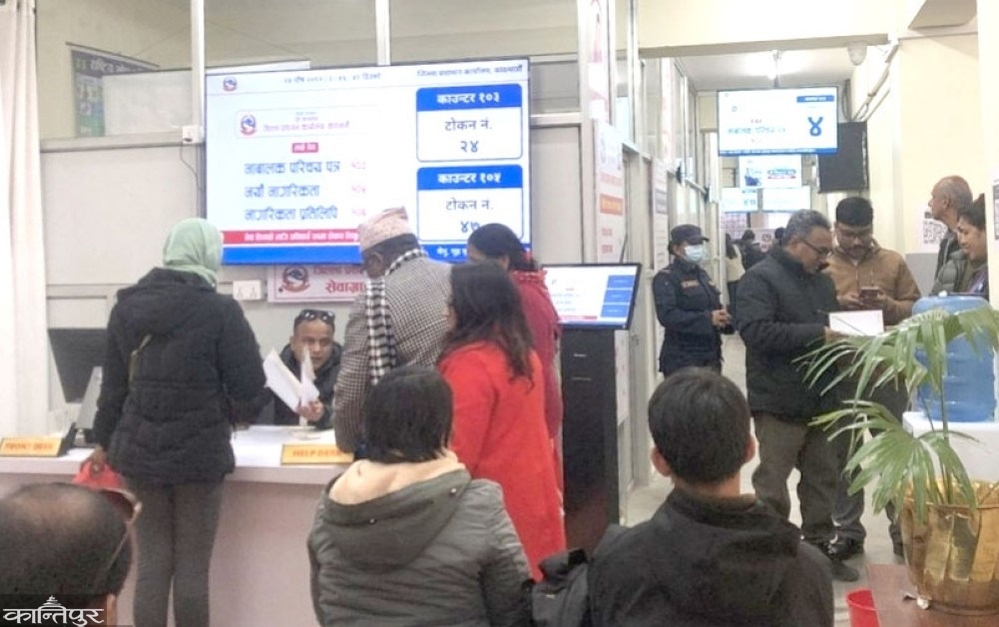
Director of the National Identity Card and Registration Department, Vijayakumari Prasai, said that local levels have been instructed not to do mandatory biometrics when a person's identity card is already biometric. "We have instructed that biometric verification should be done once, and if it is proof of life, then if there is no biometric, then write an error in the complaint," she said. "Earlier, biometrics were made mandatory. Now there is no such provision, but the problem has arisen because local levels have emphasized mandatory biometrics."
An employee of the ward office of Kathmandu Ward No. 31 said that mandatory biometrics were emphasized because if biometrics are not done, people will ask why they did not do it later. "We will do mandatory biometrics. If not today, we will call the next day," she said.
Bhagwati Phuyal from Katunje, Bhaktapur reached the Transport Management Service Office, Sallaghari on Monday to renew her scooter's blue book. As soon as she reached the office gate, someone said, "The system is closed today, a notice has been posted, don't look at the notice." She stopped at the gate for a moment and after reading the notice, she said, "It won't work today either."
This was not the first time she had gone there to renew her scooter's blue book. She had been there three days before. ‘I came yesterday Friday, the office was almost closed. There were not many staff. Today, there are staff, but the system will not work,’ she said. The deadline for renewing Phuyal’s blue book was only until mid-Asad.
Sunil Parajuli, who was found at the same office, had also come to renew his blue book for the second time. He drives a vehicle carrying Chinese tourists and said that he had arranged time from work to reach the office. ‘I came yesterday, there was no work. It will not be done today either,’ he said, ‘I got tired of running around.’
The Department of Transport Management had posted a public notice at the gate of the office, which stated that the service was affected due to ‘database migration’ to make various transport-related systems more systematic and the work of registering and matching vehicles according to the new structure was being carried out. The notice said, ‘Since it will take about 1 week to complete the technical work, you are requested to contact the relevant offices on 8th Shrawan to receive various transport-related services, except in cases of urgent work.’
The department has stated that technical improvements are being made to make the system more secure, organized and effective. Service recipients who reached the Transport Management Service Office in Sallaghari on Monday to receive services were returning after reading the information.
Keshav Khatiwada, Director of the Transport Management Department, said that all work, except for essential services for internal work, has been stopped for a few days in all provinces as per the new Economic Act. ‘Work is being done to implement the legal provisions related to tax, revenue and other economic management,’ he said, ‘Services have not been closed in all provinces, services are running in Lumbini. There is no obstacle to other essential work.’
At the end of the last fiscal year, services were affected in land reform offices across the country when problems arose repeatedly in the digital system related to land administration. The Department of Land Management and Records had issued a public notice last Thursday stating that there was a technical problem in the public access system (public access module) that has been in operation since 31 Asad.
When the problem arose in the system, there was a problem in the ‘request’ form system used by accounting professionals and banks and financial institutions. Due to this, services such as land freezing, release, transfer of title, and passes were affected. Harisharan Thapa, computer officer at the Department of Land Management and Records, said that although problems were seen due to excessive load at the end of the fiscal year, the situation has improved recently. He said, "There is not a single problem in the system. One problem is fixed, another problem appears. We keep looking at the system as it is being built, and now it is running smoothly."
Manohar Kumar Bhattarai, an expert in the field of e-governance and information technology, said that the main root of the problem seen in the government online system lies in the design of the system. He pointed out that not enough attention was paid when preparing the system's design architect. According to him, the 'architecture' has been made in a way that the network cannot handle the increase in user pressure. "All systems have peak times at some point, and the design should have been made by anticipating an increase in traffic," he said, "Cloud-based infrastructures should have the ability to expand accordingly as users increase. But the current system does not have such flexibility and capacity."
According to Bhattarai, the lack of planning and management skills is a bigger problem than the old machines. He said that technology suppliers have not been made sufficiently responsible for their work. He believes that a clear commitment should be sought in the purchase agreement to ensure that the system runs smoothly for as long as possible. ‘In some cases, due to lack of budget and foreign exchange, government agencies have not been able to purchase security patches on time,’ he said, ‘due to this, the systems are at risk.’
He commented that the government spends more time on the procurement process than on planning. Such problems are recurring due to the lack of attention to the overall cycle of information technology. According to an employee of the Registration Department, when all local levels simultaneously run the system for renewal of old age allowance identity cards, there is a high load. Especially when more than 6,700 wards log in at once from 10:30 am to 2:30 pm, the system cannot handle it. This is a challenge in management due to human behavior and old technology. ‘Our system has not been upgraded for four to five years,’ he said. ‘Software is reviewed only when there is a problem. There is no regular audit of the software.’
Not only in the Registration Department, most of the government’s information technology infrastructure has not been upgraded for the past three years. Most agencies are running four-to-five-year-old servers and infrastructure. An information technology officer from Singha Durbar said that it is expensive to build infrastructure that can handle unexpected high loads from time to time. ‘There is a problem with the software. It needs to be optimized,’ he said. ‘Some systems have to fill in unnecessary data and the service delivery is being delayed due to lengthy processes.’
Employees of the information technology service say that fluctuations in the supply and price of information technology materials in the global market have hampered the procurement process. They say this is making it difficult to add new equipment. It is also seen that improvements need to be made in the skill development and division of labor of employees.
There are also problems of increasing security risks and slowing down the system due to outdated software. The information technology officer says that lack of awareness on technical issues like ‘Secure Socket Layer (SSL) certificate’ also causes problems from time to time.
Recently, the government had made structural changes by abolishing information technology-related bodies like the Department of Information Technology and the Integrated Data Management Center. Last Chaitra, the government had brought the Department of Government Digital Infrastructure, Software Systems and IT Security under the Office of the Prime Minister and Council of Ministers to end the fragmented structure and lack of coordination seen in the country’s information technology and e-governance system. But the rationale for this has not been clarified yet, and an Organization and Management (O&M) survey has not even been conducted.
Expert Bhattarai said that a strong body with technical capacity can effectively oversee technology governance. ‘The government should not just adopt technology and become paperless, but should also invest equally in its managerial aspects,’ he said.