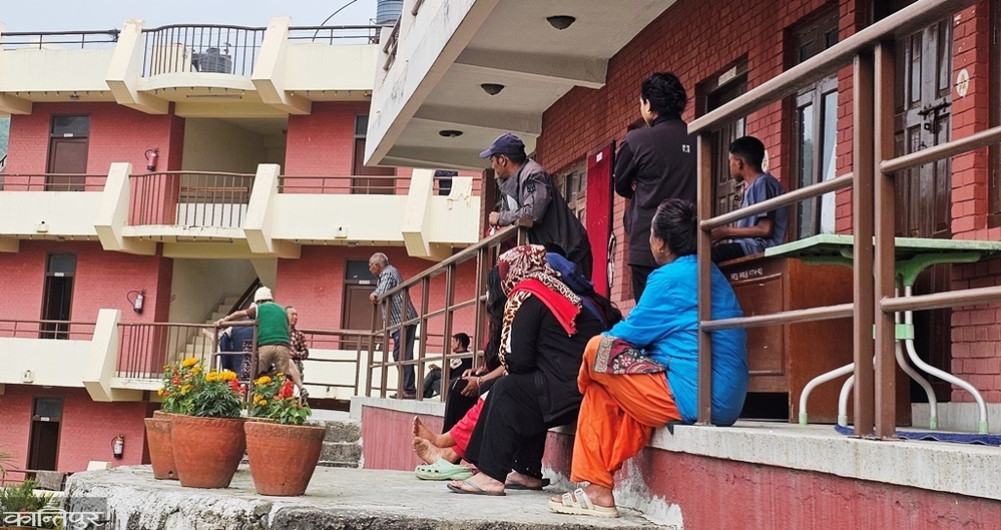
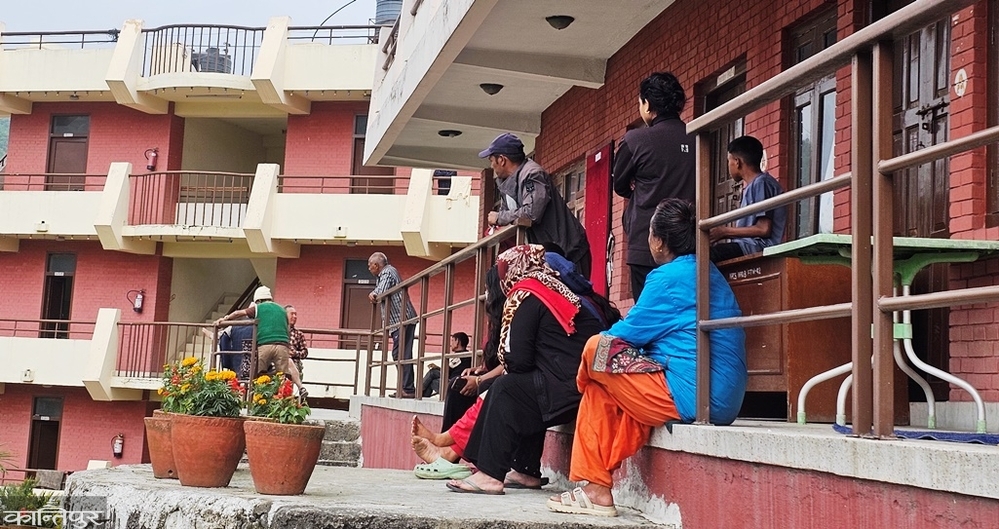
During the investigation, the process of sending certified landless people who have not been able to find land anywhere in the country to their home districts has been initiated through the Land Revenue Office's 'LRIS' system.
We use Google Cloud Translation Services. Google requires we provide the following disclaimer relating to use of this service:
This service may contain translations powered by Google. Google disclaims all warranties related to the translations, expressed or implied, including any warranties of accuracy, reliability, and any implied warranties of merchantability, fitness for a particular purpose, and noninfringement.
The government has initiated the process of managing the displaced squatters from the river banks of the Kathmandu Valley in the districts where they have permanent residence. The move comes on the instructions of the Ministry of Land Management, Cooperatives, Federal Affairs and General Administration and based on digital details collected by the empowered Bagmati Civilization Integrated Development Committee.
In accordance with the prevailing law, an investigation was conducted by the Land Management and Records Department to determine whether or not land was available in the names of landless Dalits, landless squatters and unorganized settlers across the country. During the investigation, the process of sending certified landless people who have not found land anywhere in the country through the Land Revenue Office's 'LRIS' system has been started to their home districts.
Land Problems Resolution Commission Chairman Balabhadra Bastola said that till Monday, letters had been issued to provide land to 28 families in the district where they have permanent addresses outside the country. He said that in the case of those whose land was found in other districts through the Land Revenue system during the investigation, it would not be possible to provide them with land. 'We ask and send them whether there is land in other districts through the Land Revenue's LRIS system. In cases where land is found in other districts, they were not squatters, so they could not be given land and we are deciding accordingly. In the records till yesterday, land of 6 families has been found elsewhere,' he said.
When asked when the entire process will be completed and what will happen to those who want to live in Kathmandu, Chairman Bastola said, ‘Right now, it is in the initial stage, not everything has been completed. Work is underway to take those who do not have land anywhere to the process. In the case of citizenship issued from Kathmandu or other districts, we will send it to the concerned district after the details are complete. We can do all these things within this month.
He said that it will be difficult to provide land to those who want to live in Kathmandu and its surroundings. ‘Kathmandu, Lalitpur and Bhaktapur metropolitan municipalities have clearly stated that we do not have land and cannot provide it. Since the municipalities in the valley have not been able to provide land, now the integrated housing model is also an option for the landless, so we have recommended it accordingly,’ he said.
The Land Problems Resolution Commission published a notice on 32 Ashar and confirmed that land had not been found in the names of 14 people in the first phase. According to the approved list, those whose files have been sent to the relevant districts and municipalities for land management are Kumal Ghalan and Arjun Syangtan of Makawanpur, Madan Kami of Taplejung, Rajesh Majhi of Morang, Achhelal Paswan of Rautahat, Pavita Thapa Magar of Dhankuta, Jeevan Kumar Pahari of Sindhuli, Neeraj Thapa of Sindhupalchowk, Rabbani Ansari of Mahottari, Som Bahadur Nepali of Kathmandu, Apsara Damai of Bhojpur, Harkil Giri of Sunsari, Tek Bahadur Layo of Dhanusha and Jitman Tamang of Sarlahi.
Even though their names appear on the list of squatters, the displaced people who have been living in Kathmandu for years are not happy. On the contrary, the information has added confusion to them. Kumar Ghalan, 46, tried to understand this after seeing his name on Facebook. Last Friday, he was in dilemma after receiving a call from Bagmati Rural Municipality of Makawanpur. Ghalan, who came to Kathmandu with his parents as a child, grew up in a squatter settlement in Thapathali.
Of his two children, his daughter is in her first year of graduation and his son is in grade four. Ghalan, who reached Bagmati Rural Municipality in Makwanpur immediately after receiving the information, said, “The land will be given in ward number 8 here. But they are looking for a vacant place,” he said. He had filled out a form asking if it would be available around Kathmandu. “My children studied there, we grew up there. I have talked to the employees that it would be difficult for us to make a living here. What will they do?” said Ghalan.
Panita Thapa Magar, who is working at the holding center in Kharipati, also found out about her name only after seeing the notice on Facebook. But she has not received any official information yet. Even though her permanent address is Dhankuta in her citizenship, she has not set foot in Dhankuta. She grew up in Kathmandu since she was a child. ‘I have not received a call about this yet. I have not been to Dhankuta yet. I do not know what to do there. Nor will I get employment. If that happens, it will be difficult,’ she said.
The government has clearly specified the location and area of land to be provided to landless Dalits, landless squatters and unorganized settlers based on the Land Rules 2021 (19th Amendment) 2078-02-10. As per the procedure, landless Dalits and landless squatters will get 130 square meters (7.68 dhurs) of land, i.e. 4 aanas of land in the hills, in the urban areas of Kathmandu Valley, metropolitan cities, sub-metropolitan cities and municipalities for housing free of cost.
In other areas other than this area, 30 square meters (1 katta) or 10 annas 2 daam of land will be provided for housing. For agriculture, there is a provision to provide 2000 square meters (5 katta 18 dhur) or 3 ropani 14 annas 3 daam of land in the Terai and inner Madhesh and 3000 square meters (8 katta 17 dhur) or 5 ropani 14 annas of land in the Himalayas and hills for free. Similarly, the procedure states that unorganized settlers can obtain 130 square meters (7.68 dhur) or 4 anas of land in the Kathmandu Valley and urban areas for housing and up to 1000 square meters (1 bigha 1 katta 10 dhur) or 19 ropani 10 annas of land in other areas by paying revenue or money.
The amount of land that those who go to their home districts will get will be determined according to this procedure and an environment has been created for them to receive the title deeds soon, says Chairman Bastola. "We have already held a Zoom meeting on the same day we sent the details to the concerned district committee and asked them to give them priority and move forward with the work. The Ministry of Home Affairs has also asked the CDOs to be sensitive to this issue and take action quickly. If they want, they can get the certificate within two to three months," he said.