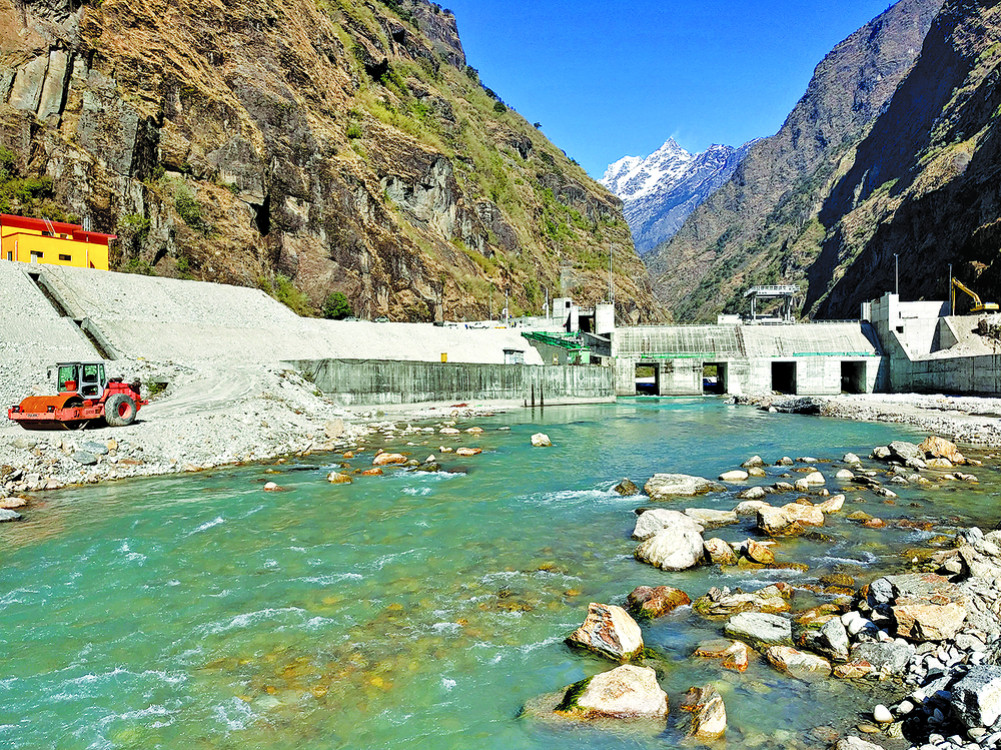
India has also been unannouncedly withholding approval for projects in Nepal, citing Chinese investment, contractor companies, etc.
We use Google Cloud Translation Services. Google requires we provide the following disclaimer relating to use of this service:
This service may contain translations powered by Google. Google disclaims all warranties related to the translations, expressed or implied, including any warranties of accuracy, reliability, and any implied warranties of merchantability, fitness for a particular purpose, and noninfringement.
The Indian government has granted special permission to four companies with ownership or business ties with China to participate in the procurement process of government projects related to important power transmission infrastructure.
Last June, the Department of Expenditure under the Union Finance Ministry of India granted a two-year exemption from the ban to TBEA Energy India, Nanjing Electric India, New Northeast Electric India and Taikai Electric (India).
Although these Chinese-invested companies have been manufacturing materials in India, in 2020, the Indian Finance Ministry had banned bidders from countries bordering India from participating in government procurement and contracting processes.
TBEA is a wholly-owned subsidiary of Chinese company TBEA Group. Nanjing Electric India is a wholly-owned subsidiary of Chinese electrical equipment manufacturer Nanjing Electric. New Northeast Electric India has collaborated with Chinese power companies on technology transfer.
Taikai Electric (India) is a subsidiary of Taikai Group, headquartered in China. However, India has given a clear instruction not to take this as an example for other companies in the future, stating that the exemption was granted to these four companies for a limited period only.
In the backdrop of improving trade relations between India and China, stakeholders say that diplomatic initiatives should be taken to remove the mistrust India has been showing regarding the involvement of Chinese companies in Nepal's hydropower projects. Nepal should obtain approval for each project to trade electricity with India.
Nepal should obtain a 'No Objection Certificate' through the Indian Embassy to import explosives in development projects. India has not given unannounced approval for projects for electricity export by looking at Chinese investment, contractor companies, etc. Therefore, stakeholders say that these obstacles should be removed through diplomatic initiatives.
India has been reluctant to renew or issue new permits for the 'No Objection Certificate' (NOC) required to import explosives for projects involving Chinese investors or Chinese contractors. For the past year, India has implemented a system of renewing NOCs for importing explosives only after submitting documents related to the import process of electromechanical and hydromechanical equipment for hydropower projects. The promoter says that the NOC is being renewed but not working, and that details of the equipment import have also been asked for to renew the NOC.
Stakeholders say that since India has also opened the public procurement process to Chinese companies, Nepal should also take the initiative to facilitate. According to a Nepali promoter, the shortage of explosives in India is another reason for the increasing problem. ‘There are problems in some production centers in India. Production is also low in Nepal. Demand is increasing. But both production and import are not sufficient,’ said the promoter. The promoter also says that since NOCs are not given to import explosives in projects involving Chinese contractors in India, they have started importing them from China.
The promoter says that problems arise from time to time in new NOCs and renewals of explosives. Mohan Dangi, chairman of the Independent Power Producers Association of Nepal (IPPAN), said that since the goods will be imported only after one and a half to two years after the civil works start, it will not be made mandatory. “Explosives are needed for various works, from tunneling to digging, and if the explosives are delayed, our work schedule will be pushed back, civil works may be stopped, and the overall progress will be affected,” he said. “We are also lobbying. The government should do the same.”
Not only explosives, India has been refusing to give approval to those projects to purchase electricity generated from Chinese-affiliated hydropower projects. India has not even given approval to export electricity generated from projects that Chinese companies have won contracts for through international competition to Nepal. An example of this is the 456-megawatt Tamakoshi Hydropower Project.
Although the hydromechanical, electromechanical, and transmission line works of the project were awarded to an Indian company, the civil works have not been approved yet because the Chinese company has done the civil works. While Nepal has been demanding approval at every Nepal-India energy mechanism meeting.
According to the working procedures of India's Designated Authority, there is a ban on electricity trade from projects with land borders with India but invested by third countries that do not have a bilateral cooperation agreement in the electricity sector. But in practice, India has been reluctant to approve electricity exports not only from projects with Chinese investment but also from projects using Chinese contractors or equipment. Dangi argues that when India has already allowed Chinese companies to participate in the bidding process, the government should also consider investment as an issue, but should not obstruct companies or work that have been deemed eligible through international tenders.
Former Energy Secretary Anup Upadhyay said that the Nepal government should take the initiative in electricity trade and other matters, saying that the Indian government has removed the obstacles to Chinese companies. 'This is the right time. Whatever fears were removed, that is gone, now why should we take the initiative to stop us,' he said, 'Our pain is where to sell and consume electricity. 27/28 thousand megawatts is not much. We should take the initiative and pave the way for trade.'
Upadhyay emphasizes the need to take initiatives with India in Prime Ministerial, Ministerial visits, and Secretaries' meetings. He says that even if there is some confusion on procedural issues, it should be discussed at the highest level.
There was a significant increase in bilateral trade between India and China in the last decade. But in 2020, relations between the two countries cooled after a clash between Indian and Chinese soldiers in the Galwan Valley in eastern Ladakh. After that, the Indian government took a strict policy against Chinese companies. At the same time, India also banned Chinese companies including TikTok. It also banned Chinese companies from participating in contracts. Trade also declined significantly. In 2019/2020, bilateral trade decreased by 5.97 percent to $81.87 billion.
The increased diplomatic dialogue and visits over the past year have gradually improved relations between the two countries. Along with the improvement in relations between the two countries, trade has also reached $151.1 billion in 2024/2025.
India's decision to involve Chinese companies in the contracting process is also seen as a continuation of the improvement in relations. Therefore, it is not giving permission to Nepali hydropower projects to export electricity undeclaredly, pointing to a third country that shares a border with India. It has also been reluctant to renew NOCs for explosives.