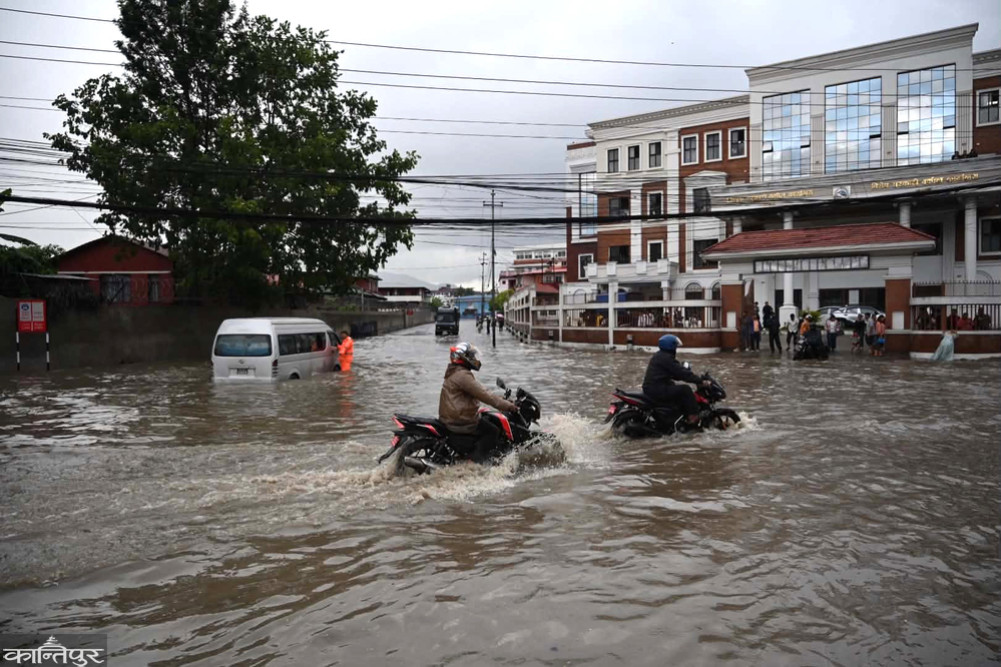
The flooding of areas including Anamnagar, New Baneshwor, Jamal, Raniban, and Singha Durbar, even during normal rainfall, has not stopped.
We use Google Cloud Translation Services. Google requires we provide the following disclaimer relating to use of this service:
This service may contain translations powered by Google. Google disclaims all warranties related to the translations, expressed or implied, including any warranties of accuracy, reliability, and any implied warranties of merchantability, fitness for a particular purpose, and noninfringement.
The areas around Anamnagar, New Baneshwor, Jamal, Raniban and Singha Durbar have not stopped getting flooded even during normal rains. After the midday rains on Thursday, the area was submerged, affecting vehicular movement. Commuters had to suffer due to traffic congestion for a long time.
Although such problems have been repeated every year, there has been no long-term solution. Prakash Kumar Rai, spokesperson for Kathmandu Valley Drinking Water Limited (KUKL), informed that since the Maitighar area is located on a slope, the water flowing in that area accumulates.
'Although the sewage in the Maitighar area is discharged towards the Tukucha River, during the rainy season, the water in Tukucha River does not flow smoothly. As a result, water accumulates on the road,' he said, 'The main problem lies in the sewage system. The old pipes are small.'
Most of the sewer pipes in the area are old, narrow, and their capacity is not sufficient to handle the flow of rainwater. Although there have been discussions on improving the integrated sewerage management around Maitighar, New Plaza, and Singha Durbar, a detailed plan has not been implemented.
Rapid urbanization, lack of a separate rainwater drainage system, limited capacity of old sewers, and the narrowing of the natural flow of rivers and streams are the main reasons for the increasing problem of flooding in the capital.