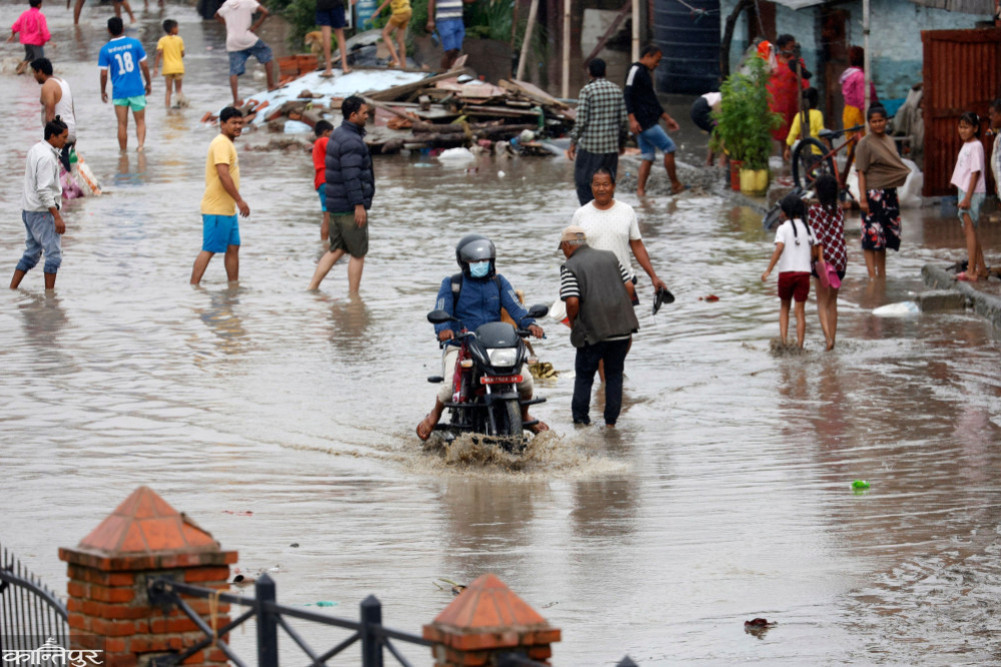
Road expansion, sewer blockages, and lack of rainwater recharge are increasing the risk of flooding in Kathmandu, even during normal rainfall.
We use Google Cloud Translation Services. Google requires we provide the following disclaimer relating to use of this service:
This service may contain translations powered by Google. Google disclaims all warranties related to the translations, expressed or implied, including any warranties of accuracy, reliability, and any implied warranties of merchantability, fitness for a particular purpose, and noninfringement.
With the onset of monsoon, the scene of roads getting flooded in the Kathmandu Valley after a few hours of rain is no longer unusual. Even though there is no heavy rain, commuters are suffering due to the lack of drainage on various roads in the valley from Maitighar to Anamnagar. The reasons for this include unorganized urbanization, poor drainage system and climate change.
In the morning, the sun is shining in Tantalapur, but when they return home in the evening, it suddenly starts raining heavily. Then, another worry of the people of the valley begins - will the roads get flooded? Drivers are forced to wade through the flooded road, while pedestrians have to wander around looking for a safe path.
Last Thursday evening was a busy time. Employees of government and various private offices were preparing to return home after finishing their day's work. School and college students were also heading towards their destinations carrying their book bags. The traffic on the roads was increasing and the capital was moving at its regular pace. Suddenly, dark clouds appeared in the sky and it started raining in a few moments. The rain was not very heavy, but its impact was visible within a few minutes.
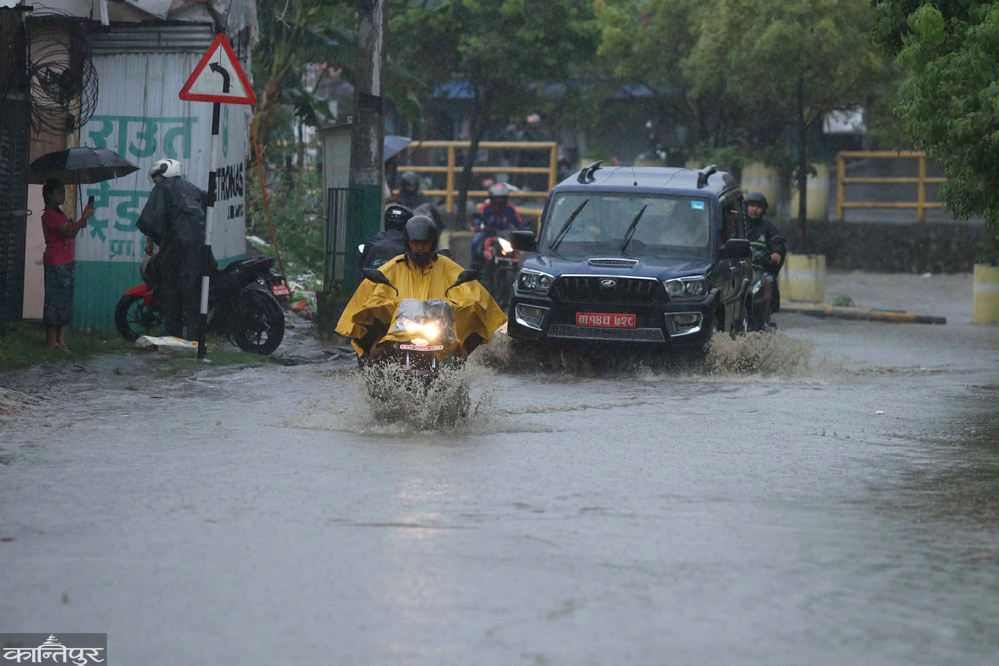
Maitighar and Anamnagar areas near Singha Durbar, the country's main administrative center, were submerged. Along with these, other roads in the valley were also submerged. Vehicles on the roads started to stop in the water, passengers were stranded and pedestrians were forced to wander around in search of a safe route. Some employees could not reach home on time. Some were taking risks and riding motorcycles on the water. The inundation was creating additional challenges, especially for two-wheeler drivers. The potholes on the road were hidden under water, which further increased the risk of accidents.
This scene was not only on Thursday evening, the capital has been submerged every year in recent years. The question arises – why does the Kathmandu Valley get flooded even when there is no heavy rain?
According to experts, the main reasons for this are unorganized urbanization, narrow and blocked drainage system, encroachment on rivers and streams, neglect of water drainage during road construction, and increasing concrete structures preventing rainwater from being absorbed into the ground. Water that flowed easily a few years ago is now being trapped in roads and settlements.
Increasing pressure in the sewer system is a problem
Kathmandu Valley Drinking Water Limited (KUKL) has stated that the problem of road flooding seen in the valley in recent years is becoming more complex not only due to heavy rains but also due to increasing pressure in the sewer system, lack of coordination between plastic waste and infrastructure construction. According to KUKL spokesperson Prakash Kumar Rai, despite the fact that sewer cleaning and repair work has been carried out from time to time, the problem has not been solved due to the tendency to throw waste such as plastic bags, bottles, packaging materials and other waste into the sewer. 'When such waste accumulates in the sewer system, the flow of water is blocked and water stagnates on the roads even during normal rainfall,' he said. 'In many places in the valley, the problem of sewage water that should flow towards the river is instead spreading on the roads. We are cleaning the sewers from time to time, but the problem of sewer blockages recurs again due to plastic waste and construction materials.'
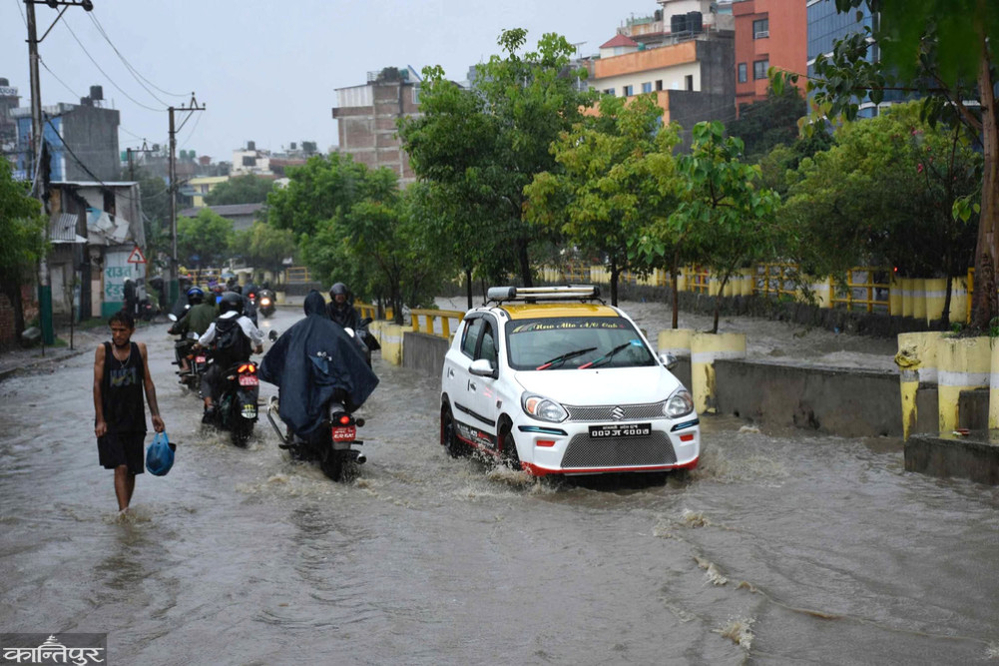
According to Rai, especially during the monsoon, the water drainage system is further affected when soil, sand and dust from road expansion, maintenance and other construction activities accumulate in the sewers. He mentioned that the problem has also increased due to the lack of adequate coordination between the bodies responsible for building roads, sewers and other urban infrastructure. Rai said that rainwater management has become challenging due to the lack of adequate study and planning of the capacity, size and drainage system required during road construction or expansion. 'Coordination is necessary between the concerned bodies on the issue of how much capacity of sewer is required in which area. The size of the sewerage system needs to be expanded as per the need,' he said.
Spokesperson Rai said that the rapid urbanization and increasing population of the Kathmandu Valley have created additional pressure on the old sewerage system. Although the land had a high capacity to absorb rainwater in the past, most of the open areas are now covered with concrete structures, so the water reaches the sewerage system directly. According to him, rainwater flowing from the roofs of houses, courtyards and concrete structures also mixes with the sewerage, causing the capacity of the sewerage system to be exceeded in a short time.
He said that the change in the nature of rainfall due to climate change has also made the problem more serious. 'Earlier, rainfall was moderate for a long time, but now there is a tendency for heavy rainfall in a short time. This has further challenged the old sewerage system,' Rai said. He said that to solve the problem of urban flooding, expansion of sewer capacity, regular cleaning, plastic waste management, rainwater collection and effective coordination between the concerned agencies are necessary.
Recharge of rainwater is necessary to reduce the pressure of sewers
Santosh Baral, Information Officer of the Kathmandu Valley Water Supply Management Board, said that various programs are being implemented in the valley for long-term sewer management and groundwater recharge. According to him, the implementation of the plan has started in accordance with the policy of gradually ending the traditional system of mixing sewage directly into rivers and streams in the valley and flowing water into the river only after treatment. Baral informed that rainwater recharge projects have been launched in schools, colleges and public buildings with the aim of recharging rainwater underground. He said that efforts are being made to protect the groundwater level by sending rainwater collected from roofs and open areas underground through these projects.
According to Baral, recharge systems have been installed in public campuses and schools including Trichandra Multiple Campus. He said that arrangements have been made to send rainwater collected from the roof of Trichandra Multiple Campus to the Ranipokhari area through a recharge system. 'So far, more than 300 recharge structures have been constructed in various places in the valley,' said Baral.
He said that the problem of sewer blockage is increasing as dust, soil and mud flowing along with rainwater enters the sewer system. He said that especially during the monsoon, the drainage of sewer water is affected due to mud and garbage flowing from roads and construction sites. Baral mentioned that although the sewer cleaning work is being done regularly, the problem is recurring due to the excessive pressure of garbage and mud.
He said that coordination between the federal government, local levels and concerned bodies is necessary to solve the problem of urban flooding, and informed that local levels are also running various programs for improving drainage. 'If effective coordination for sewage management, rainwater management and groundwater recharge can be carried out simultaneously, the problem of urban flooding can be solved in the long term,' Baral said.
Increasing risk of urban flooding due to blockage of water infiltration roads
Geologist Dr. Subodh Dhakal said that the problem of increasing urban flooding in the Kathmandu Valley, despite the absence of heavy rains, has been created due to unorganized urbanization, lack of groundwater recharge and poor sewage management. According to him, if priority had been given to cleaning sewers, rivers and drains before the onset of the monsoon, many incidents of road flooding could have been minimized. "Although it is impossible to stop the rain, if open land was kept to manage the drainage, half of the water falling from the sky would have been able to penetrate underground and the damage could have been reduced," he said. "In the past, a large part of the water falling from the sky would have been absorbed into the ground and groundwater would have been recharged, but now the expansion of concrete structures has disrupted that natural process." Dhakal said that with the recent increase in the use of cement and concrete in roads, parking areas, houses and other structures, most of the water has flowed on the surface, which has led to a lot of water reaching the sewage system in a short time and increasing the problem of flooding. He said that the water absorption capacity of the ground varies based on the geological structure. He said that although water can easily penetrate the ground in gravel and sandy areas, it will absorb less water in some places.
Dr. Dhakal said that despite the excessive exploitation of groundwater with increasing urbanization, efforts to recharge it are not enough. He mentioned that if structures are built to send rainwater into the ground in vacant lots, open courtyards and public places, it will help in both groundwater conservation and flood control. According to Dhakal, instead of covering the entire area with concrete, some parts should be left open and rainwater should be sent into the ground. 'If a small amount of open land is kept in each house and arrangements are made for recharge, its collective impact can be very large,' he said.
According to Dhakal, the problem of flooding can also be reduced if rainwater that is wasted from the roof is collected and stored in a tank and used during the winter. He emphasized that open areas, rainwater management and groundwater recharge should be included as mandatory criteria when developing new cities and settlements in the future.
Kathmandu Metropolitan City spokesperson Naveen Manandhar informed that the garbage accumulated on the banks of the rivers and drains of the valley has been managed to facilitate the flow of water throughout the year. 'Even though we have cleaned the garbage, the problem of flooding in Kathmandu has not been resolved due to the heavy rainfall at one time,' he said. 'We have tried to prevent the valley from being flooded. The flooding has occurred due to the nature of the recent rainfall. ' According to Manandhar, the Kathmandu Metropolitan City is prepared for rescue in case of flooding.
Change in rainfall pattern due to climate change
Meteorologist Binu Maharjan of the Department of Water and Meteorology said that flooding occurs when there is a lot of rainfall in a short period of time. 'Earlier, there used to be light rain for two to three days. But the rain that used to last a whole day now occurs in about an hour,' she said. 'For example, on Thursday evening, Babarmahal received 47 millimeters of rain in an hour. If it had rained 47 millimeters throughout the day, the flooding would not have occurred. The pattern of rainfall has changed recently.'
Dr. Maheshwar Dhakal, spokesperson for the Ministry of Agriculture, Forest and Environment and Head of the Climate Management Division, said that the increase in short-term heavy rainfall events in recent years can be considered a potential impact of climate change. However, he said that more scientific research and analysis are needed on this. According to Dhakal, in recent years, short-term heavy rainfall has caused floods, inundations and major damage to infrastructure. He said that the data and experience of losses and damages from such events can provide a basis for expanding Nepal's access to international climate finance and disaster relief funds.
Dhakal said that the rapid migration from rural areas to cities has created additional pressure on urban areas at a time when the risk of extreme weather events is increasing due to climate change.