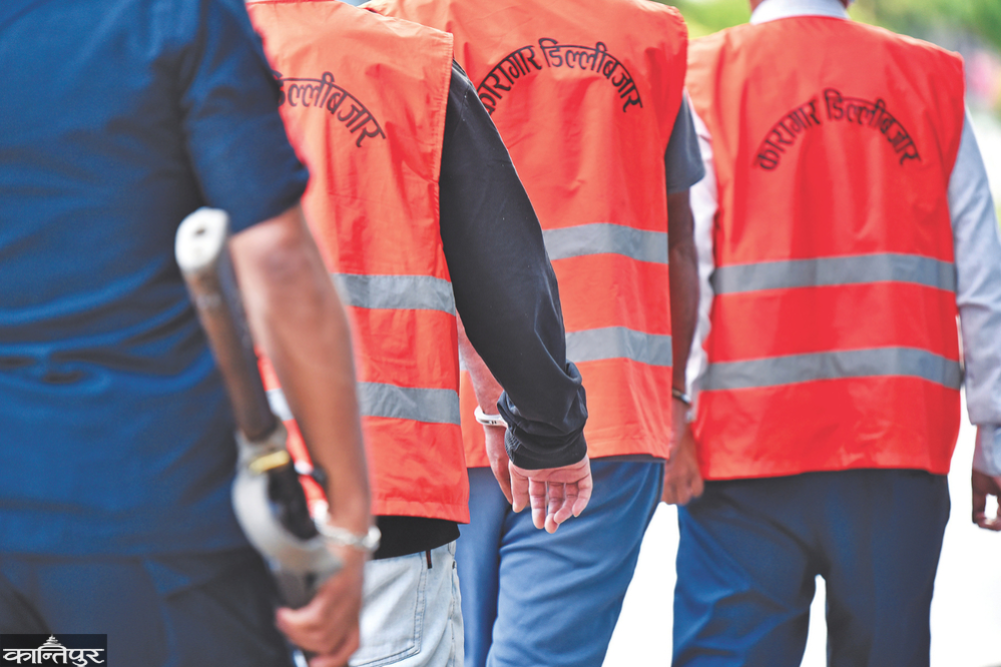
The previous draft proposal that allowed a person to apply for anticipatory bail from the court before being arrested by the police on any charge has been removed.
We use Google Cloud Translation Services. Google requires we provide the following disclaimer relating to use of this service:
This service may contain translations powered by Google. Google disclaims all warranties related to the translations, expressed or implied, including any warranties of accuracy, reliability, and any implied warranties of merchantability, fitness for a particular purpose, and noninfringement.
Preparations are underway to include a provision in the law requiring the police to give notice of the presence of those accused of crimes other than heinous or serious crimes before arresting them. There is such a proposal in the draft bill prepared to amend the Criminal Procedure Code, 2074 BS. However, the provision for anticipatory bail is not in the draft. The private sector has long been demanding that the law should include a provision for anticipatory bail.
There is a proposal to amend the current Section 14(6) provision that allows for detention for a maximum of 25 days for investigation on the order of the court. In April last year, the Ministry of Law, Justice and Parliamentary Affairs prepared a draft bill to amend the Criminal Procedure Code, which included a provision for anticipatory bail. However, the parliament was dissolved before the draft bill was presented in the form of a bill. The Ministry of Law has now prepared draft amendments to five laws related to civil and criminal offenses. The Ministry has prepared a draft bill to amend the Civil Code, Civil Procedure Code, Civil Criminal Procedure Code, Criminal Offences (Determination and Implementation of Punishment) Act and the Civil Penal Code and made it public.
Section 9 of the Criminal Procedure Code provides for the arrest of a person related to an offence. The draft proposes to add a new sub-section 9(a) to the same section, providing for prior notice to be given before arrest. The proposed 9(a) states, ‘If any person commits a heinous serious offence or has committed an enterprise, abetment or criminal conspiracy to commit such an offence or is an accomplice in an offence or in an offence other than a case where a warrant is required to be issued, such person shall be given notice of his presence before arresting him.’
A crime punishable by imprisonment for more than three years to ten years is considered a serious crime. Similarly, a crime punishable by life imprisonment or imprisonment for more than ten years is considered a heinous crime. This provision, which was in the draft prepared last year, has been brought in exactly this time too. The draft mentions that such a provision has been made for some improvements in the judicial system that investigates only after arrest. The draft gives the argument that such a provision has been made to develop the method of investigation without arresting based on the situation of the case.
However, the proposal in the previous draft that a person could apply for anticipatory bail from the court before being arrested by the police on any charge has been removed. Ministry spokesperson Dal Bahadur Adhikari said that the draft of the bill has been prepared, but he is not fully aware of what provisions are or are not included in it. He declined to answer this issue, saying, "Other colleagues from the ministry were involved in the preparation of the draft." He said that the need for amendments to the existing law was felt based on suggestions from institutions such as the Supreme Court, Attorney General's Office, Law Commission, Nepal Bar, Nepal Police and others, and the working group formed by the ministry itself.
Another official from the ministry commented that although the previous government was in favor of introducing the provision of anticipatory bail, the current political leadership was not very positive about it, so the provision may not have been included. 'If the need is felt, there is a way to include it in the final draft or in the legislative process of the parliament,' he said.
There is a proposal to amend the current Article 14(6) provision that allows for detention for a maximum of 25 days for a single or repeated period of investigation on the order of the court. An attempt has been made to make a provision that a maximum of 15 days can be used for an offense punishable by imprisonment for up to three years and 25 days for an offense punishable by more than that.
Similarly, the draft proposes a provision that the investigating agency can directly request necessary information from the telecommunications service provider. A provision has been added to Section 24 of the Act to allow for requesting information. ‘If it is deemed necessary to request any information or details from the telecommunications service provider in the course of investigating an offence, the head of the office of the investigating agency may request the necessary information from the telecommunications service provider,’ the proposed new Sub-Section 24(a) of Section 24 states.
It has been said that if such information is requested, the telecommunications service provider must provide the information immediately. Such information includes mobile or telephone call details, operational data, BTS location, SMS, MMS, CDR, user details, user location, call-wise location, internet activity, etc.
The Supreme Court has explained on 21 Magh 2072 that ‘uncontrolled access to information cannot be the privilege of the executive’. In the context of criminal investigation, the court has ordered that the police can record someone’s conversation or take call details only with the permission of the court. According to the Supreme Court's decision, investigative officers are only able to access such information with the permission of the concerned district court.