Pushpa Kamal Dahal has said that there are ongoing discussions with the UML for cooperation between the communist forces in the country at the parliament, roads, and local levels.
We use Google Cloud Translation Services. Google requires we provide the following disclaimer relating to use of this service:
This service may contain translations powered by Google. Google disclaims all warranties related to the translations, expressed or implied, including any warranties of accuracy, reliability, and any implied warranties of merchantability, fitness for a particular purpose, and noninfringement.
Nepal Communist Party (NCP) coordinator and former Prime Minister Pushpa Kamal Dahal has said that the process of reunification and cooperation among communist forces in the country is underway.
According to him, discussions are underway between the CPN and the CPN-UML on cooperation in parliament, on the streets and at the local level, although he clarified that party unification will not happen immediately. 'Only when the leftist forces unite, the basis for building an alternative force is prepared,' he said, 'the communist force can lead the country again.'
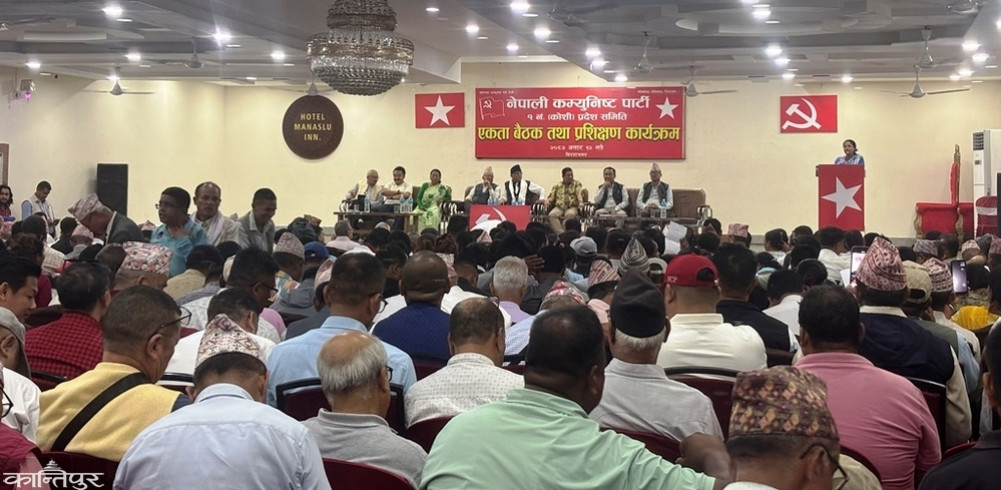
Speaking at the CPN unity meeting and training program organized in Biratnagar on Friday, Dahal recalled that the communists have started uniting after the extraordinary political situation and recalled that the CPN was formed with the participation of 10 leftist components. He said that the unity among communist forces has instilled hope in the people.
Dahal claimed that the last election was not fair and natural and alleged that there was election manipulation, especially in the Terai-Madhes. 'It is not normal for unknown people to win and established candidates to lose,' he said, 'The influence of various forces has been seen in the elections and the curtain will gradually be lifted.'
He claimed that some international powers were not satisfied with the political achievements made in Nepal through the people's war, people's movement, peace process and the Constituent Assembly. Stating that a long-term strategy had been made against federalism, secularism and inclusive system, he admitted that the communist movement had made strategic weaknesses.
'We got more involved in operational issues than strategic questions, which led to the current situation,' he said, 'We need to strengthen our ideas and strategies.'
Dahal accused the current government of not doing enough for the poor, Dalits, women and squatters. He also accused the National Independent Party (NISP) of being a 'party with neoliberal fascist tendencies' and said that challenges to the inclusive proportional representation system and federalism were increasing.
Informing that preparations are underway to reorganize the communist movement and hand over leadership to a new generation, he called on qualified and capable youth to take the lead. 'Now, we need to bring a new generation forward in leadership. Our goal is to build a new leadership from the bottom up,' he said.
He indicated that cooperation and alliances could be formed with other political parties as needed, adding that there was a possibility of cooperation with the Nepali Congress. Dahal also informed that initiatives would be intensified to strengthen the communist movement at the national and international levels.