According to the decision of the Council of Ministers meeting, each minister will now be able to appoint 3 to 5 special category (secretary) advisors and form a personal secretariat of 9 people, including the Chief Personal Secretary.
We use Google Cloud Translation Services. Google requires we provide the following disclaimer relating to use of this service:
This service may contain translations powered by Google. Google disclaims all warranties related to the translations, expressed or implied, including any warranties of accuracy, reliability, and any implied warranties of merchantability, fitness for a particular purpose, and noninfringement.
The government, which has reduced the number of ministries, has made arrangements to allow ministers to appoint a nine-member personal secretariat, including a secretary-level advisor, which will add additional burden to the state. As per the decision of the Council of Ministers meeting, now each minister will be allowed to appoint three to five special category (secretary-level) advisors and form a nine-member personal secretariat, including a chief personal secretary.
Chief Secretary Suman Raj Aryal has started sending the decisions made by the Council of Ministers on April 2 to the concerned ministries for implementation. An official from the Prime Minister's Office told Kantipur that the decisions were sent to the ministries late, saying that there could be criticism over the decision to form advisors and a large-sized personal secretariat.
Since the decision of the Council of Ministers has not been received, the ministers have not yet formed the secretariat as per the new arrangement. Government spokesperson and Minister of Education and Sports Sasmit Pokharel made all the cabinet decisions of Baisakh and Jestha public last week, but the decision of Baisakh 2 has not been made public.
According to the decision, 17 ministers will be able to appoint 57 advisors and 153 people in their own secretariats. In addition to this, there will be a secretariat with private staff as provided for by the act.
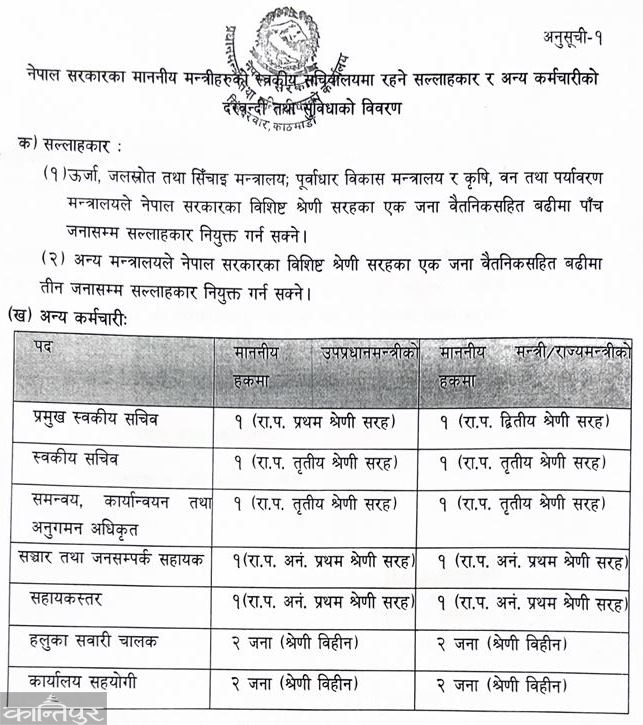
The decision of the cabinet received by Kantipur from the Prime Minister's Office states, 'The Ministry of Energy, Water Resources and Irrigation, the Ministry of Infrastructure Development and the Ministry of Agriculture, Forests and Environment may appoint a maximum of 5 advisors, including one salaried person of the special rank of the Government of Nepal.' Other ministries may appoint up to 3 advisors, including one salaried person.'
If more officials/employees are required in the Minister's advisor and personal secretariat than those specified by the Council of Ministers, the decision states that the concerned ministry may add more officials/employees based on workload and justification after obtaining the consent of the Ministry of Finance. 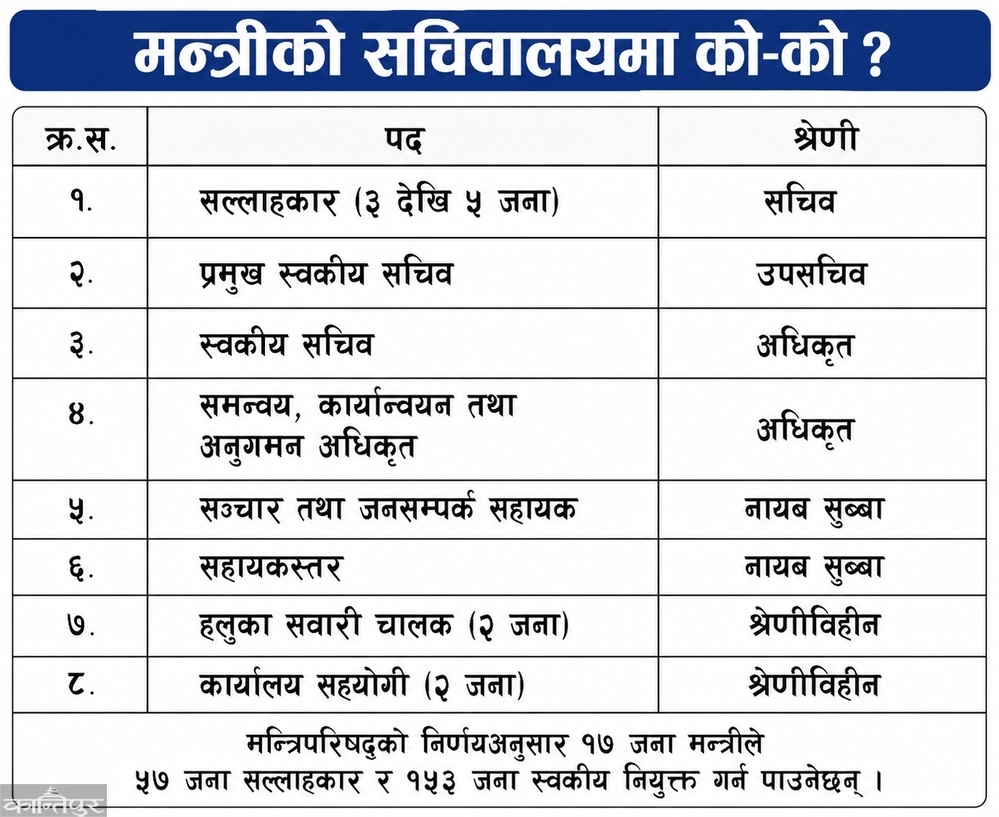
There are 17 ministries, including Defense, headed by Prime Minister Balendra Shah. 17 ministers will appoint 9 secretariat members at the rate of 153 people. Similarly, the Ministry of Infrastructure, Energy and Agriculture will appoint 5 advisors at the rate of 15 and the remaining 14 ministers will appoint 3 advisors at the rate of 57 people.
The government led by Sushila Karki, formed after the Gen-G movement, had reduced the number of advisors and personal secretariat posts of ministers, deputy prime ministers and ministers of state on 5 Asho 2082. The number of personal secretaries of ministers of federal provinces and MPs was also reduced. The Office of the Prime Minister and Council of Ministers has stated that it is necessary to revise the posts and facilities of the ministers' advisors and personal secretariats in view of the current workload, coordination and administrative needs.
 A member of the Prime Minister's Secretariat said that the number of ministers' advisors and personal secretariats has been increased to make the work performance of all ministries more effective, systematic and result-oriented. The Ministry of Finance had given its consent to the Prime Minister's Office on 24 Chaitra 2082 to maintain the posts and facilities of the ministers' personal secretariats.
The Council of Ministers was formed on 13 Chaitra 2082 after Shah was appointed Prime Minister. The Prime Minister's Office had sought an opinion and agreement from the Ministry of Finance to increase the number of ministers' advisors and personal secretariats based on the nature of the work, workload and needs of the ministries.
The minister's personal secretariat has been arranged to have 9 people, including the Chief Personal Secretary, Personal Secretary, Coordination Implementation and Monitoring Officer, Communication and Public Relations Assistant, Assistant-level employees, Light Vehicle Drivers and Office Assistants 2/2. According to the decision, the minister's secretariat will have 1 deputy secretary level, 2 officers, 2 deputy sub-inspectors, and 4 non-ranking drivers and office assistants.
'The chief private secretary will be appointed by the minister concerned and the other employees by the chief private secretary,' the cabinet decision states. Although there is no provision for a deputy prime minister in the current government, the cabinet has decided to have a 9-member secretariat with a joint secretary and chief secretary. The decision does not mention whether the deputy prime minister can appoint advisors.
The minister's biggest advisor in the ministry is the secretary of that ministry, the minister also gets a deputy secretary as a private secretary.'Why do we need other advisors and a personal secretariat?' - Gopinath Mainali, former secretary Secretaries and joint secretary-level employees of various ministries argue that the government's decision to appoint advisors will increase state expenses but will not do anything. They complain that they feel that the government's decision has mistrusted the bureaucracy.
Former secretary Gopinath Mainali argues that ministers do not need advisors and a personal secretariat. 'The minister's biggest advisor in the ministry is the secretary of that ministry, the minister also gets a deputy secretary as a private secretary,' he asked, 'Why do we need other advisors and a personal secretariat?'
Former secretary Mainali commented that advisors and personal secretariats have not been effective in the past as well. 'When ministers of the previous government had advisors and personal secretaries, their attention was seen to be diverted to extraneous matters. They used to pay special attention to employee transfers and contracts,' he said.
The current secretaries and joint secretaries say that when the advisors and personal secretariats dominate the ministry, the morale of the employees will drop further and distrust will increase. ‘Employees are a permanent government. The risk of parallel power may increase due to advisors and personal secretaries who are not accountable to the ministry, the law, do not sign, and do not even have a ministry office,’ a secretary told Kantipur.
Former secretary Mainali also says that ministers should use the employees and officials in the ministry to make them effective. ‘A government that has won a majority of the people’s votes should have more faith and trust in the existing structure. If there is distrust, the institution and employees will become even weaker. Employees feel inferior. Rather than creating a system, the ministry and the government will start running on an ad hoc basis,’ he said. Former secretary Mainali suggests that ministers can work on special tasks for a while by appointing expert human resources.
The Ministers' Remuneration and Facilities Act, 2049 BS has provisions regarding private secretariats. There is a provision for the government to provide the necessary materials for private secretaries and secretariats. Ministers have been appointing advisors and private secretariats based on the work operation guidelines of the Ministry of Finance as per the decision of the Council of Ministers. The guidelines stipulate the remuneration and other facilities of personal secretary-level employees. Since 2062/063 BS, the Council of Ministers has been repeatedly making decisions in its favor, increasing and decreasing the number of personal and advisory appointments of ministers.