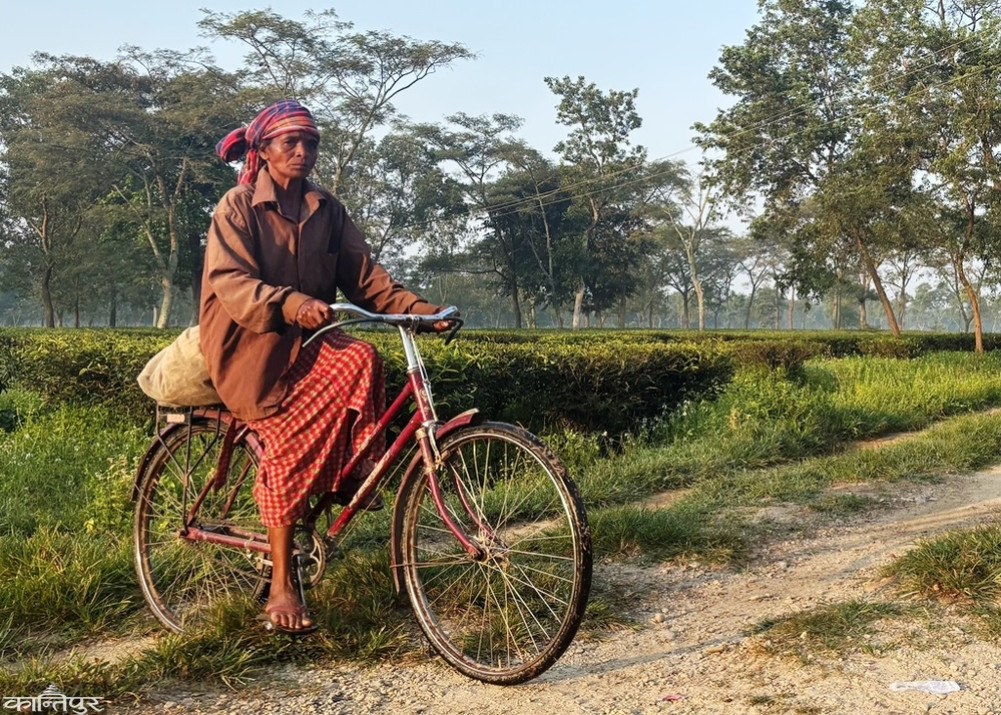
Prime Minister Balendra Shah's press and research expert Deepa Dahal informed that a task force has been formed to submit a report with immediate, medium-term and long-term suggestions within two weeks.
We use Google Cloud Translation Services. Google requires we provide the following disclaimer relating to use of this service:
This service may contain translations powered by Google. Google disclaims all warranties related to the translations, expressed or implied, including any warranties of accuracy, reliability, and any implied warranties of merchantability, fitness for a particular purpose, and noninfringement.
The government has formed a task force to resolve the problems seen in tea exports from Nepal to India.
Prime Minister Balendra Shah's press and research expert Deepa Dahal informed that the task force has been formed to study the problems seen in tea exports and submit a report with immediate, medium and long-term suggestions within two weeks. According to her, the task force has been formed under the coordination of the Joint Secretary of the Bilateral and Regional Trade Division under the Ministry of Industry, Commerce and Supplies.
The members of the task force include the Under-Secretary of the Office of the Prime Minister and Council of Ministers, the Under-Secretary of the Ministry of Finance, the Under-Secretary of the Ministry of Home Affairs, the Under-Secretary of the Ministry of Foreign Affairs, the Under-Secretary of the Ministry of Agriculture, Forest and Environment, the Deputy Director General of the Department of Customs, the Director of the Department of Food Technology and Quality Control, the Director of the Nepal Department of Standards and Metrology, the Director of the National Tea and Coffee Development Board, the Under-Secretary Member of the Bilateral Trade and Transit (India) Branch, and the Under-Secretary Member Secretary of the Ministry of Industry, Commerce and Supplies.
The provision of mandatory quality testing of all consignments of tea imported into India by the Indian government's 'Tea Board of India' some time ago, the SOP attached to the directorate, the laboratory fee and the mandatory storage of goods in the warehouse until the laboratory test report is received, etc.
The provision has caused difficulties for small and medium-scale Nepali tea farmers and exporters in exporting tea to India and the fact that goods vehicles have to be stopped for long periods at customs points, which leads to a decrease in the freshness and quality of tea and increases the cost of trade.