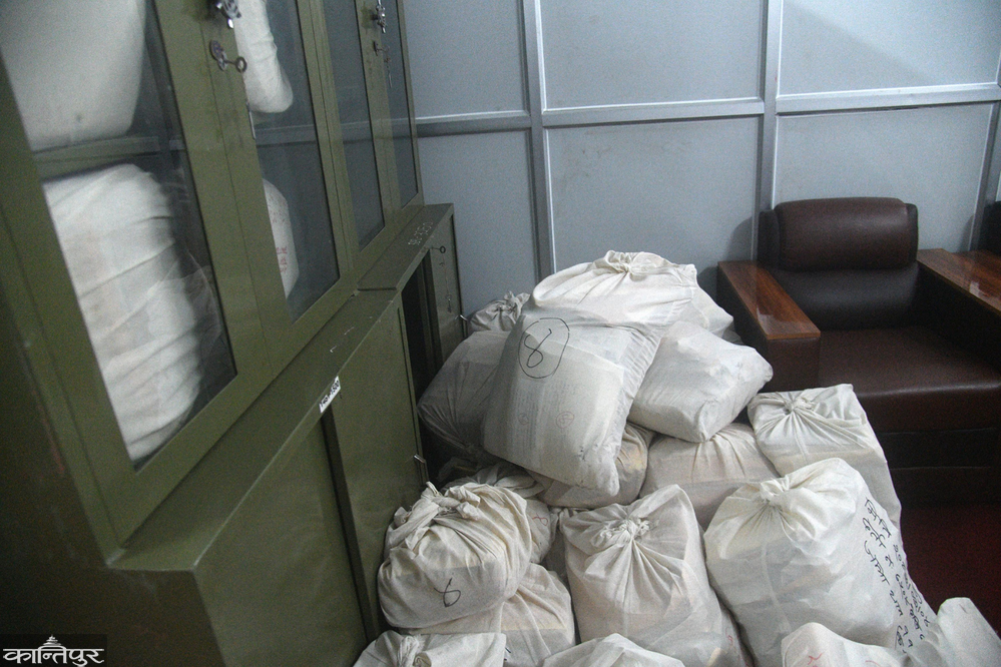
Two former Chief Justices and four former Supreme Court judges have submitted their details, arguing that they are not in accordance with the constitution and law, and the Former Judges Forum has announced that they will not submit their asset details.
We use Google Cloud Translation Services. Google requires we provide the following disclaimer relating to use of this service:
This service may contain translations powered by Google. Google disclaims all warranties related to the translations, expressed or implied, including any warranties of accuracy, reliability, and any implied warranties of merchantability, fitness for a particular purpose, and noninfringement.
Only about 10,000 people have submitted their property details to the Asset Investigation Commission led by former Supreme Court Justice Rajendra Kumar Bhandari. About 3,000 people have registered complaints saying that the property of various people should be investigated.
The commission had estimated that more than 25,000 serving and retired employees and political office bearers would submit their property details. Commission Chairman Bhandari said that the initial deadline was extended by one month after the details were not received as expected. “The number of details submitted has increased in recent days,” he said.
The government formed the commission on April 2, led by Bhandari and comprising former judges Chandiraj Dhakal, Purushottam Parajuli, former Deputy Inspector General of Police Ganesh KC, and chartered accountant Prakash Lamsal. The commission has been given the responsibility of collecting, verifying, and investigating the property details of key political office bearers and high-ranking employees who have held public office since 2062/63. The commission issued a notice on April 31, asking them to submit their property details by mid-Jestha. After less than half of the expected number submitted their details, the deadline for submitting the details has been extended to mid-Ashad. It has been said that the details can be submitted by attending the commission's office, by post and online.
The Former Judges Forum has made a public announcement that it will not submit the asset details. The forum has also urged other former judges not to submit their asset details. However, some former judges, including two former Chief Justices, have submitted their asset details, informed the commission's spokesperson Ganesh KC. According to the commission, the former Chief Justices who have submitted their asset details so far are Gopal Parajuli and Om Prakash Mishra. Former Supreme Court judges Balram KC, Purushottam Bhandari, Dambar Kumar Shrestha and Kedar Chalise have also submitted their details. The commission has stated that outgoing Chief Justice Prakash Man Singh Raut has also submitted the form.
Former Chairman of the Public Service Commission Umesh Kumar Mainali, former ministers Madhav Prasad Poudel, CP Mainali, Raghuji Pant, Bhim Rawal and Rameshwor Khanal have also submitted their asset details, the investigation commission has said. Similarly, former Chairman of the Special Court and Chairperson of the Commission of Inquiry into the Incidents of 23 and 24 Bhadra, Gauri Bahadur Karki, former Chief Secretary and former Chairperson of the Commission of Inquiry into Enforced Disappearances, Leela Devi Gadtaula have also submitted their asset details.
Some former officials of the Election Commission, National Human Rights Commission and Commission for the Investigation of Abuse of Authority have also submitted their details, informed the commission's spokesperson KC. According to him, the process of submitting asset details is ongoing through post, email, in person or through representatives. 'The number of those submitting asset details has increased encouragingly recently. We are confident that everyone will receive their details within the stipulated period,' he said. KC informed that along with the collection of asset details, a preliminary study has also begun.
Questioning the legitimacy of the commission
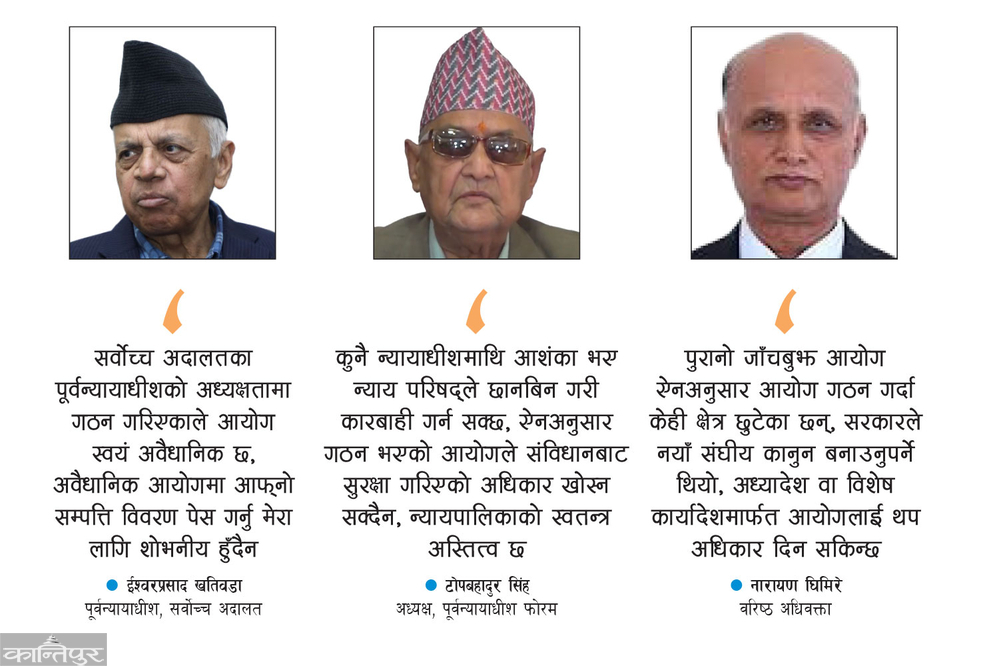
Former Supreme Court Justice Ishwar Prasad Khatiwada on Wednesday raised questions about the legitimacy of the investigation commission by publishing a 40-page long written opinion. Announcing that he would not submit the details to the investigation commission, he made his asset details public through the public media. ‘I do not consider it appropriate, necessary and legal to submit or submit my asset details to the Property Investigation Commission, 2083 BS, formed by the government,’ he said. ‘The commission has been formed under the chairmanship of former Supreme Court Justice Bhandari, contrary to the provisions of Article 132(2) of the Constitution.’
He also presented the constitutional and legal grounds for not submitting the asset details to the commission formed by the government. He argues that the commission itself has become illegal since it was formed under the chairmanship of a former Supreme Court judge. "It is not appropriate for me to submit my assets details to an illegally constituted commission," he said. "The legal status of a government body does not change by naming a commission, committee or task force. In my view, the Assets Investigation Commission is a government office and its officials are government officials.
 While the case against the Assets Investigation Commission is pending in the Supreme Court, the move of Khatiwada, who has just retired from the Supreme Court by creating an undisputed image, has created a new wave.
On 17 Jestha, the Former Judges Forum issued a statement stating that the meeting held in Kathmandu had decided not to submit the details to the commission. "It appears that the Assets Investigation Commission has issued a notice to submit the assets details in a manner that goes against the protection, immunity and independent judiciary provided by the constitution to former judges who have retired in accordance with the law."
Former Judges Forum President Top Bahadur Singh claimed that the constitution has made a provision that judges do not have to submit their assets details to the commission formed under the Inquiry Commission Act. Former Justice Khatiwada has also argued that he has already submitted his assets details to the Judicial Council, stating that he should not submit them again to such commissions that may be formed with each change of government. He claims that only judges who have been removed from office after an impeachment motion is passed under Article 101 of the Constitution or who have been removed from office on the recommendation of the Judicial Council on the basis of misconduct under Articles 142(1)(c) and 149(6)(c) of the Constitution are required to submit their assets details. Stating that Article 153 (5) and (6) of the Constitution empowers the Judicial Council to investigate from the Chief Justice of the Supreme Court to the District Judge, he has argued that such investigations cannot be conducted through other commissions or laws. Article 153 (5) provides that ‘the Judicial Council may form an inquiry committee if it is deemed necessary to conduct a detailed investigation by an expert during the preliminary investigation of a complaint filed against a judge.’ Clause (6) states that ‘If a judge, other than a judge who can be removed from office through impeachment proceedings, commits corruption and abuses his authority, the Judicial Council may investigate and prosecute him in accordance with the law.’
The provision for keeping the assets of judges confidential is in Section 29 of the Judicial Council Act, 2073. It states that ‘members of the Judicial Council and judges shall submit the details of the assets in their names and those of their families to the Judicial Council in the prescribed format within 60 days of the end of each fiscal year.’ Former Judges Forum President Singh argues that the government-formed commission cannot submit the assets details as this provision is also applicable to retired judges.
He said that if there is any objection, action will be taken while they are in office and that the assets details cannot be requested based on other laws after retirement. Outgoing Chief Justice Prakash Man Singh Raut, who received the form from the commission, said that he would study the constitution and laws and decide whether to submit the details or not.
Forum President Singh said that no former Chief Justice or former judge will disclose his assets to the Commission. ‘We are protected by the Constitution in terms of property. The issue of property is linked to our fundamental rights,’ Singh said, ‘We cannot give our assets to anyone who wants them whenever they want. That is why we have decided not to disclose our assets.’
He said that if there is any suspicion that a judge has taken a bribe or acquired undeserved wealth, the Judicial Council can investigate and take action. ‘The Commission, which is formed according to the Act, cannot take away the rights protected by the Constitution,’ Singh said, ‘The judiciary also has an independent existence.’
Commission spokesperson KC claims that the Commission itself will take action against those who do not disclose their assets or action will be taken through the state mechanism. He also said that he was not officially informed about the announcement made by the former judges not to disclose their assets. ‘We have no comment on this matter,’ he said, ‘The commission believes that everyone will submit their details.’
 Judges and employees submit their asset details annually
There is a legal provision that sitting judges must submit their asset details to the Judicial Council and employees in government service to the concerned office. Section 50(1) of the Prevention of Corruption Act, 2059 states that a public servant must submit an updated statement of the assets in his or her and family’s names, including the source or evidence, to the agency in which he or she works or its officials within 60 days of the end of each fiscal year. In the case of judges, there is a provision in the Judicial Council Act that such details should be kept confidential.
Section 50(2) of the Act states that if a person is unable to submit his or her asset details within the specified time limit, the concerned agency or official can extend the time limit by a maximum of 30 days if a person requests an extension of time with reasons. ‘A fine of Rs 10,000 will be imposed on anyone who fails to submit their asset details within the time limit. An investigation may be conducted on the assumption that there is illegal property in the name of his or her family,’ the act states. Retired employees have also complained that it is troublesome to form a commission again and ask for a refund without investigating based on the property details submitted annually according to this system.
On 24 Falgun 2058, the Sher Bahadur Deuba-led government had formed the 'Property Judicial Inquiry Commission' under the chairmanship of the then Supreme Court judge Bhairav Prasad Lamsal. The commission was formed to investigate after allegations were made that officials holding public positions had amassed disproportionate assets. The commission submitted its report to the then King Gyanendra Shah on 4 Chaitra 2059. However, the report was not made public.
Former employee seeking old accounts
Former chairman Dilliraj Ghimire reached the administrative court at Singha Durbar a year later. After retiring as a law secretary, he became the chairman of the administrative court in 2077. After retiring in 2082, he had to submit details to the Property Inquiry Commission, so he went to the court to find old accounts.
Ghimire requested the accounts department to provide him with the salary, allowances and other financial details he received when he was the chairman. ‘In the past, such details were not kept systematically. Now, a notice has come to submit the details. That is why I am looking for old documents,’ he told Kantipur.
A former Chief District Officer (CDO) was also found at the Employees Provident Fund in Singha Durbar. He, who retired seven years ago after serving in remote districts like Humla and Jumla, had also gone there to look for his old account. ‘When he was the CDO, the government used to give rice allowance. It was not accounted for. The remote area allowance was given in cash, and there is no record of that either,’ he said. ‘Now, the details have to be submitted. Since there are no bank records, will the commission accept the notes as evidence?’ Like the former chairman and former CDO in the administrative court, many former employees are now running to banks, Employees Provident Funds and old offices to look for details of their old assets and income.
Army, sitting judges, ministers and MPs outside the scope of investigation
The Assets Investigation Commission does not include ministers of the current government, MPs (elected for the first time) and some bodies, including the Nepal Army, within its jurisdiction. Senior advocate Narayan Ghimire said that many individuals and bodies are outside the scope of investigation as the commission was formed according to the 2026 Commission of Inquiry Act. ‘This is a commission formed on the basis of the old act,’ he said, ‘The government should have made a new federal law to include everyone. Some areas have been left out when the commission was formed in a hurry according to the Commission of Inquiry Act.’
Senior advocate Ghimire says that the commission can be given additional powers through an ordinance or a special order of duty (TOR). ‘The power to investigate everyone can still be given to the extent that the constitution and law do not prohibit it,’ he said, ‘otherwise, like the reports of previous commissions, there is a risk that this report will not be implemented.’
Commission member and spokesperson KC said that the commission will work within the mandate given to it. ‘अदालत, सेना र संवैधानिक आयोगका पदाधिकारीहरूको सम्पत्ति छानबिन गर्ने अधिकार आयोगलाई छैन,’ उनले भने, ‘राष्ट्रपति, उपराष्ट्रपति, पूर्वराष्ट्रपति, पूर्वउपराष्ट्रपति तथा पूर्वराजाको सम्पत्ति छानबिन गर्ने अधिकार पनि आयोगलाई छैन ।’
३१ वैशाखमा राजपत्रमा प्रकाशित ‘सम्पत्ति छानबिन आयोग, २०८३ गठन तथा कार्यसम्पादनका सर्त’ मा बहालवाला न्यायाधीश, नेपाली सेना वा आयोगको कार्यक्षेत्रमा नपरेका अन्य पदाधिकारी वा कर्मचारीका सम्बन्धमा उजुरी प्राप्त भएमा अनुसन्धानका लागि सम्बन्धित निकायमा लेखी पठाउने’ भनिएको छ ।