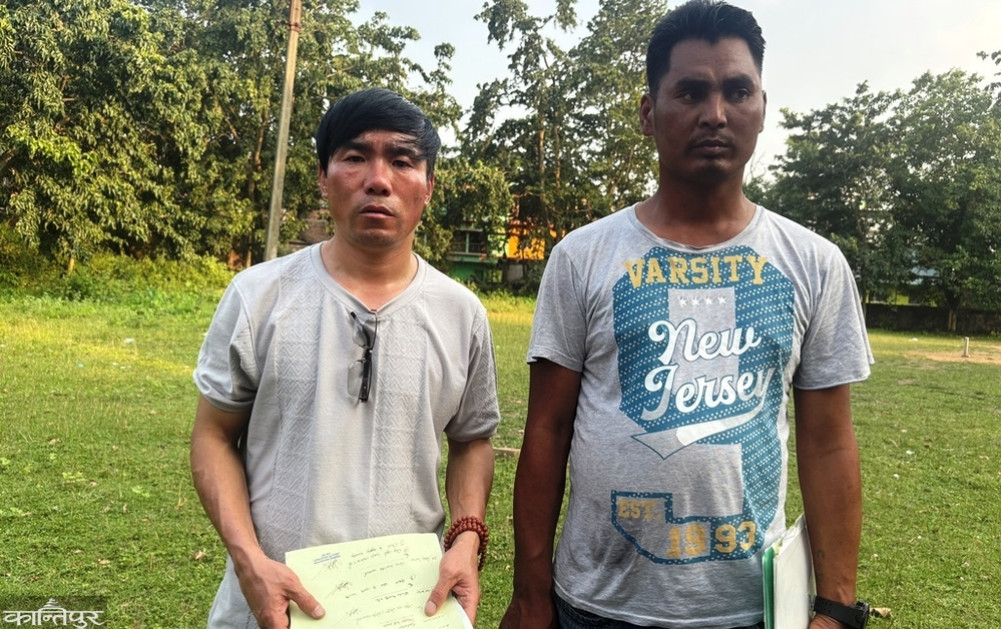
After spending 18 years and 3 months in a Bhutanese prison, Chaturman Tamang and Hasta Bahadur Rai arrived at the Panitanki border crossing in India to enter Nepal. They stayed at the border all day, but were unable to enter because they had no documents to prove their identity.
We use Google Cloud Translation Services. Google requires we provide the following disclaimer relating to use of this service:
This service may contain translations powered by Google. Google disclaims all warranties related to the translations, expressed or implied, including any warranties of accuracy, reliability, and any implied warranties of merchantability, fitness for a particular purpose, and noninfringement.
After spending 18 years and 3 months in a Bhutanese prison, Chaturman Tamang (42) and Hasta Bahadur Rai (44) thought, ‘Now the day has come to return home.’ The home they had been dreaming of was a refugee camp in Nepal.
On 18 Jestha, they heaved a sigh of relief as the doors of Bhutan’s Chamgang Central Prison opened. After their release, Bhutanese security personnel took them to Jaigaon on the India-Bhutan border. They each had a TV and a few bags with them.
During their farewell, they were warned, ‘Now go straight to Nepal, if you come back here again, you will be stuck in jail.’ Both nodded their heads in agreement and crossed the international gate towards Jaigaon Bazaar. The prison administration even gave them 30,000 rupees each for their travel expenses. However, they were not given any official certificate of release. This lack of a single document has forced them to wander around ‘looking for a country’.
‘It would have been easier to understand them if they had proof of their release from prison in Bhutan,’ said Sanchahang Subba, secretary of Beldangi refugee camp. ‘On what basis can we understand a person without any proof?’
On 19 Jestha, they arrived at the Panitanki checkpoint in India to enter Nepal. They stayed at the border all day. However, they were not allowed to enter Nepal because they did not have any documents to identify them. They had no basis except for the hospital prescription of Chaturman, a diabetic. Finally, they returned to Jayagaun, where they had come the previous day. ‘The camp secretary said that they needed the papers to release them from prison, so they had to return,’ said Hasta Bahadur.
They are currently sheltering in the house of a Nepali-speaking worker in Jayagaun. The Nepali-speaking worker, who met them while riding an auto rickshaw, said that he had given them shelter after hearing their pain. The worker told Kantipur on the phone, ‘I have given them shelter as a Nepali brother. If I find out that they have been kept, I may also have a problem.’
He also urged them to create an environment for them to return to Nepal as soon as possible. After reaching Jayagaun, Chaturman even thought about going straight to Bhutan. However, his inner mind did not agree. He said, ‘I also thought about running away to Bhutan, but I was also afraid because they were told not to come back.’
After the camp secretary Subba asked them to bring their release certificate from prison, they are again looking for it. However, they are confused about who to meet, where to go and how to gather evidence. ‘I am afraid of being arrested again when I go to ask for the documents,’ Hasta Bahadur said, ‘I do not know who to ask or where to go.’
According to human rights activist Dr. Gopalkrishna Shiwakoti, the names of these two prisoners of war who are stranded in India have been found in the records of the refugee camp. Therefore, an initiative has been started with the Office of the United Nations High Commissioner for Refugees (UNHCR) and the International Committee of the Red Cross (ICRC) to bring them to the camp in Nepal. "Once these two organizations verify their identities, the path to the camp can be opened," said Shiwakoti.
Chaturman and Hasta Bahadur were innocent children when they were displaced from Bhutan with their families and entered Nepal in 1992. They grew up in a refugee camp in Jhapa. However, in 2008, they were arrested at the border while trying to enter Bhutan following their old place of origin. Since then, their lives have been confined within the four walls of the prison.
Meanwhile, the refugees have repeatedly protested, demanding their return home. There were sit-ins and demonstrations at Mechi Bridge. However, India never opened the way to Bhutan. Instead, the refugees were resettled in third countries. Currently, only a few thousand refugees remain in the camp. Many are elderly and disabled. Most went to third countries, including the US, Australia, Canada, and Norway, for resettlement. Chaturman and Hasta Bahadur's relatives also left the camp and went to seven seas.
Where did they go after being released from prison? They had no destination to return to except the camp. However, the desire to visit the place where they grew up once again remained unfulfilled. An identity card is now mandatory to cross the border. India has made ‘ID verification’ mandatory at the border after Covid. They were also directly affected by this. ‘If the border had not been tightened, we could have reached the camp secretly,’ Chaturman said, ‘It wasn’t before, but now it is difficult to cross.’
They do not have documents that any country accepts. Neither Bhutanese identity card, nor Nepali citizenship, nor Indian identity card. All they have with them is a patient certificate from a Bhutanese hospital and the painful memories of 18 years spent in prison. ‘Sometimes I thought we would go to Nepal and breathe a sigh of peace,’ Hasta Bahadur said, ‘But if we go to Nepal, we could not even see it from afar.’ They are confused – ‘Where to go now? What is our country after all?’