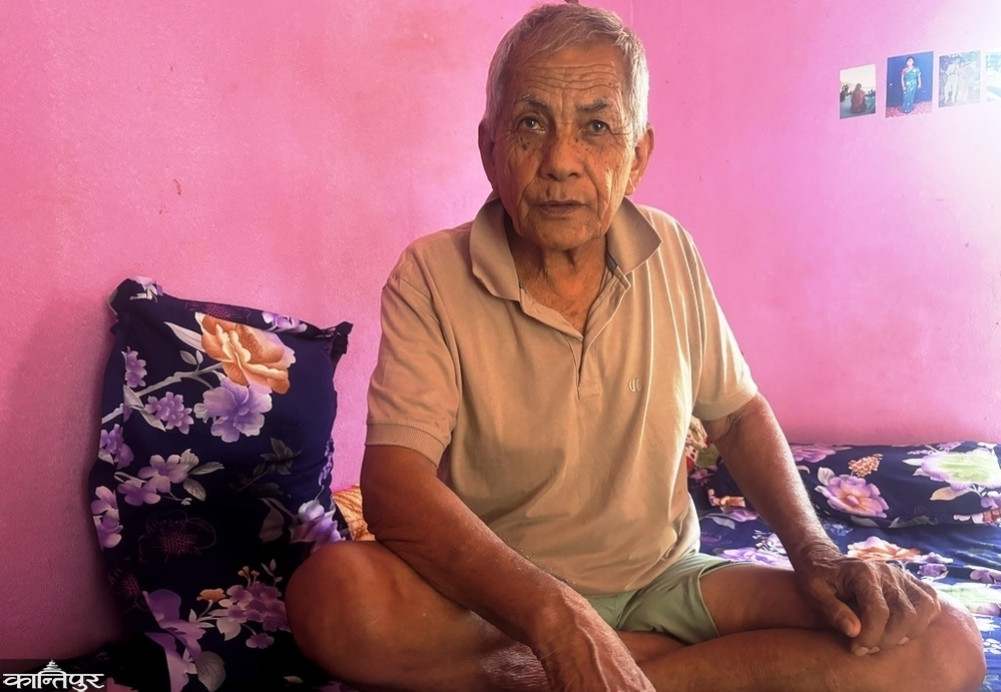
Ram Bahadur Pradhan (84) of Bahundangi, Mechinagar-4, Jhapa, has donated 2 bighas and 5 kattas of land, worth Rs 45 million, to Manav Sewa Ashram, which he earned through a lifetime of hard work, struggle and sacrifice.
We use Google Cloud Translation Services. Google requires we provide the following disclaimer relating to use of this service:
This service may contain translations powered by Google. Google disclaims all warranties related to the translations, expressed or implied, including any warranties of accuracy, reliability, and any implied warranties of merchantability, fitness for a particular purpose, and noninfringement.
Ram Bahadur Pradhan (84) of Bahundangi, Mechinagar-4, Jhapa, has donated 2 bighas 5 kattas of land worth Rs 45 million, earned through a lifetime of hard work, struggle and sacrifice, to the Manav Sewa Ashram. After transferring the property, he is living under the protection of the ashram.
After the idea of land donation came to him, he understood many things. And, he came to the decision to donate the land to an old age home or a children's home. As he understood, he joined the Manav Sewa Ashram. 'I had the idea of donating the land to a good organization,' he says, 'Manav Sewa Ashram seemed right.' There were repeated discussions with Ramji Adhikari, a representative of the Manav Sewa Ashram. Finally, an agreement was reached five years ago. Pradhan decided to donate 2 bighas 5 kattas of land in his name in Bahundangi, Mechinagar, Jhapa, to the ashram. 'I told the ashram - this land, these two mothers and a cow are your responsibility,' Pradhan recalled, 'But, I will not take any of your services. From today, I am free.’
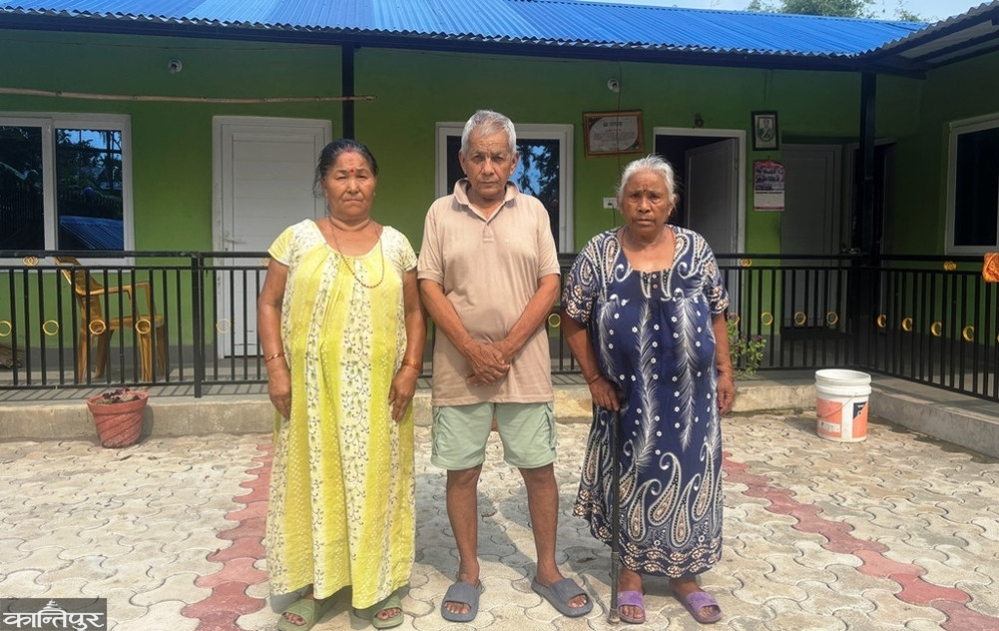
Then Pradhan went to the Land Revenue Office in Bhadrapur and transferred the land to the name of Manav Sewa Ashram. Currently, 104 people, including the elderly, helpless, street people, and children, are dependent on Manav Sewa Ashram. Pradhan also lives in the ashram with his two wives, Lakshmi and Purnamaya. ‘The ashram has taken care of all the basic needs including food, clothing, and medicine,’ says Pradhan.
Ram Bahadur was born in the village of Jilu in Dolakha. He left home at the age of 14-15 in search of employment. Like many young people at that time, he also went to ‘Mughalan’. He took the train from Birgunj-Raxaul to Siliguri. Then he took a jeep to Sikkim. The present-day Indian state of Sikkim was an independent country at that time.
He got a job carrying heavy loads and digging roads. At that time, men used to get 25 paise, women 20 paise, and children 12 paise for working in the village. In Sikkim, he felt that labor was valued while carrying heavy loads. However, he could not stay long in that Himalayan country, which was always cold. And then he went to Siliguri. At that time, Nepali-speaking people were in majority in Siliguri. Nepali faces were everywhere in every chowk, alley and road of Siliguri.
Pradhan met a Nepali friend in Siliguri. The friend pointed to the west and said, ‘Our Nepal is over there. Do you want to go and see?’ Pradhan was surprised to hear what his friend said. Although he was initially skeptical, he agreed to go. From Siliguri, he reached Naxalbari via Matigada-Bagdogara. From Naxalbari Bazaar, they crossed the Mechi and reached Bahundangi via the northwest. ‘I was shocked to see Nepal so close,’ Pradhan elaborated with excitement, ‘After crossing Nepal, I did not want to go back.’
This was around 2020 BS. At that time, the East-West Highway was just being dug. A bridge had just been built on the Mechi River. He met Toyaraj Bharati of Bahundangi. He decided to buy land in Bahundangi with a few thousand rupees he had earned by carrying heavy loads in Sikkim and a few thousand rupees he had brought from selling two lakhs of land. ‘At that time, I bought land for four thousand rupees per bigha,’ he recalls.
Along with farming, he also did the ‘waripari’ business of paddy and maize. He would buy paddy and maize cheaply in the village and sell them at a high price in the Naxalbari market. When he sold them in the Indian market, he made double the profit. The business gradually increased his financial status. ‘I have suffered so much. Now, when I think about it, it feels like a dream,’ he said, becoming emotional as he recalled the past. Now, in the latter half of his life, he decided to donate his assets to the ashram. He says he was proud to donate land worth crores. "Even without us, hundreds of helpless, poor, elderly and children will continue to enjoy our land," Pradhan adds, "What greater satisfaction could there be for us?"