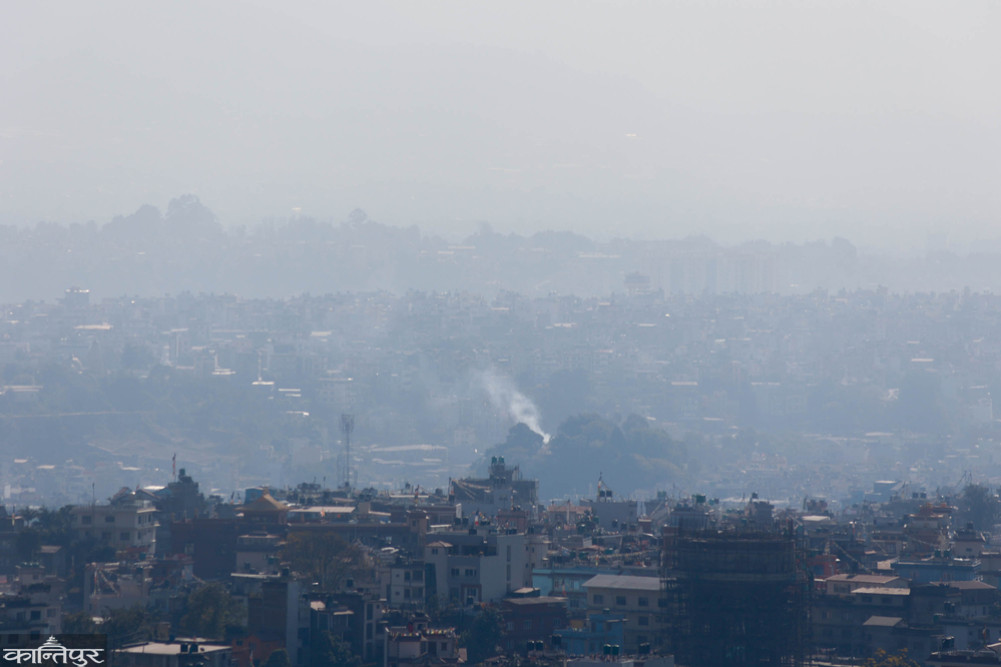
The government expects the project, which will be implemented from 2083/084, to focus on green transformation of the industrial sector and improvement of air quality.
We use Google Cloud Translation Services. Google requires we provide the following disclaimer relating to use of this service:
This service may contain translations powered by Google. Google disclaims all warranties related to the translations, expressed or implied, including any warranties of accuracy, reliability, and any implied warranties of merchantability, fitness for a particular purpose, and noninfringement.
The government is set to launch the $57 million (about Rs. 8.71 billion) 'Nepal Clean Air and Prosperity Project (NCAP)' to control rising air pollution. The project, which will be implemented from 2083/084, will focus on green transformation of the industrial sector and improvement of air quality.
The World Bank's approval of a $52 million concessional loan and a $5 million grant has paved the way for the project's implementation.
Director General of the Department of Environment Gyanraj Subedi expressed confidence that the 'Nepal Clean Air and Prosperity Project (NCAP)' will bring about a qualitative change in the country's air quality management system. According to him, the project is expected to significantly reduce industrial pollution, especially as it will help convert the industrial sector to clean energy.
'We have tried to make the monitoring system more effective. "We believe that as industries convert to clean energy, the amount of pollution will decrease and positive results will be seen within the next five years," he said.
Subedi said that multilateral and international coordination will be necessary to control inter-country air pollution, especially pollution from neighboring countries. The project will focus on controlling pollution sources within Nepal, reduce industrial emissions, effectively monitor air quality, and support fact-based policymaking, he said.
Under the project, the number of air quality measurement centers will be expanded, the capacity of existing stations will be enhanced. In addition, modern equipment will be added to laboratories, the capacity of technical human resources will be developed, and the institutional capacity of the Department of Environment will be strengthened, she said.
Director General Subedi said that air pollution is also having a major impact on the economy, and various studies have shown that air pollution causes economic losses equivalent to about 6 percent of the global gross domestic product (GDP). 'A study will also be conducted to determine how much air pollution has affected the economy in Nepal, how much pollution is being emitted from which areas, and what its economic and social impact is,' he said.
According to Saroj Kumar Chaudhary, Deputy Director General of the Department of Environment, the main objective of the project is to reduce the emission of fine particles (PM 2.5) found in polluted air and increase air quality management capacity. He said that the level of PM 2.5 in Nepal, especially in the Kathmandu Valley and the Terai regions, is eight to nine times higher than the standards set by the World Health Organization, and this is having a serious impact on public health.
'Under the project, boilers and furnaces operating in the industrial sector using fossil fuels and coal will be converted to green technology based on electricity and biomass,' he said. 'Under this program, which will be run through the Department of Industries, a capital subsidy of up to 20 percent of the total capital expenditure (Capex) will be provided to industries converting to electric furnaces.'
Similarly, a subsidy of up to 10 percent of the total capital expenditure will be provided to industries converting to biomass-based furnaces such as biobriquettes and biopellets, Chaudhary said.
'Under this program, which will be run by the Department of Industries, 20 percent of the capital investment will be provided to industries converting to electric furnaces and 10 percent of the capital investment to biomass (biobriquettes and biopellets)-based furnaces after conversion to boilers and furnaces,' he said, 'The remaining amount will be provided for a long period (about 15 years) at interest rates. There is no provision for any subsidy for other air pollution control equipment, but there is a provision to provide long-term loans at market interest rates.'
The economic impact of the project, which will provide concessional financial access to 400 industries, is expected to be significant. According to Chaudhary, the goal is for 400 industries to get concessional financial access, 300 industries to install clean boilers or furnaces, and a concessional loan worth 30 million US dollars will be mobilized. He also said that an additional 18 million US dollars of investment is expected to be attracted from the private sector.
'Under the project, air quality measurement centers will be expanded and upgraded. Four centers will be converted into 'supersites' to enhance the capacity for identifying pollution sources, analyzing data, and monitoring transboundary air pollution,' Chaudhary said. 'Once the project is fully implemented, PM 2.5 emissions are expected to decrease by 500 metric tons annually and greenhouse gas emissions are expected to decrease by 110,000 tons annually.'
Chaudhary informed that 400 industrial establishments across the country, about 60,000 workers employed in those industries, and about 18 million citizens of the Kathmandu Valley and Terai regions will benefit directly and indirectly from the project.
Challenges of project implementation
Environment youth activist Prakash Lama said that air pollution should no longer be considered just an environmental problem but a daily public health crisis. He said that the Nepal Clean Air and Prosperity (NCAP) project, which is being implemented with the support of a US$52 million loan and a US$5 million grant from the World Bank, has provided an important opportunity for pollution control.
'But with debt comes responsibility,' he said, 'it has to be repaid with interest and ultimately our generation will have to bear the burden.' He said that effective interventions should be targeted at major sources of pollution, such as the brick industry, high-polluting vehicles, small and medium industries and traditional stoves.
'US$57 million is not just financial assistance, it is also a responsibility,' he said, 'let's use it wisely, ensure results and build a Nepal that moves forward with clean air and sustainable economic prosperity.'
Other policy arrangements
The Air Quality Management Action Plan for Kathmandu Valley, 2076 BS also states that the AQI value set by the Nepal government will be considered a disaster if it exceeds 300. The action plan to prevent this disaster includes stopping garbage burning, expanding the use of brooms and vacuums to clean roads, and issuing public notices to children, senior citizens, and the sick to take special precautions.
According to the National Environment Policy 2076, there is a government strategy to prepare and implement national standards for water, air, soil, sound, electromagnetic waves, radioactive radiation, and hazardous chemical pollution prevention to reduce pollution. The strategy states that air, water, and sound quality will be mapped by establishing and operating quality measurement centers in major cities and industrial establishments, including areas at risk of pollution.
'Provisions will be made for the treatment of polluted water discharged from industrial and other sectors. Environment-friendly technology will be implemented to manage polluted smoke, dust, and water discharged from industries and other businesses,' The policy states, 'To reduce indoor air pollution, devices such as solar stoves, electric stoves, biogas, improved stoves, chimneys will be promoted. Emphasis will be placed on the construction of energy-efficient buildings.'
National and international study reports are coming out regarding the rapid deterioration of air quality in the Kathmandu Valley. In the study conducted in 180 countries of the Public Environment Performance Index 2018, Nepal is among the five countries with the highest air pollution. Nepal's level in terms of air pollution is 31.44.
The Department of Environment has established pollution measurement centers in Dhulikhel, Pulchowk, Ratnapark, Tribhuvan University Kirtipur, Sainu, and Sainik Vidyalaya Bhaktapur targeting the valley. Arrangements have been made to access data in the central system and for the general public to get information about the pollution situation.