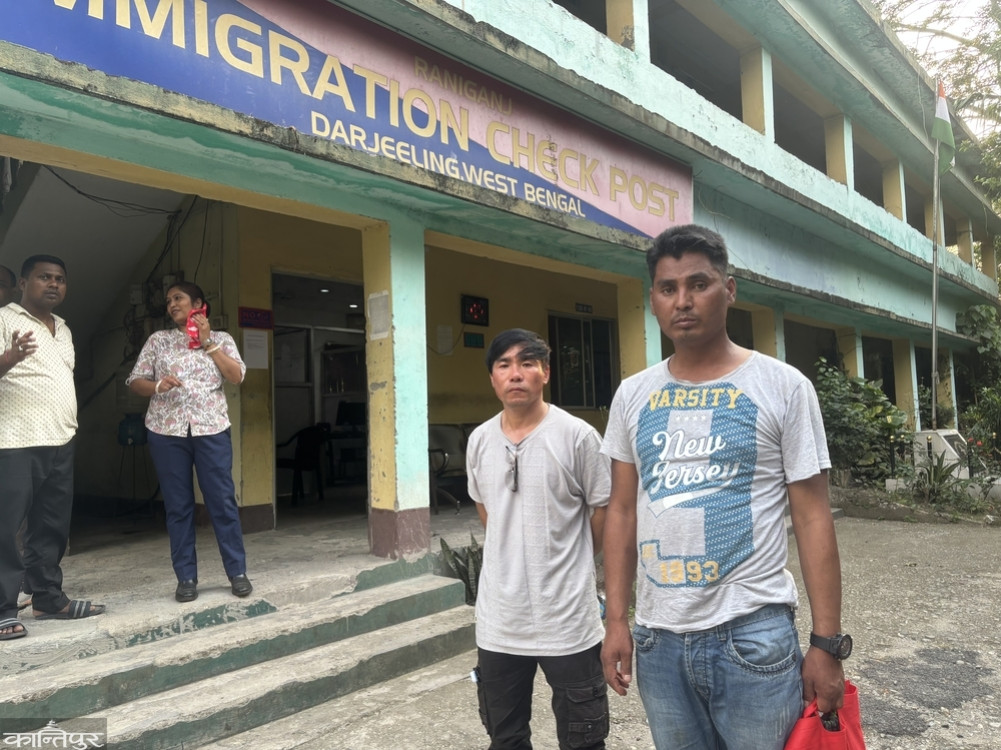
Chaturman Tamang and Hasta Bahadur Rai, who spent 18 years and 3 months in a Bhutanese prison as Bhutanese prisoners of war, returned to Bhutan on Tuesday evening, exhausted from searching for a way back home.
We use Google Cloud Translation Services. Google requires we provide the following disclaimer relating to use of this service:
This service may contain translations powered by Google. Google disclaims all warranties related to the translations, expressed or implied, including any warranties of accuracy, reliability, and any implied warranties of merchantability, fitness for a particular purpose, and noninfringement.
Chaturman Tamang was around 6 and Hasta Bahadur Rai was around 8 when they were chased by the Bhutanese ruler in 1992. They only have vague memories of entering Nepal when they were chased by the Bhutanese ruler. ‘I know little by little,’ Hasta Bahadur recalls, ‘Indian vehicles had abandoned them in the Mechi River.’ Chaturman doesn’t remember that either. The Nepali-speaking refugees from Bhutan were first kept on the banks of the Mai River. Later, they were kept in camps in Jhapa-Morang including Timai, Khudunabari, Beldandi, Pathari Shanishchare. After coming to Nepal, Tamang and Rai lived as neighbors and studied together in the same school in the camp. However, they were unable to study much due to the repatriation campaign and the movement.
In 2008, they reached the Bhutanese border by eluding the SSB deployed at the Indian border. However, the Bhutanese security personnel arrested both of them from a place called Samjhang. Since then, they have been in Chamgang Central Jail. After being imprisoned, their contact with their family was cut off. Until 2016, family members would occasionally come to visit them. After that, they have not been able to meet anyone.
Later, they learned that all their relatives in Nepal had resettled in Australia and America. After that, the family's relationship reached across the seven seas. Hasta Bahadur's sister and elder sister are in Australia. They had sent a family photo to Hasta Bahadur through their relatives. He returned to Beldangi carrying the same basket of memories. However, he returned from Panitanki near Nepal, disappointed.
They were released on Monday after 18 years and 6 months. Where did they go after being released from prison? They were confused about where to go. Around 1 pm, the Bhutanese security personnel asked them to sit in the vehicle. They sat down and waited. The vehicle drove towards India.
After reaching the border town of Jaigaon, the Bhutanese security personnel made them get out of the vehicle and said, ‘Don’t forget to come back to Bhutan or you will end up in jail again.’ They just nodded their heads in agreement.
A vehicle was waiting at the Jaigaon market towards the Nepal border. They boarded it. They arrived near Bagdogra on Monday night and stayed in a hotel. On Tuesday morning, they got down at Panitanki, a border market near Nepal, along with their pottery.
The Indian paramilitary force (SSB) stationed at the border did not allow them to enter Nepal. Because they did not have any identification documents.
‘ID verification’ is mandatory to cross the border. After being turned away by the SSB from the border, they reached the Raniganj Immigration Office, Panitanki. They sat in the open field there for the whole day, hoping to return to Nepal. 
However, the head of immigration, Gautam Biswas, said that he could not help a person whose identity was not disclosed.
They also contacted Sanchahang Subba, the secretary of the Beldagi camp in Jhapa, from Panitanki, to ask for an environment to come to the camp. However, Sanchahang said that people without documents cannot be understood. He said, ‘Bring the evidence left by the Bhutanese prison and I will come myself to do the SIV.’
After Subba said this, both of them decided to return to Bhutan on Tuesday evening. Before that, they submitted a petition to the Chief of the Indian Study Office, Biswas. The petition read, ‘We could not go to Nepal because we did not have any documents. Now we will return to Bhutan. If we survive, we will return.’
They became even more disappointed when Jhapa’s Assistant Chief District Officer Anjan Neupane told them that Bhutanese citizens cannot enter without a passport. Neupane said, ‘They cannot enter Nepal without completing the immigration process.’
Two prisoners of war who spent 18 years and 3 months in a Bhutanese prison have returned to Bhutan in the evening, exhausted from searching for a way to return home. "The Bhutanese police have told us not to return, but we have nowhere to go now," says Chaturman, a diabetic patient. "We will return to Bhutan even if we die."