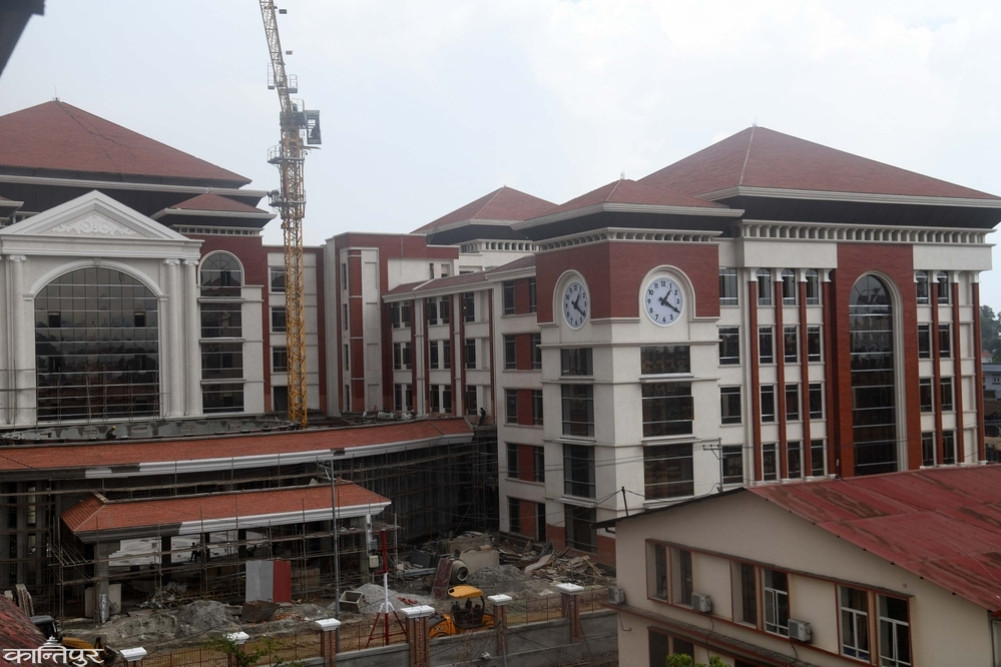
The judiciary had been demanding a budget allocation of at least 1 percent of the total budget. However, as in the past, this year too, the budget allocation has been less.
We use Google Cloud Translation Services. Google requires we provide the following disclaimer relating to use of this service:
This service may contain translations powered by Google. Google disclaims all warranties related to the translations, expressed or implied, including any warranties of accuracy, reliability, and any implied warranties of merchantability, fitness for a particular purpose, and noninfringement.
The government has allocated only 0.45 percent of the total budget for the judiciary. Finance Minister Swarnim Wagle has allocated Rs 9.49 billion 16 million for the judiciary. Which is only 0.45 percent of the total budget of the federal government.
The judiciary had been demanding at least one percent budget allocation of the total budget. However, like in the past, this year too, the budget has been allocated less.
The government had given a ceiling of Rs 9.34 billion during discussions with the court. It seems that Rs 150 million has been added to the ceiling in the budget. The judiciary received a budget of Rs 10.6 billion last year. This year, there has been a decrease of Rs 1 billion. Supreme Court Chief Registrar Bimal Poudel responded that the judiciary did not get one percent of the budget even though it asked for it. He said that since some amount has been added to the ceiling given by the government, work will be taken forward from this budget to make the administration of justice more efficient, starting with digital courts.
19-year-old agenda, transitional justice finalization
The government has reiterated that it will finalize the transitional justice process (TRC). The budget statement presented in the federal parliament on Friday states that ‘the remaining work related to the peace process and transitional justice will be concluded as soon as possible’. The budget includes a commitment to finalize the transitional justice process through the Truth and Reconciliation Commission and the Commission of Inquiry on Enforced Disappearances, established by the government to investigate human rights violations committed during the Maoist armed conflict. However, the commitment to finalize the transitional justice process has been expressed for the past 19 years. The current government also seems to have only continued it. The government had dismissed the officials of both the commissions through an ordinance some time ago. Currently, both the commissions are being operated by employees.
The budget mentions that a law on conflict of interest will be formulated for good governance and policy-level corruption will be eliminated. The budget mentions that recovery, seizure, acquisition and management will be made more effective by linking the relevant bodies to an integrated information system for effective management of criminal assets. The budget mentions that the digital time card will be implemented in government offices and the national identity card will be used as the basic identity card for public service delivery, and the system related to civil services such as land revenue, transportation, passport, personal incident registration and social security management will be strengthened.
The budget also announces that the ‘Electronic Court Management System’ will be expanded by making maximum use of information technology to make the justice system faster and more effective, and that a free legal aid program will be launched for citizens in poor and remote areas. Similarly, the budget also mentions that the ‘Hello Government’ mechanism will be developed as an effective platform for government-citizen dialogue.