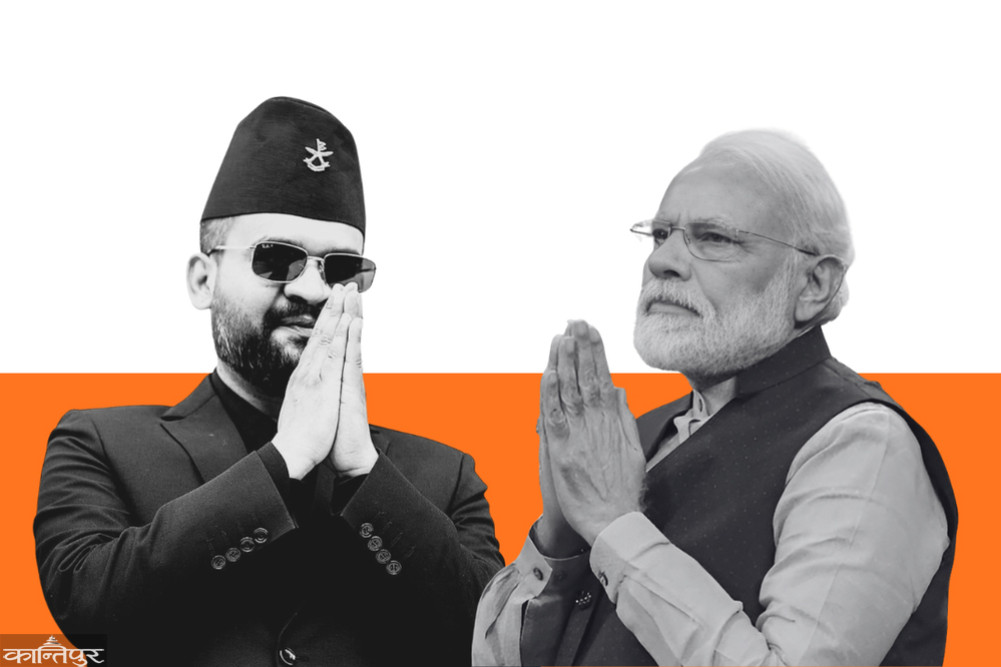
Prime Minister Balendra Shah's diplomatic style has made New Delhi uncomfortable. Is this a well-thought-out foreign policy or just a fad? That is still unclear.
We use Google Cloud Translation Services. Google requires we provide the following disclaimer relating to use of this service:
This service may contain translations powered by Google. Google disclaims all warranties related to the translations, expressed or implied, including any warranties of accuracy, reliability, and any implied warranties of merchantability, fitness for a particular purpose, and noninfringement.
Even after a month and a half of the government being formed, Prime Minister Balendra Shah refused to meet the Indian ambassador. He refused to meet the US President's special envoy. He tightened customs in a way that affected the daily lives of the citizens of the Nepal-India border area. And, he sent diplomatic notes to both New Delhi and Beijing for starting a pilgrimage route through Nepali territory, Lipulekh—this happened just a few days before the Indian Foreign Secretary was due to visit Kathmandu, which ultimately led to the postponement of the visit.
According to diplomats, analysts and foreign affairs experts who closely follow Nepal-India relations, this is a clear sign that the new government in Kathmandu wants to work differently. But whether this is an expression of a well-thought-out and coherent foreign policy or the whims of the leadership that has come to power for the first time or initial immaturity—it is still unclear.
‘In the understanding of diplomats and officials of both countries, the series of events including not meeting the Indian ambassador, tightening the implementation of customs duty arrangements, refusing to meet the Indian foreign secretary, re-raising the border dispute and postponing the Indian foreign secretary’s visit to Nepal, all within 45 days, is a sign of nationalist attitudes,’ says an expert on Nepal-India bilateral relations.
Most of the current and former Indian diplomats, bilateral relations analysts, foreign policy experts, professors and leaders of the Ministry of Foreign Affairs and the Rashtriya Swayamsevak Sangh (RSS) who were contacted by The Kathmandu Post to get their views on these issues requested anonymity for fear of diplomatic ‘protocol’ and public criticism.

The unprecedented mandate that the RSS got in the 21 Falgun elections within four years of its establishment was not only unexpected for Kathmandu and New Delhi, it also raised expectations of a new era in Nepal’s foreign relations. Critics have been calling Nepal's foreign relations a 'surrender diplomacy' and it has been defined accordingly. The prime ministers of the Congress, UML and Maoists used to meet foreign ambassadors within hours of coming to power. And, some of the meetings took place in the absence of foreign officials. Even low-level officials of powerful countries could easily meet the prime minister without worrying about 'protocol'.
Former foreign minister Kamal Thapa, who has seen this style of political leadership for decades, says, 'In the past, the Congress, UML and Maoists completely ignored protocol in diplomatic meetings.'
India has been benefiting the most from this due to its large neighbor and Nepal's high economic dependence. Despite the nationalist rhetoric, New Delhi expected the RSP leadership to follow in the footsteps of its predecessors and adopt the old style. There was some background behind this expectation. India did not interfere in political developments until the Gen-G rebellion of 23-24 Bhadra, the government led by Sushila Karki formed on its foundation, and the elections it held. And, it was received positively by both sides. Some analysts even interpreted it as a sign of maturity in the relationship.
Immediately after the election results, Indian Prime Minister Narendra Modi called Prime Minister Shah and Rashtriya Swayamsevak Sangh President Ravi Lamichhane to congratulate them. He also expressed his commitment to work together with Nepal for the benefit of both sides. There is indeed goodwill towards Nepal and the new leadership in that, but it did not last long.
After Balendra Shah formally joined a political party in early January, Indian diplomats in Kathmandu and members of the foreign department of the ruling BJP and its parent organization, the Rashtriya Swayamsevak Sangh (RSS), had repeatedly tried to meet him. Some even reached out to Shah's aides. However, according to two RSS sources, Indian diplomats wanted to meet Shah directly after the elections and after. However, they were unsuccessful. They were also hoping to meet him after the oath-taking. However, that did not happen either.
Shah did not show any interest in meeting foreign ambassadors in person like his predecessors. According to two senior government officials, Delhi pressured Shah through both formal and informal channels to meet Indian Ambassador Naveen Srivastava after the Prime Minister's oath-taking. However, Shah refused.
This was not just an exception but a new style of the new government. According to two Rashtriya Swayamsevak Sangh leaders, it was decided not to meet any foreign official below the rank of head of government or minister during the period between the 21 Falgun elections and Shah's oath-taking on 13 Chaitra.

Officials in the Ministry of External Affairs consider this a clear stance. Shah has not held any formal bilateral meeting with any ambassador since he took power. Even his senior aides have been instructed to seek prior approval before meeting foreigners.
Finance Minister Swarnim Wagle and Foreign Minister Shishir Khanal have different views on the matter. According to Foreign Minister Khanal, both he and Wagle had said that it would be in the country's interest to meet the Prime Minister directly and meet with high-ranking officials from India, China and the US. 'The Prime Minister politely declined,' Khanal said. The taciturn Shah gave a clear indication that he would stick to his decision.
Foreign policy analyst and head of think tank 'PEI' Anurag Acharya sees this as a problem of inertia rather than a matter of 'protocol'. 'Protocols should be flexible based on our own interests and priorities,' he said. 'Even looking at international experience, there are many examples of powerful presidents and prime ministers breaking established protocols for the national interest.' There are instances of welcoming and sending off their counterparts at the airport to create a conducive environment for strengthening bilateral relations.’
Acharya does not consider the presence or absence of ‘protocol’ to be the main question. ‘There should be a protocol, but it should not create unnecessary friction in external relations,’ he said. ‘If an important trading partner or powerful neighbor sends a special envoy and the meeting opens a new door for bilateral cooperation, the Prime Minister should not get entangled in the protocol.’
Former Foreign Minister Thapa argues that being too assertive in the name of correcting the previous style will also increase the risk. ‘The Prime Minister should not go to extremes in the name of reform, which can be counterproductive for the country, so all foreign powers cannot be put in the same basket,’ he says. ‘We should set our priorities and have an active dialogue with our neighbors and major powers.’ If tensions arise in the relationship, Nepal will lose more, so the responsibility is ours.’
Against this backdrop, Foreign Minister Khanal had visited Mauritius on 26 Chaitra. Khanal had gone to Mauritius to participate in the 9th Indian Ocean Conference jointly organized by the India Foundation, a think tank close to India’s ruling party BJP, and the Indian Ministry of External Affairs. The meeting between Khanal and his Indian counterpart S. Jaishankar on 27 Chaitra was seen as a sign of continuing bilateral relations. Khanal then told Indian journalists that Prime Minister Shah had accepted his counterpart Modi’s invitation to visit India.
However, the visit was not possible immediately. Before scheduling the high-level visit, both sides had also reached an understanding to activate existing bilateral mechanisms and identify new areas of cooperation. In the meantime, Indian Foreign Minister Jaishankar had committed to sending Foreign Secretary Vikram Mishri to Kathmandu. Mishri had previously visited Kathmandu last August. There is a tradition of such goodwill visits from Delhi when a new government is formed in Nepal. After the historic victory of the Communist Party of Nepal in 2074, India sent the then Foreign Minister Sushma Swaraj to Kathmandu.
The meeting and understanding in Mauritius were encouraging from the perspective of Nepal-India relations. However, the developments that followed could not continue that enthusiasm.
The government decided to strictly implement the previous decision to impose customs duty on goods worth more than one hundred rupees imported from India, saying it would increase revenue and control smuggling.
Director General of the Customs Department Shyam Prasad Bhandari claims that this is not a new arrangement but only the implementation of the arrangement made in the Customs Directive. However, the impact of this strictness was immediately visible. There have been cultural, social and economic relations between locals on both sides of the border for years. Along with the strictness in customs, people who cross the border to buy daily necessities were stopped and charged. The Madhesi parties immediately opposed it after the citizens of their constituencies were more affected.
Stating that there has been opposition for decades to the restrictions on the movement and shopping of citizens along the border, Surendra Jha of the Janata Samajwadi Party (JSP) says that the government's latest decision has exposed the double standards in the state's border security. 'There is a lot of smuggling at the border at night in collaboration with the security agencies, which is out of sight,' he said, 'but it is regrettable to stop those bringing daily necessities and collect customs duty.'
In response to a question asked by journalists on this issue, Indian Ministry of External Affairs Spokesperson Randhir Jaiswal had stated that Nepal had implemented the previous arrangement. “We are aware of reports that Nepali authorities have implemented the previous system, which includes levying customs duty on goods purchased in India worth more than Rs 100,” he said at a regular press conference held at the Ministry of External Affairs on April 10. “We understand that the Nepalese government has taken this step specifically with the aim of controlling informal trade and smuggling.” India’s view was seen as more of a diplomatic concern than a cause for controversy.

Author and geopolitical commentator Chandradev Bhatta says it is unclear what objective is being sought to be achieved by tightening the border. “Imposing customs duty on goods worth more than Rs 100 does not make us self-reliant, but rather sends a message that we are dependent on others for revenue,” he said. “Nepali tea exports to India are already facing problems and India’s tough stance could have long-term repercussions in this area.” Meanwhile, India has said it will ease the mandatory testing of Nepali tea.
Similarly, the Lipulekh dispute has now come to the surface. On April 17, the Indian Ministry of External Affairs announced that the Kailash Mansarovar Yatra will be conducted from June to August in coordination with China. The statement issued by the Ministry of External Affairs said that Indian pilgrims will travel to Kailash-Mansarovar via two routes in teams of 50-50 people. One of the two routes passes through Nepali territory. The Nepalese government says that there was no consultation and information from the Indian side before announcing the journey through its sovereign land, Lipulekh.
After India's announcement, the Ministry of External Affairs formally protested on April 20. The government had sent a diplomatic note to India and China, stating that ‘the territories east of the Mahakali, including Limpiyadhura, Lipulekh and Kalapani, have been an integral part of Nepal since the Sugauli Treaty of 1916.’ He said that India's response to Nepal's diplomatic note is also a sign that both countries are moving forward on the path to resolving disputed border issues including Lipulekh.
'We immediately sent a diplomatic note claiming our land.' They also have their own claims. But the response we got is that they also want it to be resolved through diplomatic initiatives,' he said. He also informed that after a long period of obstruction, the technical committees related to the border of both countries are working intensively to demarcate the border. 'I think, after a long time, Nepal and India are gradually moving towards resolving the border disputes through diplomatic dialogue,' Khanal told the committee.
Amid the border dispute and the 'protocol' stance, Prime Minister Shah had also refused to meet US Assistant Secretary of State Sameer Paul Kapoor, who had landed in Kathmandu on 7th Baisakh. He was not in a position to defend him diplomatically. Mishri's visit scheduled for 28th Baisakh was postponed. Both sides have cited different reasons for the postponement of the visit.
Khanal, speaking to a parliamentary committee on Wednesday, said that the information about the postponement of the visit came from New Delhi due to internal reasons. ‘The Ministry of Foreign Affairs has received information that the visit has been postponed due to some important internal meetings held in India,’ he said, ‘This will not affect the dialogue between Nepal and India.’ Although Minister Khanal claimed that the postponement was due to India, diplomats and analysts disagreed with this and claimed that the main reason was the diplomatic note sent regarding Lipulekh and the ‘protocol’ stance.
‘The possibility of Shah repeating the same protocol with Mishri had raised concerns in the Indian Foreign Ministry,’ said a Nepali diplomat privy to internal discussions. ‘Given the special Nepal-India relationship, New Delhi had expected that Mishri’s case would not be a matter of protocol.’
The Kathmandu Post did not respond to a request for comment on the matter.
There is a structural reality behind these diplomatic tensions. Which no nationalist stance can easily change. India’s share in Nepal’s foreign trade is more than 63 percent. Bilateral trade increased to about 1.3 trillion in the fiscal year 2081/82. India is the largest source country of foreign direct investment (FDI) coming to Nepal.
India has also been providing the necessary transit facilities for almost all trade with third countries. Nepal imports 100% of its petroleum products from India. Nepali Ambassador to India Shankar Prasad Sharma, who was recently recalled by the Balen government, also emphasized the same point. “From petroleum products to essential goods like fertilizers, medicines and energy trade, we are dependent on India. No other country can take India’s place in our external relations,” he said.
With the global increase in fuel prices due to the ongoing war in West Asia, dependence on India has increased further in recent days. Nepal has requested India to supply the necessary fertilizers for the planting season. Khanal confirmed in a parliamentary committee meeting on Wednesday that Nepal is going to purchase 80,000 metric tons of chemical fertilizers from India under the G2G.
Meanwhile, both sides have set their own priorities for future high-level visits. The government has prioritized issues such as the long-pending airspace dispute, completing stalled aided infrastructure projects, and reviewing the Agneepath scheme launched by India in 2022. Significant changes have been made in the service facilities for Nepalis joining the Indian Army under the Agneepath scheme. According to which, only 25 percent of those who complete their four-year service period will continue in service. And, the rest will retire without pension.
Khanal said that he will also prioritize the issue of no significant progress even after almost three decades in the Pancheshwor Multipurpose Project envisioned by the Mahakali Treaty of 1996. Two leaders of the Rashtriya Swayamsevak Sangh (RSS) said that the new government is not very interested in making public the report of the Intellectuals Group (EPG) jointly formed by Nepal and India.
The Indian side understands that the political leadership in Kathmandu will come to dialogue sooner or later due to the depth and dependence of the relationship. That is why he does not seem to be in favor of stirring up controversy in public and formal meetings on these issues.
Former diplomat and former assistant national security advisor Pankaj Sharan says that bilateral patience is needed. ‘It is not in the interest of either country to create a situation where personal incidents affect the commitment to a new relationship with mutual trust and benefits,’ he said. ‘Delhi’s intention is to welcome the new generation of leadership emerging in Nepal and take bilateral relations to new heights.’
Professor Mahendra P. Lama, an Indian member of EPG, presents a precise analysis on these issues. According to him, decisions such as group meetings with ambassadors, not going on foreign visits for a year, implementing customs duties, and sending notes on the Lipulekh dispute are only superficial changes in foreign policy. Lama's analysis is that there is no concrete initiative towards making Nepal a dynamic bridge between India and China through the terms of electricity exports, financial investment in infrastructure and the tripartite economic cooperation envisioned by the NCP through its manifesto.
Lama argues that India's traditional influence structure in Nepali politics has collapsed in recent times. 'All structures, including its traditional spheres of influence and channels that have established open and secret access to the Nepali government, are now unstable, difficult to identify and under strict internal surveillance,' he said, 'Therefore, India and other countries have no choice but to watch Nepal closely and wait patiently.'
Where are bilateral relations heading? Bhatta, a commentator on geopolitical affairs, considers the growing dispute and mistrust as a diplomatic failure on the two sides. He analyzes that making the Lipulekh dispute a matter of confrontation rather than dialogue will close all doors without a solution. ‘When the door to talks is closed, our options are limited, and we cannot and will not lose,’ he said. ‘A moderate initiative can provide a solution, but for that, diplomatic foresight is needed rather than political propaganda.’ Bhatta’s analysis is that there is also a risk of the centuries-old relationship falling into a new vortex, going beyond the control of both sides.
‘Will Nepal-India relations fall into a geopolitical vortex or will we be able to guide it for the real interests of both countries – this is the main question,’ he said. ‘Everything depends on us, prudent and far-sighted initiatives can safeguard the relationship, but haphazard steps taken on the contrary can put the deep and old relations at risk.’
According to Acharya, Prime Minister Shah has a capital with him, which he has not used so far. Acharya understands that Shah is respected not only in India’s diplomatic sphere but also by the entire Indian society due to his Madhesi identity and international popularity. He said that only a few prime ministers of Nepal have received such goodwill. ‘After Girija Prasad Koirala, we do not have a prime minister who has received sufficient trust and respect from the Indian side,’ he said, ‘The Shah has a historic opportunity to use his image to overcome the differences that have been seen in bilateral relations for more than a decade. Whether he uses his popularity to become a national hero or to please the nationalist base – that depends on him.’
Both sides now seem to be looking for an effort to get closer. Foreign Minister Khanal is preparing to go to New Delhi at the end of May to participate in the first international Big Cat Alliance summit. Where he is expected to meet Jaishankar. Nepal’s Foreign Ministry is expecting the Indian Foreign Minister to visit Kathmandu after that. However, the main question is whether the previously postponed visit of Indian Foreign Secretary Mishra will be rescheduled and if he comes, the Prime Minister will meet him or not. The answer to this question will clarify the direction of Nepal-India relations more than diplomatic notes or missed meetings.
Suhasini Haider, diplomatic affairs editor of the Indian English daily The Hindu, says that now is not the time for Nepal and India to get stuck in protocol. “The war in West Asia and its repercussions in South Asia have made the current distance between the two capitals untimely,” she said, “So this is not the time for both countries to get stuck in protocol. Foreign Secretary Mishra’s visit to Kathmandu and Prime Minister Shah and his ministers’ visit to Delhi should be scheduled soon.