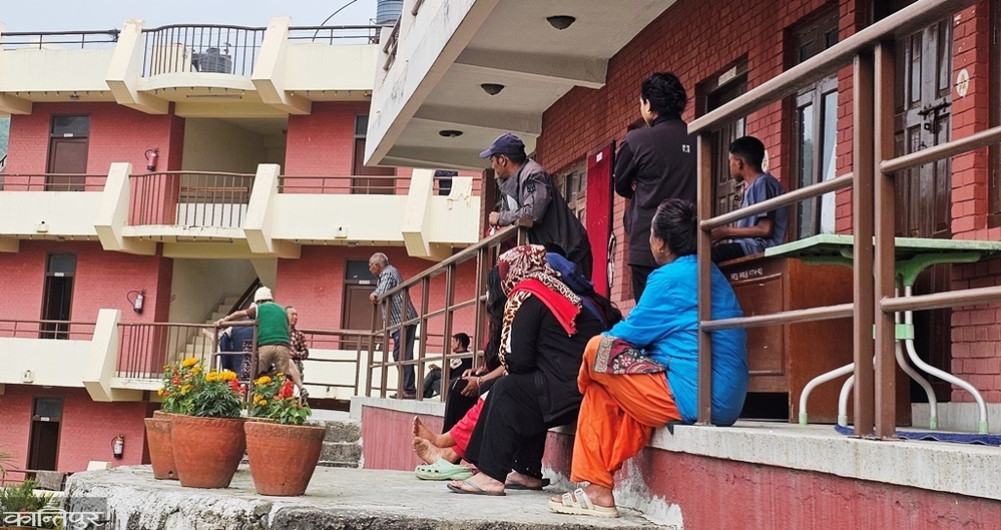
Families who were evicted from slums in the Kathmandu Valley and placed in holding centers are in limbo about employment, housing, and their children's education.
We use Google Cloud Translation Services. Google requires we provide the following disclaimer relating to use of this service:
This service may contain translations powered by Google. Google disclaims all warranties related to the translations, expressed or implied, including any warranties of accuracy, reliability, and any implied warranties of merchantability, fitness for a particular purpose, and noninfringement.
Slum dweller families who were evicted from various places in the Kathmandu Valley are now living in temporary shelters. The problem of families who were evicted from the riverside slums and placed in holding centers due to the government's decision to vacate them is not limited to the lack of shelter. After the displacement, their daily lives have become more difficult due to stress such as losing jobs, not getting a room, facing social discrimination, and having their children's education disrupted.
The family of 32-year-old Ramesh Rai Yadav from the slums of Thapathali is living in the Nepal Red Cross Society's training center in Banepa-6. He has been working as a supply worker in a company in Baneshwor, Kathmandu, for 11 years. These days, he has to start preparing for work before 4 am. He takes a bus from Banepa at 5 am, but he cannot reach the office on time. According to him, it usually takes 7:30 am when he reaches the office in Baneshwor by bus from Banepa. His duty at the company starts at 7 am. ‘The company people are starting to get angry. What will they do if they say they don’t need someone who can’t come tomorrow?’ he said. When he lived in Thapathali, he used to ride a bicycle and reach work in 20 minutes. He spends at least 4 hours a day commuting from Banepa to Kathmandu by bus, paying Rs 200 a day for a car.
Ramesh earns Rs 22,000 a month. He has three children and a wife. ‘He spends around Rs 200 on daily commuting alone,’ he said. ‘When you add food, tea and snacks, it ends up being around Rs 18,000 a month. 18,000 of the 22,000 he earns goes on travel and food. How will he run the house? How will he educate his children?’ He said that most of the people living in the holding center have to struggle more to secure employment than to settle down. ‘Having to live far away has added time, money and physical fatigue. When a person who walks in a hurry returns home, it is already night. He always has to call the security guard to open the gate. He said that many people have the same concerns as they have not decided where and how to educate their children.
000
Nilam Lama has been a security guard at the Nepal College of Hotel Management in Dhobighat, Lalitpur, for 20 years. He used to reach Dhobighat from Thapathali in 25-30 minutes. After moving to Banepa, it takes him more than two hours to reach the office. Lama's family lived in a squatter settlement in Thapathali. After the settlement there was removed on Baisakh 12, they were sent to Balaju, Kathmandu. From there, they have been kept at the Red Cross training center in Banepa for temporary residence. He commutes from Banepa to work every day. 'The train never reaches on time.' "When it rains, the road gets blocked, and if we are late, we will have problems at work," said her daughter Anisha.
After displacement, problems such as losing jobs, not getting a room, facing social discrimination, and disrupting the education of our children have made their daily lives even more difficult. Anisha, who used to leave for work at 4 am, said that sometimes she would stay with relatives after she started having problems with time and expenses. "We spend up to Rs. 250 on car rental every day. When we add the cost of food and drinks, it comes to Rs. 400 a day," said Anisha. "More than half of our monthly salary of Rs. 22,000 goes on car rental and food. It is difficult to run the house, educate my sister, and meet other expenses."
Dalli Bik, who lives with her two sons in a small hut in a slum in Manohara, Kathmandu, used to clean houses and offices. A bulldozer was driven into the hut there on April 12. The bulldozer not only destroyed her house, but also her only source of employment and income. Now she is worried about the future of her two sons. ‘If I had become a husband, I would have hoped that everything would gradually be settled,’ she said, ‘What am I going to do alone, I will survive no matter what, my sons’ studies will be ruined. Now I don’t even have a job, how will I manage the household? I am worried.’ Her daily life, which consists of going to different places all day long, is now spent in one room.
15 years ago, Dalli came to Kathmandu from Humla with her husband in search of work. In the 3/4 years she came to Kathmandu, she built a small hut in Manohara. The couple was raising two sons with their income. Dalli lost her husband in 2072 BS. She now has two sons, aged 13 and 11. After her husband's death, she was worried about raising her sons, and now she has lost her job, which has added to the stress.
As soon as she received the notice to vacate the slum on the banks of the Manohara River, she tried to find a room nearby. 'From the day after coming to the slum and miking, I went to Lokanthali, Koteshwor and other places to look for a room for three days.' As soon as I said I was from Manohara, they immediately recognized the slum and refused to give me a room, and they refused to give me a room even to a single woman,' she said.
000
Januka Pokharel, who moved here from Manohara, said she had to lose her job with the displacement. She used to work at a cafe in Kathmandu. Her husband works at Balaju's factory. She said she had to quit her job after moving to Banepa because she was far away. She said that since her husband also found it difficult to travel regularly, she had started staying with friends and relatives there for a few days.
Januka's family came to Kathmandu from Morang and started living in Manohara. Until two years ago, she used to do business on the roadsides in different areas of Kathmandu. After the Kathmandu Metropolitan City banned business on the roadsides, she started working in a cafe. 'We were able to support our daughter's education and household expenses with the income of two people, but after we brought her here, we could not even leave our little daughter and go to Kathmandu every day.'
Before being displaced from Thapathali, Geeta Pariyar used to run her family by sewing at home. She was supporting her household expenses, taking care of her sick husband, and paying for her son's education with this. Her sick husband cannot move around. She said that she was confused because she had no other source of income.
She had also looked for a room before being displaced from Thapathali. She had also paid an advance for a room in Balkot, Bhaktapur. The next day, she complained that the advance was not given to her, saying that she was a ‘slum dweller’. ‘We had given an advance of Rs 10,000.’ The next day, when she tried to get a room, they returned the money saying, ‘You are slum dwellers,’ she said.
Although the government has decided to give 25 thousand rupees per family to the families removed from the risky settlement, there is still uncertainty about the long-term management. Ayusha Tamang, who has been earning her living by working as a daily wage laborer, said that she was devastated after being displaced and losing her source of income. Ayusha, who came from Sunsari, used to work as a laborer in Thapathali with her husband. ‘I have a baby in my arms, I don’t know where to go after carrying the baby,’ she said. ‘The baby cries because it is hungry, I have nothing to feed it.’ We only had money the day we went to work, now we have no work, no money.' She complained that the government had removed us from the settlement without proper study. 'We should have been investigated and managed. Now we are being treated as if we are not human beings,' she complained.
Roshni Pariyar, who was displaced from Thapathali, said that both her employment and education were affected after the displacement. She used to earn about 12 thousand rupees a month working in a clothing shop in Lazimpat. But after the settlement was removed, she lost her job. 'Now we are not sure where to live. We have also lost our employment. We are worried about how to continue the education of our younger siblings,' she said.
Around 100 squatters are currently being housed at the Nepal Red Cross Society training center in Budol, Banepa Municipality-6, in coordination with the Ministry of Urban Development. People ranging from 13-day-old babies to 90 years old have been brought here from different slums in Kathmandu. There are 28 children here. Men who work as wage laborers and other workers get up early in the morning and go to Kathmandu. Women and children stay at the training center. Arrangements have been made for them to eat at a nearby hotel.
The displaced families have complained that they are in further crisis after the government forcibly removed them without ensuring alternative accommodation, employment and education for their children. They have demanded immediate long-term management from the government. When asked when and how long-term management will be provided for them, Khagendra Bista, a sociologist at the powerful Bagmati Civilization Integrated Development Committee under the Ministry of Urban Development, said that data collection and screening of squatter families is underway. ‘This is not for long-term settlement, but only for a short period,’ he said, ‘The government will manage them as soon as possible after identifying the real squatters.’
Meanwhile, the government has decided to provide a lump sum of Rs 25,000 to families displaced by the removal of squatter settlements in the Kathmandu Valley. The meeting of the Council of Ministers held on Tuesday decided to provide Rs 25,000 per family for rehabilitation expenses after verifying the details of those displaced by the removal of squatter settlements.
Making public the decision of the Council of Ministers, government spokesperson Sasmit Pokharel, who is also the Minister of Education and Sports, said that families with five members will be given Rs 15,000 per month to encourage those displaced from squatter settlements to find alternative management on their own. Spokesperson Pokharel said that it has been decided to provide housing management expenses for three months by adding Rs 2,000 per member to the Rs 15,000 for families with more than five members.
The government has decided to keep the elderly, disabled, helpless and those unable to manage themselves in designated holding centers. Spokesperson Pokharel has also informed that it has been decided to ensure the education and schooling of children and students and the provision of health services in coordination and cooperation with the local level.