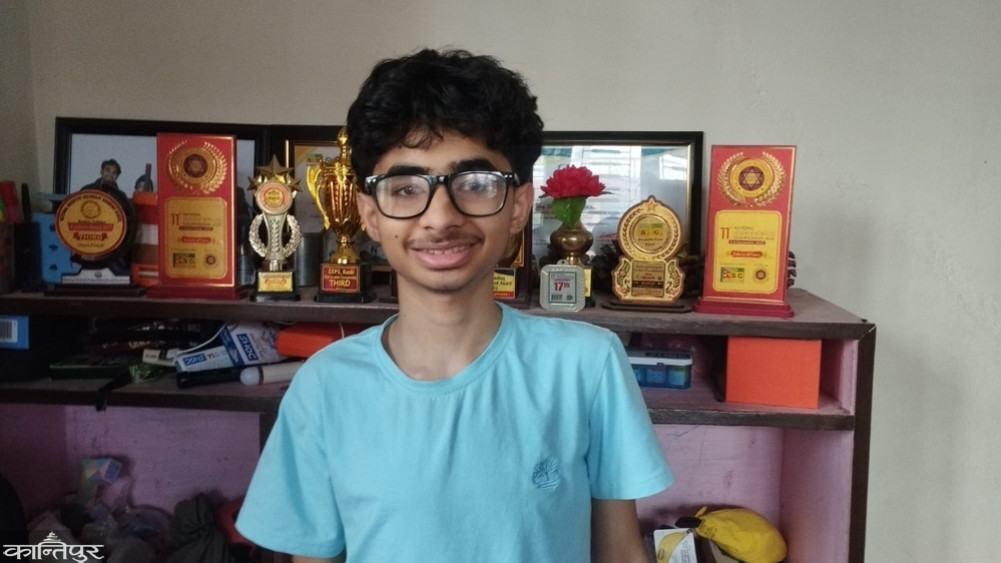
Animesh Lamichhane from Pokhara, who suffers from osteogenesis imperfecta, scored 3.37 GPA in SEE.
We use Google Cloud Translation Services. Google requires we provide the following disclaimer relating to use of this service:
This service may contain translations powered by Google. Google disclaims all warranties related to the translations, expressed or implied, including any warranties of accuracy, reliability, and any implied warranties of merchantability, fitness for a particular purpose, and noninfringement.
Animesh Lamichhane of Pokhara Lakeside, who suffered from brittle bones, broke more than 60 bones in his body. His nose was broken, ribs were broken, his shoulder was broken, his hand was broken, his leg was broken. The more bones in his body were broken, the stronger his self-confidence and determination to study became. Animesh passed this year's SEE with a GPA of 3.37.
Animesh, who was born on 3 Jestha 2066, was 11 months old when his family realized that his body was different from others. The first time his bone broke was in his ankle. After that, one or the other bone in his body started breaking almost every month. The doctor said that this disease is 'Osteogenesis Imperfecta'. A disease in which bones break easily. The bone structure of a person suffering from this disease is so weak that even with normal walking or a slight bump, the bone cracks and breaks.
X-rays, plasters, surgeries, and waiting for the day when another bone would break became a regular routine in his house. Within a month or two of removing the plaster, another bone would break, and the process continued for years. After breaking his bones 16 times, in 2069, the family decided to take Animesh to Canada for treatment. At the Shriners Hospital for Children there, a ‘telescopic rod’ was placed in both his legs. This rod was of modern technology that gradually lengthened with the bone. Along with this, treatment with a drug called pamidronate was started, administered intravenously for three days every three months.
After returning to Nepal, going to school was no less than winning a battle for Animesh, who was admitted to the National Inventive Boarding School in Pokhara. ‘We never let him feel weak,’ recalls Animesh’s father Khim Lamichhane, ‘sometimes we would take him to school in a stroller or a wheelchair. Even when he was receiving treatment at home, he never left his pen and paper.’ The school also moved the classroom to the lower floor and made the doors wider for his convenience.
The role of Animesh’s classmates in Animesh’s educational journey is incomparable. From taking him to the toilet, carrying his bag to making him urinate in a bottle when necessary, his friends selflessly helped him. ‘My friends are truly angels,’ Animesh says emotionally.
According to his father Khim, Animesh’s physical condition was so critical that in 2081, both his legs were broken at once. One was his thigh bone, the other his hip bone. On top of that, the treatment was extremely complicated because he already had a curved spine and structural problems in his waist. After four months, the family breathed a sigh of relief when he slowly started walking two or four steps with the help of a walker. But that joy did not last long. While sitting in a chair, his right arm broke. A week later, the family tried to walk. Two weeks later, his left arm also broke. Now he was completely dependent on others. He needed help from others to eat, brush his teeth, change his diaper, and reach for itchy areas on his body.
By this time, the number of broken bones had exceeded sixty. ‘For a parent, seeing their child’s bones broken more than 60 times was like putting a stone on their heart, but his eagerness to study made us stronger,’ said Khim. ‘My chest still feels heavy when I remember that time, but Animesh never cursed God, never cried, ‘Why did this happen to me?’ Seeing that gave us courage.’
After removing the plaster from both hands, they tried to walk again, but unbearable pain started in their hip joints. After months of physiotherapy, there was no improvement, so the family decided to take him abroad for treatment again. Attempts to treat him in Sweden were not possible. Finally, on June 6, 2025, Animesh reached the same hospital in Montreal, Canada, with his mother Durga Lamichhane. The doctors there concluded that surgery was not possible and started physiotherapy as the main treatment. After three months of treatment, they returned to Nepal.
After experiencing all this, disappointment began to settle in Animesh's mind. When his hope of being able to walk independently was not immediately fulfilled, he began to break down inside. He used to go to school but did not enjoy studying. It was at this time that the teachers inspired him to play 'Scrabble'. After starting to play with words, new energy began to awaken in his mind. In no time, he secured third place in an inter-school competition organized at the Pokhara Public Library. That one award restored his confidence.
Then Lekhnath started participating in district and national level competitions. Last year, in the national competition organized in Hetauda in December, he was selected among the best players from all over the country and represented Nepal in Thailand. This energy energized him in his preparation for SEE.
Long treatment, repeated hospital stays and trips to Canada had left a big gap in his studies. He was in doubt whether to take the SEE or not. With the encouragement of his teachers, he decided to take the exam. A month before the exam, he called a teacher at home and made special preparations. He scored 3.37 GPA, or an ‘A’ grade, in the SEE. ‘I was confident that he would get this number,’ says his father Khim, who works at Manipal Teaching Hospital in Pokhara, ‘because he never considered the situation bigger than himself.’
With the success of the SEE, Animesh’s next campaign has begun. He is participating as the sole representative of Nepal in the international competition to be held in Bangkok, Thailand under the World English Language Scrabble Players Association (VESPA) Youth Cup. Animesh, who is going to represent the country on the international stage in a wheelchair, wants to be a source of inspiration for thousands of people with physical challenges like him.