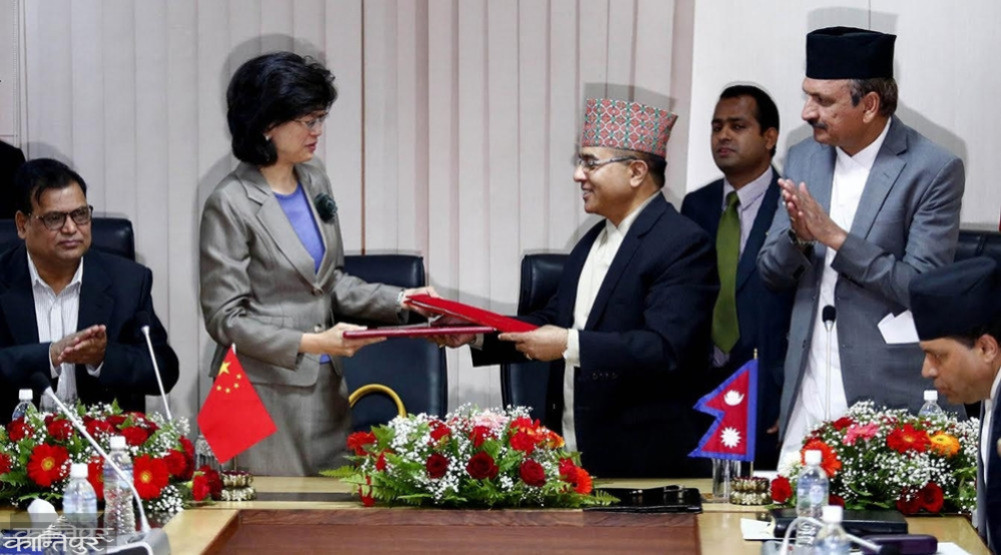
These days, even Chinese officials in Nepal seem to be focusing on the Tibetan refugee issue and concerns related to the US, rather than implementing the BRI.
We use Google Cloud Translation Services. Google requires we provide the following disclaimer relating to use of this service:
This service may contain translations powered by Google. Google disclaims all warranties related to the translations, expressed or implied, including any warranties of accuracy, reliability, and any implied warranties of merchantability, fitness for a particular purpose, and noninfringement.
Tuesday marks 9 years since the signing of the Belt and Road Initiative (BRI) Memorandum of Understanding (MoU) between Nepal and China. The two countries signed a formal agreement on May 12, 2017. However, Nepal has been interested in the project since Chinese President Xi Jinping announced it in 2013. Initially, it was named the ‘Silk Road Economic Belt’, then for some time it was named ‘One Belt One Road’ and finally ‘BRI’. As mentioned in the Nepal-China Memorandum of Understanding, the main goals of the BRI are focused on policy coordination, infrastructure connectivity, free trade, financial coordination and promotion of people-to-people relations.
After the signing of the MoU, Kathmandu and Beijing have taken several initiatives to advance it. But despite the interest of both sides, this ambitious project has been limited to seminars, high-level meetings and visits.
For the past 9 years, Nepal and China have been discussing and negotiating the theoretical aspects of the BRI, the projects to be carried out under it, and its implementation and investment framework.
China has unilaterally announced that the Pokhara Regional International Airport will be built under the BRI framework. But Nepal opposed China's unilateral decision to keep Pokhara Airport within the BRI framework. After some time, this airport project was linked to a corruption case worth billions of rupees.
Apart from this, there has been no significant progress in the implementation of this project in Nepal. Despite the governments in Nepal that have had good relations with China, this project has not gained momentum.
There is now general interest in the perspective of the powerful new government formed in Kathmandu under the leadership of Balendra Shah on the BRI and the future agreement on the implementation of past agreements.
At one time, this project was thought to be able to transform Nepal from a landlocked country to a land-linked country. Discussions were held on everything from loan structures to investment frameworks. However, the two sides have not been able to reach a complete agreement on projects under the BRI in the past. Some experts have said that the new government may give a signal of a new beginning by reviewing the projects under the BRI. A senior official at the Ministry of Foreign Affairs told The Kathmandu Post that important discussions are yet to be held between the two sides on the implementation of the BRI.
“Once high-level visits begin, some talks may move forward,” the official said on condition of anonymity. In his meeting with Foreign Minister Shishir Khanal, Finance Minister Swarnim Wagle and other ministers, the Chinese side has also not expressed any concrete interest in how to move the BRI forward in the changed times.
Khanal had said during his meeting with Chinese Ambassador Zhang Maoming that Nepal’s attitude towards China would not change. He refuted the suggestion that the current government was leaning towards Western countries. However, he did not explicitly mention the BRI. In addition to Wagle and Khanal, Ambassador Zhang has met Speaker Dol Prasad Aryal and several other ministers in the past month. According to officials who participated in those meetings, the Chinese representative rarely raised issues related to Beijing's strategic interests, such as the BRI, connectivity and infrastructure projects under the Trans-Himalayan Multi-Dimensional Connectivity Network, or the proposed Chinese railway from Kerung to Kathmandu. The Chinese side is sensitive to the fact that growing American influence could undermine China's key strategic and security interests in Kathmandu, officials involved in the meetings told the Post. Zhang also raised the issue of Tibetan refugees and delays in Chinese-invested projects, according to officials.
‘In most of his meetings, the Chinese ambassador urged Tibetan refugees not to issue identity cards, not to sign the US State Partnership Program (SPP) and not to use the Starlink internet service. He had said that Chinese companies like Huawei are interested in providing high-tech and affordable internet services in Nepal,’ said an official who attended the meeting with the ministers.
‘The Chinese ambassador also advised Nepal not to rely too much on the assistance of the US Millennium Challenge Corporation (MCC). He said that the optical fiber network coming from China should not be monitored by other countries. Similarly, he expressed concern about foreign activities taking place in Mustang,’ said another official who attended the meeting between the Chinese delegation and the ministers.
‘After the signing of the BRI Memorandum of Understanding in 2017, the Nepali delegation led by the then Prime Minister KP Sharma Oli during his visit to Beijing had proposed 35 projects to China. At China’s request, the list was reduced to 9.
Of these, except for the feasibility study of the Kerung-Kathmandu railway, no progress was made on the remaining 8 projects.
In July 2023, the ‘Silk Roadster’ under the larger umbrella of the BRI was launched in Kathmandu. This plan is related to small-scale cooperation projects, training and cultural exchanges.
In December 2024, a comprehensive framework for the BRI was signed between Nepal and China in Beijing. It mentioned the topic of re-discussing 10 projects along with a clear BRI framework between Nepal and China.
However, no government agency has a definitive answer about the latest status of those 10 projects.
In the third week of April, Cao Jing, Deputy Director General of the Asian Affairs Department of the Chinese Ministry of Foreign Affairs, held talks with Foreign Secretary Amrit Bahadur Rai and Joint Secretary of the Northeast Asia Division of the Ministry of Foreign Affairs, Bhrigu Dhungana.
In the process, she discussed the potential complications of the MCC compact. Similarly, an official said that Nepal has been urged not to participate in the US ‘State Partnership Program’ (SPP) and Elon Musk’s ‘Starlink’ satellite network.
But officials said that she has not put any pressure on the implementation of the BRI or other agreements between Nepal and China.
Former Nepali Ambassador to China Krishna Prasad Oli said that there is no alternative to implementing the BRI. He said that large projects under it should be implemented.
‘BRI can only move forward through a partnership between both sides, so one side cannot implement it alone. Nepal and China should take a decision soon on bringing the Chinese railway to Kathmandu, expanding energy connectivity and building some roads. This also reflects our strategic autonomy,’ Oli told the Post.
He said that issues such as the construction of a dry port, increasing Chinese investment in Nepal and exporting Nepali products to the Chinese market could also be included in it.
According to a briefing published by the Kathmandu-based think tank, the perspective taken by major partners such as neighboring India and the world power United States towards the BRI has also affected Nepal's understanding.
'India sees the BRI as a strategic initiative to challenge its status and influence in South Asia. The United States sees it as an attempt to expand China's sphere of influence,' the briefing states.
CSIFP's analysis is that if the BRI projects are realized and its provisions are implemented, it may be difficult for Nepal to maintain geopolitical balance.
The main concern now is how the Nepalese government presents itself to Beijing regarding the BRI.
‘The current government may not actively pursue the BRI for three main reasons,’ said Pramod Jaiswal, research director at the Nepal Institute for International Cooperation and Engagement (NIICE). ‘First, there is no clear national consensus on the BRI in Nepal.
Second, the BRI is surrounded by controversies at the regional level. Be it the Hambantota case in Sri Lanka or India’s concerns over the China-Pakistan Economic Corridor (CPEC). Third, the BRI is facing additional challenges in the region as many countries in South Asia are wary of transparency and strategic implications.’
However, he said Nepal might be more positive if China offered projects in the form of grants instead of loans.
China affairs experts, however, see great potential for cooperation under the BRI framework. “The recent political developments in Kathmandu have brought about the possibility of policy continuity, political stability and pragmatic diplomacy. This indicates a positive atmosphere,” said Gao Liang, deputy director of the Nepal Studies Center under the Institute of South Asian Studies at Sichuan University.
He said China expects pragmatic dialogue with Nepal to implement past agreements and achieve quick results.