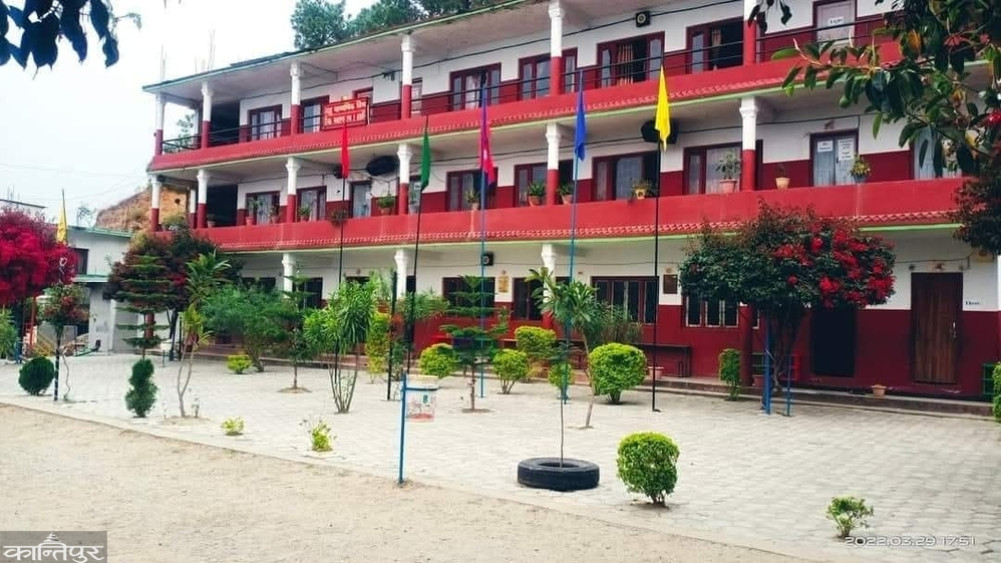
Out of 66 students who took the SEE exam from Dahu Secondary School, a community school in Ramechhap where 600 students from 30 districts are studying, 11 have achieved a GPA of 4.
We use Google Cloud Translation Services. Google requires we provide the following disclaimer relating to use of this service:
This service may contain translations powered by Google. Google disclaims all warranties related to the translations, expressed or implied, including any warranties of accuracy, reliability, and any implied warranties of merchantability, fitness for a particular purpose, and noninfringement.
With the publication of the results of the Secondary Education Examination (SEE) 2082, a school in the rural area of Ramechhap has once again come into the national spotlight. Dahu Secondary School located in Bethan, Sunapati Rural Municipality-4 of the district has secured 4 GPA in this year's SEE.
According to the results released by the National Examination Board on Monday, 11 out of a total of 66 students of the school have secured 4 GPA. According to the school, 9 students studying in the technical stream of computer engineering and 2 students studying in the general stream have secured 4 GPA. Similarly, 38 students in the technical stream have secured 3.60 to 3.96 GPA and one student has secured 3.59 GPA. 9 students in the general stream have secured 3.60 to 3.96, 5 students have secured 3.20 to 3.60 and 2 students have secured 2.80 to 3.20 GPA.
The school's principal Dal Bahadur Bal said that the achievement of Dahu Mavi in the year when 65.98 percent of students passed the national SEE results is the result of collective dedication, discipline and continuous struggle. He said, 'I am grateful to the dedicated fellow teachers, hardworking students and faithful parents who have continuously created new history in the field of education despite sacrificing many joys in their personal lives.' He said that it is a historic achievement that 16.66 percent of students have achieved a 4 GPA. He said that this is the best result in the history of Dahu Mavi.
Dahu Mavi is a school that has been in the news due to its excellent management and the results it has been achieving in examinations. Despite limited resources, rural environment and lack of opportunities, the school has been continuously achieving excellent academic achievements. Local parents seem excited about the success of the school.
Parents say that Dahu Mavi has set an example that even government schools can produce excellent results if there is hard work, discipline, competent management and cooperation between teachers and parents.
Impressed by the school's educational environment, discipline and management, Prem Bahadur Shrestha of Manthali Municipality-9 said that he got his daughter, who was studying in a private school in the district headquarters Manthali, admitted to Dahu Mavi three years ago. He said, 'The school's education, discipline and results have won the trust of our parents.'
According to Rina Tamang, a teacher at the school, teaching is currently being done in English medium from nursery to grade 12. Regular classes are conducted in the school every day from 6:30 am to 4:30 pm, and after that, students are involved in sports, dance and other extracurricular activities. 'The school has achieved its greatest success so far as a result of the hard work and collective efforts of all teachers, students and parents,' Tamang said, 'We are happy with this. But our goal has not yet been achieved. In SEE 2082, we expected 25 students to get a 4 GPA, but only 11 achieved that achievement. Therefore, there is a need to work harder.'
From 18 thousand loans to 8.4 million savings
Dahu Secondary School is a school that has been known in the local community for its educational quality since its establishment in 2018 BS. Although teaching and learning has been strong since its establishment, the financial condition of the school has been weak for a long time. The school's situation started to change after local Dal Bahadur Bal became the principal of the school in 2061 BS. He himself is a former student of this school, while both his grandfather and father worked as office assistants in this school.
When Bal became the principal, the school was in debt of Rs 18,000. Despite limited resources, weak financial conditions, and challenging circumstances, he took over the leadership with a clear plan and strong determination to improve the school. He recalls that the school reached a balance (profit) of Rs 50,000 in the 2062 audit.
But not everyone was satisfied with the initial signs of improvement. Recalling that the operating committee and parents expressed dissatisfaction that the progress was not as expected, Principal Bal says, 'Even when the school's balance was Rs 50,000, not everyone was happy. On the contrary, there were complaints that it was less for such a large school.' Then I greeted everyone and promised to make the school better and continued to work.'
After that, the collaboration between teachers, management committee, and parents gradually strengthened. He says that over time, not only the school's financial condition, but also the educational quality and physical infrastructure have been improving significantly.
The school is currently in a strong financial position, says Principal Bal. He said that the school currently has a balance of Rs 84,47,215 in its account. Another special feature of the school is free tuition for local students. There is no fee for local students studying here. However, local students contribute Rs 1,500 annually for educational activities and management.
Similarly, a monthly fee of Rs 6,000 has been fixed for students coming from outside, including residential facilities. The school has stated that accommodation and food arrangements are completely free for students in grades 11 and 12.
Students from 30 districts
Dahu Secondary School is now becoming the school of choice for students and parents not only in Ramechhap but also in various districts of the country. While most parents in the village are increasingly sending their children to the district headquarters and cities in search of a better education, Dahu Mavi, located in a remote settlement of Sunapati Rural Municipality, is attracting students from the city to the village.
Amidst the declining trust in community schools, Dahu Mavi has established itself as a model school in the country through its academic quality, discipline, and residential management. Recently, many parents, teachers, and representatives of various local levels have been visiting the school.
According to Principal Bal, a total of 600 students are currently studying in the school. Of these, 360 students come from 30 districts and are studying with residential facilities. 'Despite the desire to educate all the students who come from far away, it is difficult to manage,' Principal Bal said, 'That is why we have been selecting students only through entrance exams. We have had to determine the quota of students living in the hostel and take admission.'
According to the school, students from districts including Kavre, Dolakha, Okhaldhunga, Sindhuli, Sindhupalchowk, Bhaktapur, Lalitpur, Rautahat, Mahottari and Jhapa are currently studying here. Similarly, students from districts including Kathmandu, Makawanpur, Bajhang, Myagdi, Doti, Nawalparasi, Baitadi, Salyan, Saptari, Arghakhanchi, Siraha, Chitwan, Surkhet, Sarlahi and Sunsari are also studying at Dahu Mavi on a residential basis.
The school says that the attraction of parents is increasing as they get quality education in English medium, a disciplined environment and practical learning opportunities in a rural setting.
Efforts to link education with labor and production
Dahu Mavi Bethan has also increased its activity in the agricultural sector as an effort to link education not only with textbooks but also with labor, production and practical skills. The school has conducted an agricultural and animal husbandry program in the first phase with the aim of encouraging modern agricultural practices.
According to the Principal, the school has brought the agricultural farm into operation with the aim of linking education with practical life. 'We have tried to teach the students the importance of labor and production along with book knowledge,' he said, 'We have started the practice in the school with the aim of making agriculture modern and professional.'
Currently, 11 pigs are raised in the school farm and there are more than 400 boiler chickens. Along with that, the school is also operating vegetable farming. According to the school, both students and teachers actively participate in the management of the farm.
More than 300 students are currently studying in the hostel in the school, which is operated with residential facilities. The Principal said that more than 50 kg of meat is consumed every week for those students. In addition, the school has been managing vegetables in large quantities through its own farm.
The meat and vegetables produced by the school have been used in the meals of the hostel students. On the one hand, this has helped the school become self-sufficient and on the other hand, the school principal says, it has helped teach students practical agricultural knowledge and respect for labor.