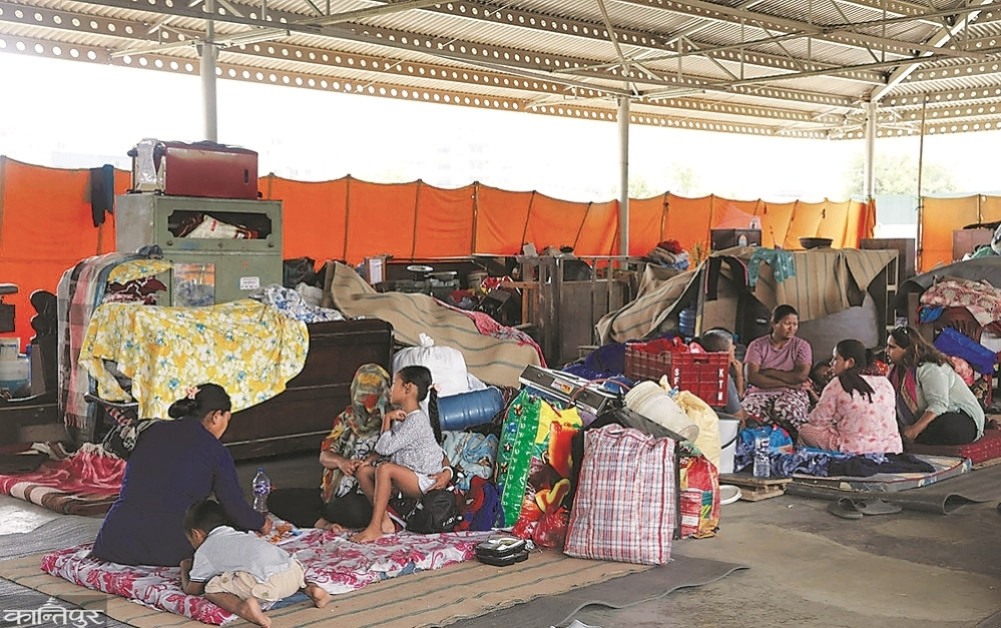
Supreme Court's interim order for proper management of squatters and unorganized settlements.
We use Google Cloud Translation Services. Google requires we provide the following disclaimer relating to use of this service:
This service may contain translations powered by Google. Google disclaims all warranties related to the translations, expressed or implied, including any warranties of accuracy, reliability, and any implied warranties of merchantability, fitness for a particular purpose, and noninfringement.
The Supreme Court has issued an interim order in the name of the government not to forcibly evict more squatters and unorganized settlers from their settlements. The Supreme Court has also ordered that basic needs such as housing, education, health, and food be effectively managed for the displaced squatters or unorganized settlers.
A joint bench of Supreme Court Justices Kumar Regmi and Nityanand Pandey issued the interim order on Friday while hearing a writ petition filed against the government's move to use dozers in squatter settlements. Gopal Ranpaheli and others had filed the writ petition on April 11, senior advocate Dinesh Tripathi on April 14, and Majid Ansari and others on April 17, seeking an order to stop the demolition of squatter settlements.
The interim order came from the Supreme Court after the government deployed dozers in the squatter settlements of the Kathmandu Valley. The Supreme Court has said that an interim order need not be issued immediately for work that has already been completed. The interim order was issued as the government has also initiated the process of removing squatters and unorganized settlements in other parts of the country.
The Supreme Court has emphasized that the removal of squatters and unorganized settlements from their homes without following the due process of law should be considered in view of the irreparable damage to education, health, housing, etc. and the humanitarian crisis that may arise. The interim order states, ‘Item No. of the agenda on governance reforms approved by the Council of Ministers on 13 Chaitra. 91 and the circular issued by the Ministry of Federal Affairs and General Administration to all municipalities and rural municipalities on 17 Baisakh and the letter of the Ministry of Home Affairs on 17 Baisakh, do not forcibly remove or displace squatters and unorganized settlers from the settlements without following the phased process specified in the interim order.
The petitioner's statement that the basic needs of the squatters who were removed from the settlements were not met and the National Human Rights Commission also pointed out the problem.
It further states, 'More effective work should be done to provide or cause to be done basic needs of displaced squatters or unorganized settlers, including housing, education, health, and food.' The Prime Minister's Office had directed the concerned bodies to remove the squatter settlements on 9 Baisakh. The District Administration Office, Kathmandu had issued an 'Urgent Notice' on 10 Baisakh to evacuate the settlements along the river. The notice asked to vacate the houses and shacks by the evening of 11 Baisakh. Micking was also done that day.
From 12 Baisakh, security personnel were deployed and bulldozers were used in the squatter settlements on the banks of the river. A writ was filed in the Supreme Court alleging that the eviction from the settlements was started without any written information, alternative housing, resettlement compensation or any other proper arrangements, without any consultation with the affected families, and without a survey.
The writ petitioners had demanded an order to manage the people of the demolished settlements so far and to stop the bulldozers in the areas where there are more squatters and unorganized settlements. They had demanded that the government take action only after adopting proper procedures as the eviction of houses and shacks in more squatter settlements in the country would create a dangerous situation.
On 14 Baisakh, a single bench of Justice Shantisingh Thapa had issued a show-cause order. Then, during the hearing in the joint bench, legal practitioners appearing on behalf of the Government of Nepal and the Kathmandu Metropolitan City argued that the squatters and unorganized settlers kept in the 'shelter' were treated humanely and were provided with basic necessities and were being managed for the long term.
The Supreme Court also mentioned in the order that this case should be decided quickly. 'Since the submitted writ petition contains serious questions regarding the proper management of squatters and unorganized settlers, it appears that it should be resolved quickly, the written response from the opponents should be given priority for a full hearing within 15 days after the expiry of the period,' the order said.
With the interim order, the government, local level or security body has to immediately stop the removal of squatters and unorganized settlers. That is, until the process prescribed by law is completed and the final decision on the writ pending in the court is made, the settlement cannot be removed. Legal process means that the government must ensure identification, classification, alternative housing, rehabilitation and basic services before removing the settlement.
Advocate Arnab Chaudhary, one of the writ petitioners, says that the management of squatters has been reinstated as a question of 'human rights and constitutional rights' rather than an administrative matter of 'removing encroachments'. 'We went to the court with confidence. The court has shown that the problem of squatters should also be viewed from a human rights perspective,' he told Kantipur.