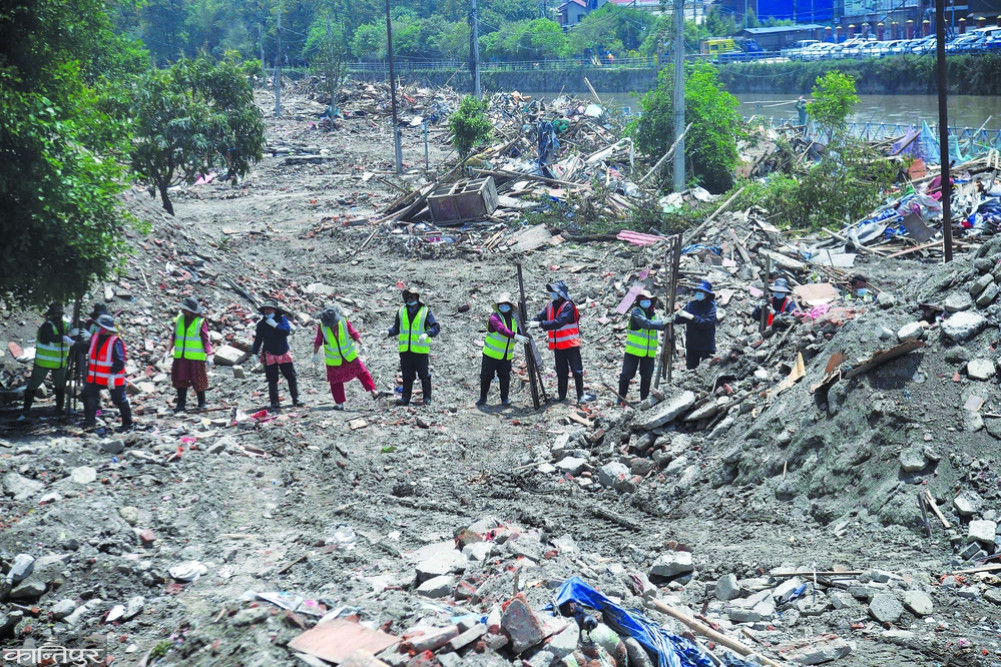
Experts say – ‘We should not remove settlements and build concrete structures again, we should manage them naturally’
We use Google Cloud Translation Services. Google requires we provide the following disclaimer relating to use of this service:
This service may contain translations powered by Google. Google disclaims all warranties related to the translations, expressed or implied, including any warranties of accuracy, reliability, and any implied warranties of merchantability, fitness for a particular purpose, and noninfringement.
The government is preparing to build a park in the area cleared by removing squatter settlements in Kathmandu. The Ministry of Urban Development has stated that there is a plan to expand the corridor road by clearing the river banks and build a park in the remaining area.
Dilip Bhandari, Joint Secretary of the Ministry of Urban Development, said that a detailed plan will be prepared through the Kathmandu Valley Development Authority to expand the corridor road along the river banks and build a park in the remaining area. ‘Due to the existence of squatter settlements, corridor roads could not be expanded in some places, there are preparations to clear the debris and open the corridor,’ he told Kantipur.
Machakaji Maharjan, Project Director of the powerful Bagmati Civilization Integrated Development Committee, which is responsible for managing a 20-meter area of the river bank in the valley, says that attempts have been made several times in the past to clear the river banks in the valley. ‘This has been an effort that has been going on for a long time, and it has finally been cleared now,’ he said, ‘There are discussions underway to build an open park in it.’
Urban development expert Kishor Thapa, who is also a former secretary, says that the land around the valley should be kept clear. ‘Small open spaces can also be built there so that it is good for walking, so that there is no damage even during floods, so that water can spread,’ he told Kantipur, ‘We should not build large structures like before.’ He says that even when building a park, it should be like a park, ‘A park in Nepal is one where you cannot see greenery, there is concrete everywhere. Keeping it is an invitation to flood disasters.’
Prime Minister Balendra Shah had also defended the decision to vacate the squatter settlements, citing the damage caused by floods in the past. ‘However, if those structures are removed now and concrete structures are built in the name of parks again, the problem will remain,’ says urban development expert Thapa, ‘Therefore, the surrounding areas should be managed in a natural way as much as possible.
He says that if there is an open open space, it will be a place to sunbathe, sit and take a ‘morning walk’ in winter. ‘Even when floods come, water freezes for a while and then goes away. So it should be left empty,' he says.
After the bulldozers were used in Bagmati, AI-generated videos have also started going viral on social media, showing everything from concrete structures to well-equipped parks. Milan Rai, an activist who has been advocating for open spaces, green and environmentally friendly urban planning in the city, says that the history of the riverbank should not be forgotten. 'It may be fun to just look at the view without thinking too much, but we should pay attention to who it is for and what it is for,' he said. 'A large empty space in Kathmandu is a UN park, and even that can be used to come up with ideas for what to do.'
The riverbanks of the Kathmandu Valley are also home to cultural heritage. Since there is also a 'social ecology' along the riverbanks, there is a good opportunity to look at everything and go for nature-based solutions, says urban development expert Sanjay Upreti, who is also the head of Pulchowk Campus. ‘There were some places where concrete was poured on the river banks in the name of greenery, this is an opportunity to stop it and organize it,’ he said, ‘After the management of the squatters, the government should pay attention to how the use of the vacant space can be linked to social ecology.’
Upreti says that it is necessary to not only make public spaces beautiful, but also to link them to the economic activities of the city and the risk of disasters. Kathmandu’s squatter settlements used to get flooded every year because they were close to the river banks. Even the UN Park has been flooded. Due to the lack of space for water to spread around due to the structure, water pressure was building up in the lower areas.
Prime Minister Balendra Shah, when he was the mayor of Kathmandu Metropolitan City, had launched a plan to empty the river banks of the capital and beautify them. Along with the Bagmati, there are Bishnumati, Tukucha, Ichchumati, Bhajkhusi, Parokhusi, Manohara, Dhobi Khola and Balkhu rivers under Kathmandu Metropolitan City. Aiming at that, Shah had launched a plan for beautification including corridor cleaning.
He had requested help from Narayan Kaji Shrestha to Rabi Lamichhane when he was the Home Minister to clear the squatters' settlements in Kathmandu. But the central government did not help. Shah cleared the squatters' settlements after joining the Rashtriya Swayamsevak Sangh (RSS), where Lamichhane is currently the president, and became the Prime Minister.
The '100 Agendas for Government Reforms' brought by the government after Shah became the Prime Minister stated that the collection and verification of integrated digital data of landless squatters and unorganized settlers across the country would be completed within 60 days. There was even protest that no option was given for verification and management before the settlement was cleared. At least 2 people died due to the stress of the displacement of the squatters' settlements.
About 2,000 families have registered their names for help, saying that they were left homeless when the government used dozers. Prakriti KC, the joint spokesperson of the Valley Development Authority, says that it will take time to get exact details as the process of contacting them is still ongoing. "What to do with the vacant land is being discussed at the highest level," she said.
According to a report prepared by the empowered Bagmati Civilization Integrated Development Committee in 2079, there were 3,496 households living in unorganized settlements along the river banks in the valley. Of these, 2,245 were in Kathmandu Metropolitan City, 90 in Kageshwari Municipality, 156 in Budhanilkantha, 17 in Lalitpur Metropolitan City, and 773 in Bhaktapur Municipality.