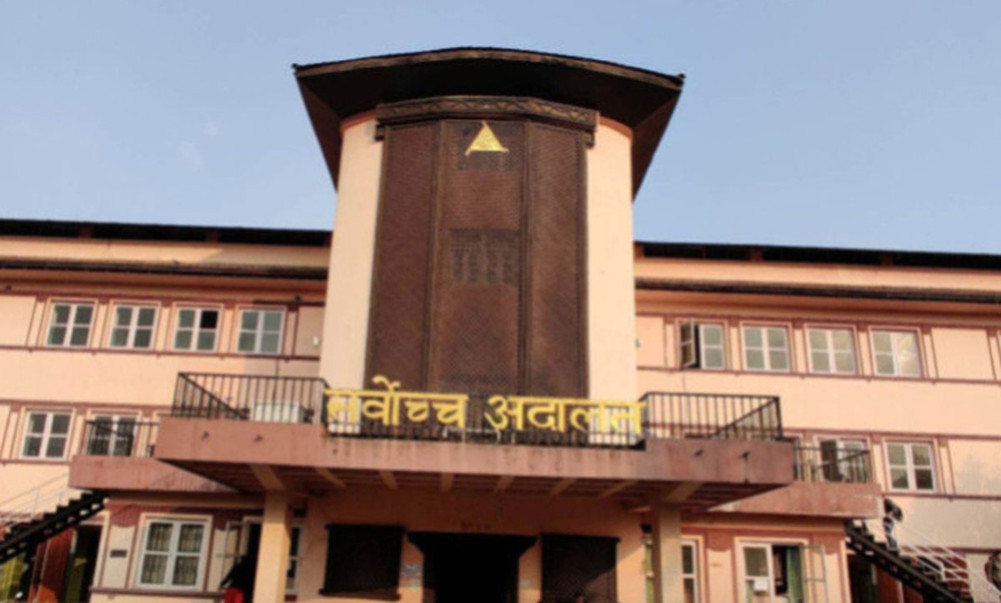
Until the process prescribed by law is completed and the writ pending in court is finally decided, no settlement removal work can be carried out.
We use Google Cloud Translation Services. Google requires we provide the following disclaimer relating to use of this service:
This service may contain translations powered by Google. Google disclaims all warranties related to the translations, expressed or implied, including any warranties of accuracy, reliability, and any implied warranties of merchantability, fitness for a particular purpose, and noninfringement.
The Supreme Court has issued an interim order not to implement the government's decision, saying that the process prescribed by law has not been completed while evicting squatters and unorganized settlers. A joint bench of Justices Kumar Regmi and Nityanand Pandey issued the order in the name of the government on Friday, asking it not to forcibly evict the settlements without alternative arrangements.
The court issued the order on Friday while holding the second hearing on the writ petition filed by Gopal Ranpaheli, senior advocate Dinesh Tripathi, Majid Ansari and others against the government's campaign to evict squatters from various places including Thapathali.
On what basis did the Supreme Court issue the order?
The court has mainly emphasized two grounds in the order - legal process and human rights. The bench has stated that 'due process' must be adopted while evicting squatters and unorganized settlers. The order directs the government to follow the step-by-step process outlined in the circular sent to local levels by the Ministry of Federal Affairs and General Administration on April 17, 2006, and the letter of the Ministry of Home Affairs on the same date.
The court has ruled that forcibly evicting squatters without adopting those criteria and procedures could cause irreparable damage to fundamental rights including education, health, and housing and could lead to a humanitarian crisis. The order states, 'Squatters and unorganized Bose residents shall not be forcibly removed or displaced from their settlements.'
During the hearing, legal practitioners present on behalf of the government and Kathmandu Metropolitan City claimed that the process of long-term management of squatters has been taken forward and that basic necessities have been provided to the evicted families. However, the petitioner and the National Human Rights Commission had drawn the court's attention to the fact that all the displaced families were not getting minimum basic services. It seems that the Supreme Court took that side seriously and immediately issued an interim order.
How did the dispute start?
The dispute intensified after April 10. The District Administration Office, Kathmandu, had issued an 'urgent notice' to evacuate the settlements along the river. The notice asked to vacate the houses and huts by the evening of April 11. However, the locals alleged that the dozers were used without giving sufficient time, that written notice was not given effectively, and that an attempt was made to displace them without arranging alternative accommodation.
Gopal Ranpaheli, one of the writ petitioners, then filed an application in the Supreme Court. However, when the interim order was not issued immediately in the initial hearing, the dozers had already been used in some settlements including Thapathali.
Earlier, a single bench of Justice Shantisingh Thapa had issued a show cause order and summoned the government to discuss the interim order. After a detailed hearing, the joint bench has now issued an interim order.
What happens now?
With the interim order, the government, local levels or security agencies will have to immediately stop the eviction of squatters and unorganized settlements. Settlement eviction will not be allowed until the process prescribed by law is completed and the final decision on the writ pending in the court is made.
This means that now, before forcibly evicting a settlement using a dozer at any location, the government will have to ensure identification, classification, alternative housing, rehabilitation and basic services. This does not mean that the court has permanently legalized the squatter settlements. Since the final verdict is yet to be issued, the government still has the right to manage.
Another writ petitioner, advocate Arnav Chaudhary, says that the management of squatters has been re-established as a question of 'human rights and constitutional rights' rather than an administrative matter of 'removing encroachments'. 'We had gone to the court with confidence.' The court has shown that when the government illegally evicts people from the ground floor, the court will provide justice and that the problem of squatters should also be viewed from a human rights perspective,' Arnav told Kantipur.