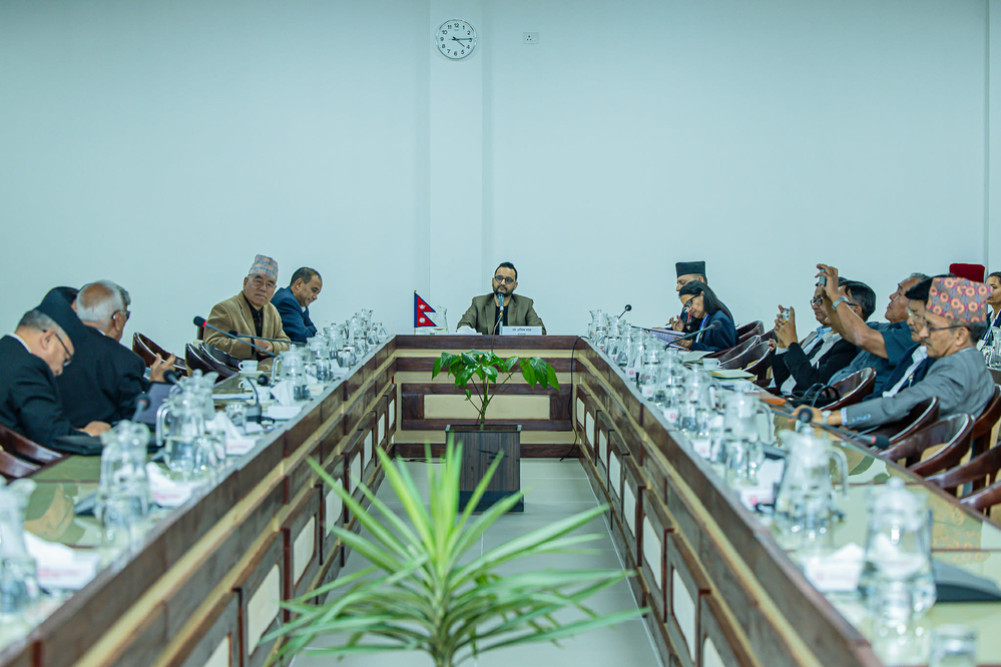
The task force, coordinated by Asim Shah, the Prime Minister's political advisor, held discussions at the Office of the Prime Minister and Council of Ministers.
We use Google Cloud Translation Services. Google requires we provide the following disclaimer relating to use of this service:
This service may contain translations powered by Google. Google disclaims all warranties related to the translations, expressed or implied, including any warranties of accuracy, reliability, and any implied warranties of merchantability, fitness for a particular purpose, and noninfringement.
The task force formed to prepare a discussion paper for the constitutional amendment consulted with former attorneys general and legal experts on Wednesday.
The task force, coordinated by the Prime Minister's political advisor Asim Shah, held discussions at the Office of the Prime Minister and Council of Ministers. The participating former attorneys general presented their suggestions on issues including the form of government, electoral system, federal structure, restructuring of the judiciary, number of constitutional bodies and inclusiveness.
Former Attorney General Dr. Yubaraj Sangraula suggested that the task force clearly define the objectives and needs of the constitutional amendment. He said that making the local level non-partisan, directly electing the provincial chiefs could be made, and some international practices should be studied.
Former Attorney General Savita Bhandari said that the mindset and conduct of implementing the constitution or the law are more important than the constitution or the law. She said that there is no need to change the form of government and that a system where experts and MPs can become ministers would be appropriate. Former Attorney General Bhandari expressed the opinion that Nepalis living abroad should be given the right to vote, the number of provinces should be reduced, and the ministries should be merged by removing duplication. She said that the structure of the Judicial Council and parliamentary hearings could also be reconsidered.
Former Attorney General Raman Kumar Shrestha believed that there should be a system of directly elected chief executives. He said that MPs should not become ministers, that the judiciary needs to be restructured, and that the appropriateness of the constitutional bench should be reconsidered.
Former Attorney General Mahadev Prasad Yadav believed that the role of leadership character and ethics is important in the implementation of the constitution and state building. He suggested reviewing the number of constitutional commissions.
Former Attorney General Muktinarayan Pradhan emphasized the need to ensure additional rights while protecting the currently acquired rights. He presented suggestions on the system of directly elected chief executives, accountability to parliament, restructuring of the judiciary, and further strengthening the High Court. He was of the opinion that instead of reducing the number of provinces, the provincial structure should be made more effective.
Former Minister for Law, Justice and Parliamentary Affairs and former Attorney General Agni Prasad Kharel said that a clear political view on the form of governance is necessary. He suggested that the local level should be made more powerful and that inclusiveness should be continued as the main basis of the constitution.
Constituent Assembly member Suresh Ale Magar expressed his opinion in favor of a fully proportional electoral system. He stated that the restructuring of the judiciary was necessary and that the problem would not be solved by simply reducing the number of constitutional commissions. He said that the effectiveness of the institution would be linked to the leadership and honesty of the office bearers.
House of Representatives member Parashuram Tamang said that international agreements, issues of Madhesi, Muslim and indigenous communities should be included in the debate on constitutional amendment. He suggested that conflicting schedules should be removed to make local levels and provinces effective, that a system should be put in place to ensure the selection of parties, communities and individuals in the electoral system, and that the representation structure in the National Assembly should be reviewed.
Former Secretary Rajiv Gautam suggested that the governance system should be clear, the number of constitutional commissions should be reviewed, and the law-making process should be made more effective and shorter. He opined that the performance evaluation of judges and the role of the provincial chief should be made more clear and effective. Shah, coordinator of the
task force, clarified that the need for amending the constitution was felt due to the concept of amendment after 10 years, the increasing debate among political parties, and the demand for ending corruption and good governance from the latest generation (Genji Movement). He said that the suggestions received were important for the preparation of the debate paper.