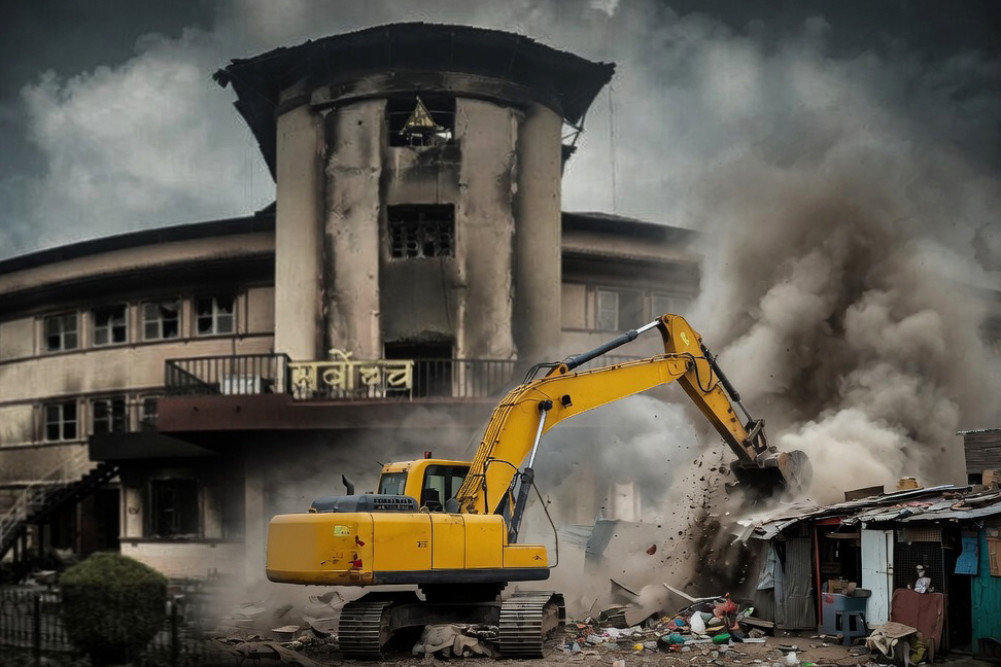
The government's immediate eviction policy and the court's delayed process have left hundreds of squatter families homeless.
We use Google Cloud Translation Services. Google requires we provide the following disclaimer relating to use of this service:
This service may contain translations powered by Google. Google disclaims all warranties related to the translations, expressed or implied, including any warranties of accuracy, reliability, and any implied warranties of merchantability, fitness for a particular purpose, and noninfringement.
When the Nepal Police came at night to remove the settlement and miked, Gopal Ranpaheli, who lives on the banks of the Bagmati River in Thapathali, had only one hope in his mind - 'The case is in court, so maybe the house will not be demolished.'
However, by the time the Supreme Court turned over the file and issued a 'show cause' order, Gopal's tent was already in the ground.
The proverb 'Justice delayed is justice denied' has exactly applied to the life of Gopal, a squatter in Thapathali. The speed with which the government's bulldozers demolished Gopal's house, the court's legal process was just as slow to stop it.
As a result, hundreds of families are now not only homeless, but some are forced to live in hotel rooms under the state's 'token' system, while others are living a difficult daily life in holding centers.
However, this is not only a matter of delay, but also a contradiction within the Supreme Court's decision. The Supreme Court had ordered the removal of structures within 20 meters of the Bagmati and its tributaries on 2080 Pus 3. At that time, the court had said that actual squatters cannot be displaced without alternative arrangements, and if necessary, they should be relocated only by providing cash relief.
'How can you go to court without receiving any notice?'
The incident began on 10th of Baisakh. The District Administration Office, Kathmandu, put an 'Urgent Notice' on its website. Interestingly, the notice, which was made public on 11th of Baisakh, had the date 10th. The notice said - 'Those living on the banks of the river should vacate their houses and properties by 7 pm on 11th.'
Even before this notice was issued without even giving 24 hours' notice, the police had already started miking in every settlement. The Prime Minister's direct instructions and the active participation of the heads of security agencies made it clear that this time the government was not going to give 'alternatives' but to 'displace'.
Amidst this panic, the leaders of the Genji movement including Gopal Ranpaheli of Thapathali reached the Supreme Court on the 11th of Baisakh. Their demand was - 'No one should be made homeless without identification and alternative arrangements.'
'The government had not issued any written notice, we went to court on the 11th as soon as we heard the miking and the rumors,' Ranpaheli recalls that day, 'While we were registering a writ in the court, the employees there were saying, 'You came late.' But, the house is being demolished. How could we come to file a case without being informed that we were being picked up? I said.' The next day, on the morning of Baisakh 12, the dozer arrived in Thapathali. Years of sweat turned to dust before Gopal's eyes. 'We filed a writ on the 11th, and the dozer started working on the house where I was staying the next morning. It was difficult to even remove the belongings, everything was in a state of chaos,' Ranpaheli told Kantipur. After the writ was filed on the 11th, the court was not in a position to hear it on the 12th. Because Saturday and Sunday were public holidays on the 12th and 13th. That is why the initial hearing of the case in the court was held only on Monday. The single bench of Justice Shantisingh Thapa did not see the seriousness of the petition. Even though a writ was filed to stop the demolition of the house immediately, the bench refused to issue an 'interim order'. The Supreme Court had set the hearing date for April 14. Ranpaheli thought the court would say something. However, it did not turn out as he had expected. The Supreme Court only issued a show cause order that day.
'... Considering the nature and seriousness of the issues raised in the petition, it seems appropriate to reach a conclusion after hearing the discussions of both sides...' Instead, an order was issued to call the government for an interim order and discuss it. And, the date for the discussion was April 22. By this time, the Thapathali squatter settlement where Ranpaheli lived had become a ruin.
'The court had called on April 14, we went. But even then, the court did not ask to stop the dozer, other houses would have been saved if the order had been given,' Gopal said, recalling that day, 'Now today (22nd) it has been called again, but my house has already been demolished. What can I say if I go there now?'
The Supreme Court called the government to discuss the issue of squatters, and an additional writ was filed
Those who were made homeless were initially taken to Dashrath Stadium. There, their citizenship was demanded. They were made to fill out some documents. And then, their family was given a number on a piece of paper and sent to stay in a lodge. 'Right now, I am in a hotel with my family, but how long will I stay like this? It is not decided,' he says.
Because, the Supreme Court had already clearly stated in its judgment regarding the vacating of 20-20 meters of the river bank. The actual squatters should not be evicted without making alternative arrangements and the right to housing (Article 37(1) of the Constitution) should be taken into account. Therefore, legal practitioners argue that even considering their own previous interpretation, there is sufficient basis for issuing an interim order in this case.
'Article 37(1) of the Constitution grants every citizen the right to housing. Several precedents of the Supreme Court say that no one can be brought to the streets without making alternative arrangements,' he said, 'In such a situation, when irreparable damage was certain to occur, it would have been a great relief if the court had issued an interim order immediately.'