Expressing disagreement with the ordinance that provides for decisions to be made by three out of the six members of the council, he urged the proposal to be reconsidered and sent back.
We use Google Cloud Translation Services. Google requires we provide the following disclaimer relating to use of this service:
This service may contain translations powered by Google. Google disclaims all warranties related to the translations, expressed or implied, including any warranties of accuracy, reliability, and any implied warranties of merchantability, fitness for a particular purpose, and noninfringement.
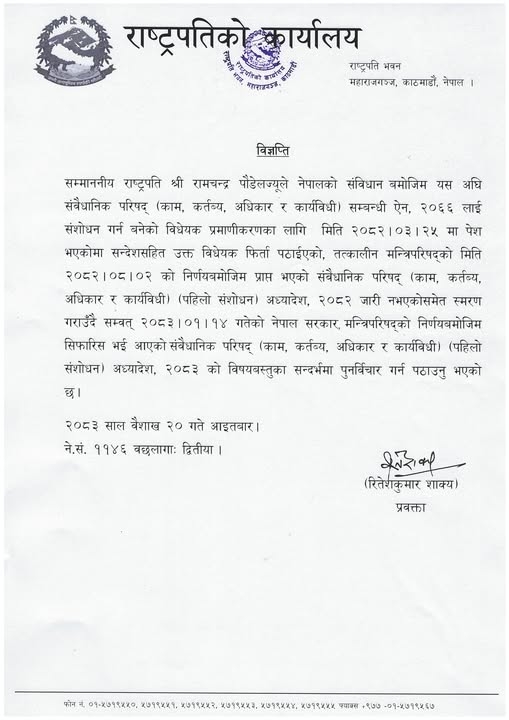
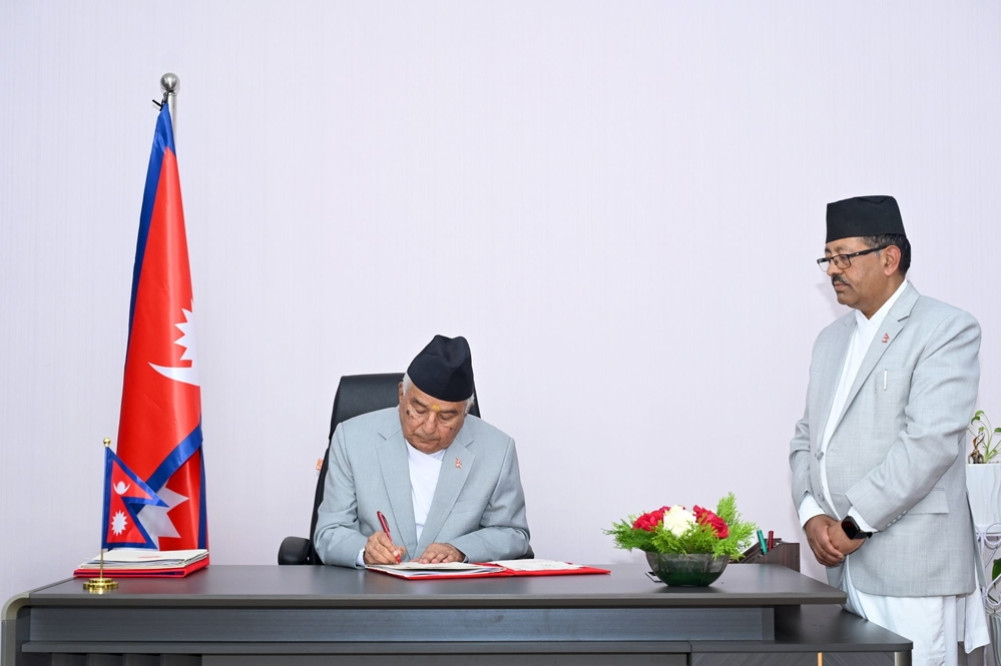
President Ram Chandra Poudel has sent back the ordinance related to the Constitutional Council and urged the government to reconsider the essence of the majority system. Expressing disagreement with the ordinance that provides for decisions to be made by three out of the six members of the council, he urged the government to reconsider the proposal and send it back.
'Reminding that the Constitutional Council (Works, Duties, Powers and Procedures) (First Amendment) Ordinance, 2082, which was received as per the decision of the then Council of Ministers on 2082.08.02, has not been issued, the Government of Nepal has sent it for reconsideration in the context of the contents of the Constitutional Council (Works, Duties, Powers and Procedures) (First Amendment) Ordinance, 2083, which has been recommended as per the decision of the Council of Ministers on 2083.01.14, Sambat,' said Ritesh Kumar Shakya, Spokesperson of the Office of the President, in a statement issued on Sunday.
The government had recommended an ordinance to amend the 'Constitutional Council (Work, Duties, Powers and Procedures) Act, 2066'. The ordinance proposed to change the provisions on quorum and decision-making process in Section 6 of the Act and the provisions on parliamentary hearings in Section 7. According to the proposed provision, a meeting can be held if four people are present and a decision can be made by a majority of the members present, that is, three people.
However, President Poudel has concluded that such a provision would weaken the basic essence of the majority system. Since there are a total of six members in the council, decisions should be made with the consent of at least four of them.
According to the President's legal advisor Baburam Kunwar, while withdrawing the ordinance, the bills passed by both houses of the federal parliament and submitted for verification in the past, the ordinance recommended by the then Sushila Karki-led government, and the precedents of the Supreme Court were also taken into account.
The Constitutional Council, to be formed under the chairmanship of the Prime Minister, will include the Speaker of the House, the President of the National Assembly, the Chief Justice, the leader of the main opposition party, and the Deputy Speaker. The President is of the opinion that in such a structure, a majority should mean the agreement of at least four members.
Meanwhile, the government has been saying that the amendment to the act is necessary to avoid obstacles in the appointment process of constitutional officials.
After the ethical complications regarding the issuance of the ordinance were seen, President Poudel consulted constitutional experts and officials of the Nepal Bar Association. He also tried to discuss the issue with the Prime Minister. However, before direct consultation, he decided to send the ordinance back with the conclusion that the essence of the majority system should be preserved.