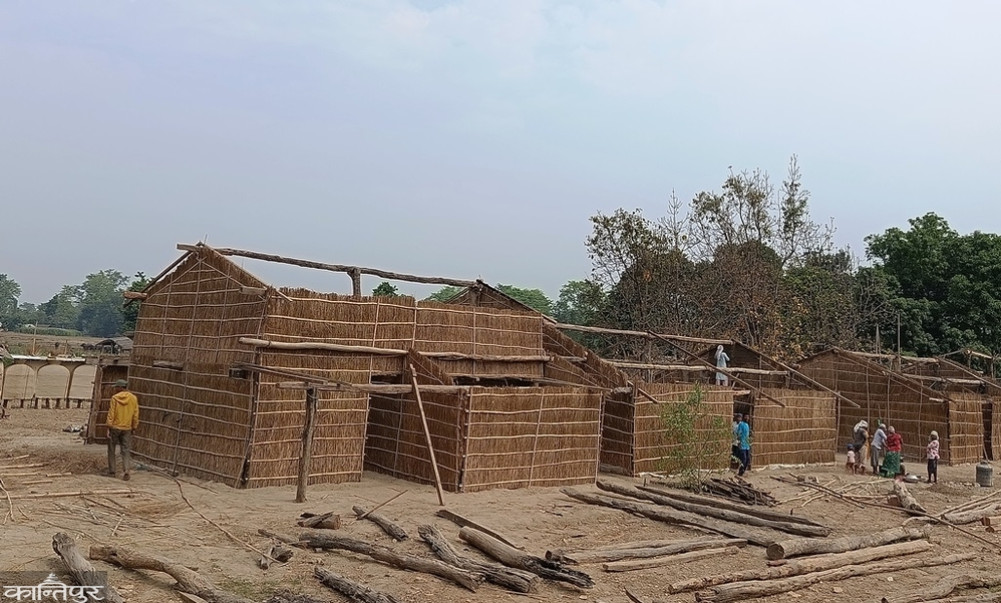
Nine traditional wood-thatched houses are being constructed in Madhuban-1, Pattharboji, after a joint family of 59 members separated by mutual consent.
We use Google Cloud Translation Services. Google requires we provide the following disclaimer relating to use of this service:
This service may contain translations powered by Google. Google disclaims all warranties related to the translations, expressed or implied, including any warranties of accuracy, reliability, and any implied warranties of merchantability, fitness for a particular purpose, and noninfringement.
Nowadays, it is difficult to find a family living together. The custom of family members gathering only during festivals like Dashain and Tihar and other occasions is increasing. At such a time, a family in Madhuban-1 Patharbojhi has separated, and a small settlement has been formed.
A family that had been living together for a long time has separated by mutual consent. They used to live in the same house and nine new houses have been built since they separated. Now they are building each other's houses together. There are 59 members in the family.
Nine identical houses are being built on the edge of the forest in Patharbojhi. Traditional houses made of wood and thatch are being built. The work is being done collectively at an equal pace. The construction of identical houses in waves has given a glimpse of a 'new village' being built.
None of the members of the family are free at the moment. Some are seen tying the mats, some are seen carrying wood. Some are seen covering the mats with mud. Some are responsible for cooking and feeding. Relatives are also helping them.
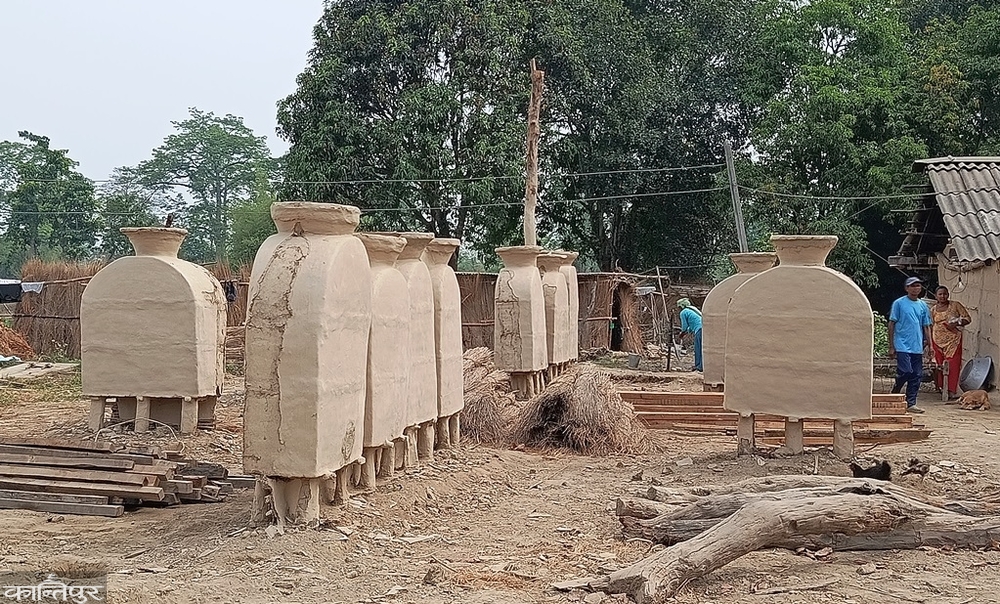
During the separation, the belongings in the house have been distributed equally so that no one is inconvenienced. Each brother has arranged the wood, firewood and other belongings in front of his own house. Everyone is happy as the family shares the property. Their grandfather's four brothers had three children. Those three brothers gave birth to 9 sons from their father. The family head Mahangu Chaudhary said that now the property is divided among the 9 brothers. According to him, two of the 9 brothers currently live in Karmala in Bhurigaun. Seven brothers live in Pattharbojhi. Out of these 9, the younger brother has four children. 2 of the four are currently building houses here. The remaining two live in Orali Bazaar. ‘My parents passed away last November,’ said Mahangu, ‘My grandparents have already passed away. Now there is a younger uncle.’
The Tharu community plans a year-long project every year in Maghi. Lal Bahadur Chaudhary said that the family was separated as per the decision taken last Maghi. He is the eldest son of My uncle. ‘The land is being divided by marking the land with agreement and a house is being built,’ he said, ‘It has not been legally divided yet, why go to court after the brothers have reached an agreement.’
When it was a joint family, work was divided in turns. That is why the same work was not always done. Everyone used to do farming work together. ‘After being separated, you have to do your own work,’ he said, ‘it is a little more difficult than in Sagol.’ He said that everyone still helps whoever has the burden of work.’
When in Sagol, the responsibility of cooking also kept changing. Ramdulari Chaudhary, the eldest daughter-in-law, said that it used to be one person’s turn to cook for a month and a half. ‘Relatives have come to help build the house,’ she said, ‘so now I am cooking and feeding 65 people alone in the morning and evening.’
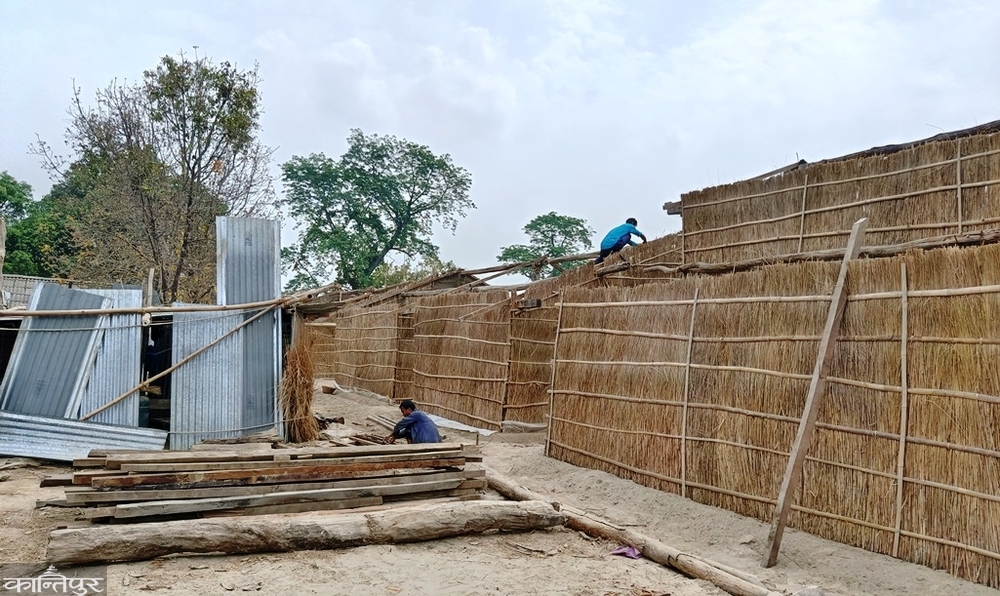
Chhalluram Chaudhary of Madhuvan-1, who has been helping his nephew build his house for the past month and a half, said. He said that he does not take wages for his work. ‘It is our tradition to help relatives when they are in need,’ he said. When in Sagol, family members would gather in one place only for meals. At other times, everyone would be busy with their own work. They have 8 bighas of their own land. They have been cultivating rice in an additional 10 bighas.
Earlier, there was only one cook in the family. If one person had to go on forced labor, one person from the house would go. One person would go to graze the livestock. ‘After separation, one person from each house has to go on forced labor in the village,’ said Mahangu.
Wildlife often moves from their place of residence in the Pattharbojhi settlement under the Khata Biological Route. The Biological Route connects Bardiya National Park with the Katarniaghat Wildlife Sanctuary in India. ‘There is no financial condition to build a permanent house,’ said Mahangu. ‘Elephants repeatedly destroy houses built using local resources.’
Earlier, no compensation was given when elephants destroyed houses. According to Mahungu, relief has come after the implementation of the micro-home insurance program with the financial support of the Terai Land Boundary and Conservation Program. ‘I have received compensation of Rs 14,000 and Rs 7,000 once when elephants destroyed houses,’ he said.
Khata Community Forest Coordination Committee Chairman Hari Gurung said that the micro-home insurance program has been operating for three years with the support of the Terai Land Boundary and Conservation Program as elephants moving through the ecological path have been destroying the houses of the residents of this area. ‘4,684 households have been insured in wards 1 to 5, Rajapur Municipality-10 and some wards of Thakur Baba,’ he said. ‘Since the financial year 079/080, we have provided damage relief worth Rs 794,084 to 30 households affected by wild elephants and disasters.’ Each household has to pay Rs 95 for micro-home insurance.