Labor Day is celebrated every year on May 1. However, the day does not affect those who earn their living by working.
We use Google Cloud Translation Services. Google requires we provide the following disclaimer relating to use of this service:
This service may contain translations powered by Google. Google disclaims all warranties related to the translations, expressed or implied, including any warranties of accuracy, reliability, and any implied warranties of merchantability, fitness for a particular purpose, and noninfringement.
Today is the 137th International Workers' Day. Its importance for the rights and privileges of workers is unique.
Today is considered an important day for workers. On the occasion of this, big programs are held in various places. However, the general public, who are worried about how to make ends meet in the morning and evening, are not aware of Workers' Day. Labor Day is celebrated on May 1 every year. However, the day does not touch those who earn their living by working.
Ganesh Magar is one of them. In his old age, he was walking near the bus park with a sack of onions and other vegetables on a cart. He was equally cautious, fearing that his belongings might fall somewhere. 65-year-old Ganesh, wearing a dhaka top on his head and slippers on his feet, has a permanent home in Dhading. He has been transporting goods on a cart in Kathmandu for 18 years.
The income from that is what keeps his house running . Ganesh's family of four is supported by his own earnings . His two sons and wife live in the village . He says, 'I don't earn much . Living alone in Kathmandu, I can barely afford to pay the rent, let alone eat,' he said, 'That's why I'm living with a friend . The two of us pay the rent together .' 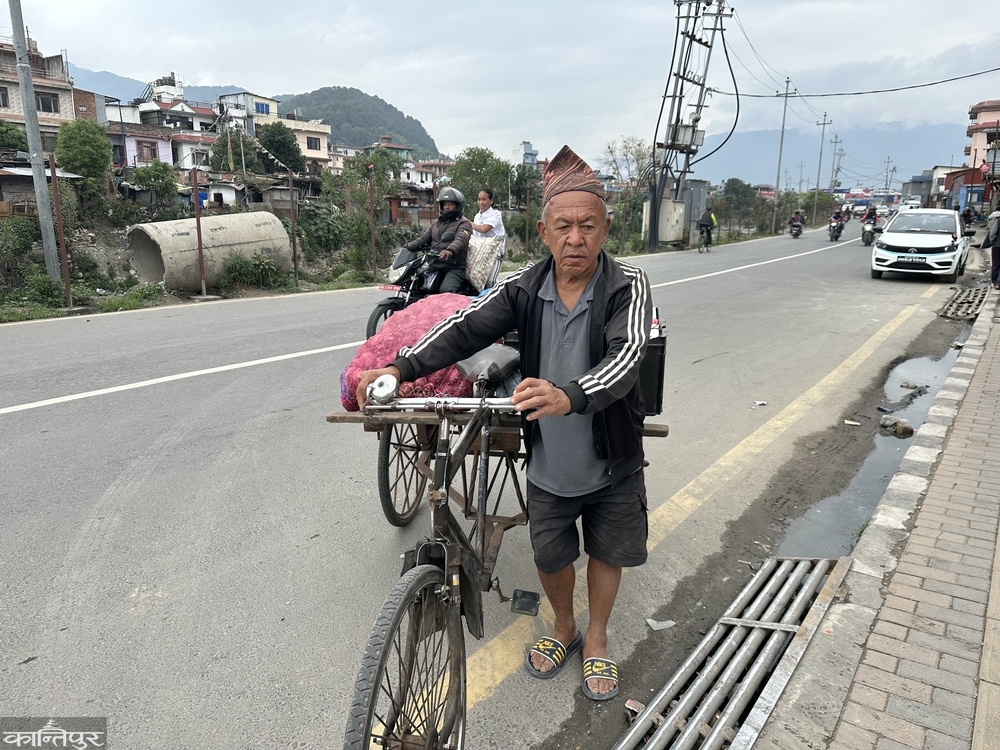
Ganesh says she doesn't know about Labor Day . He says, 'We always think we'll be able to carry a lot of stuff tomorrow . We always think we'll earn enough money to send back to the village in a month,' she said, 'We don't know much else . Even if we know, there's nothing we can do .'
Ganesh spends his days pushing a cart full of stuff from 4 am to 8 pm . 'On days when I don't get much work, my mind becomes restless . What can I do? The stove won't light up at home,' he said.
He lives near the vegetable market in Machhapokhari, Kathmandu. Ganesh's reason for living there is a little different. 'He says that Ganesh Dai will deliver the heavy goods as soon as they are heavy,' he said. People come to the vegetable market in Machhapokhari from far and wide in the morning. Ganesh puts the goods of those who buy a lot of vegetables in the cart and takes them to the car or taxi. He said that he gets 150 to 500 for that, depending on the weight of the goods. Ganesh wants his sons to earn money so that the price will go down.
000
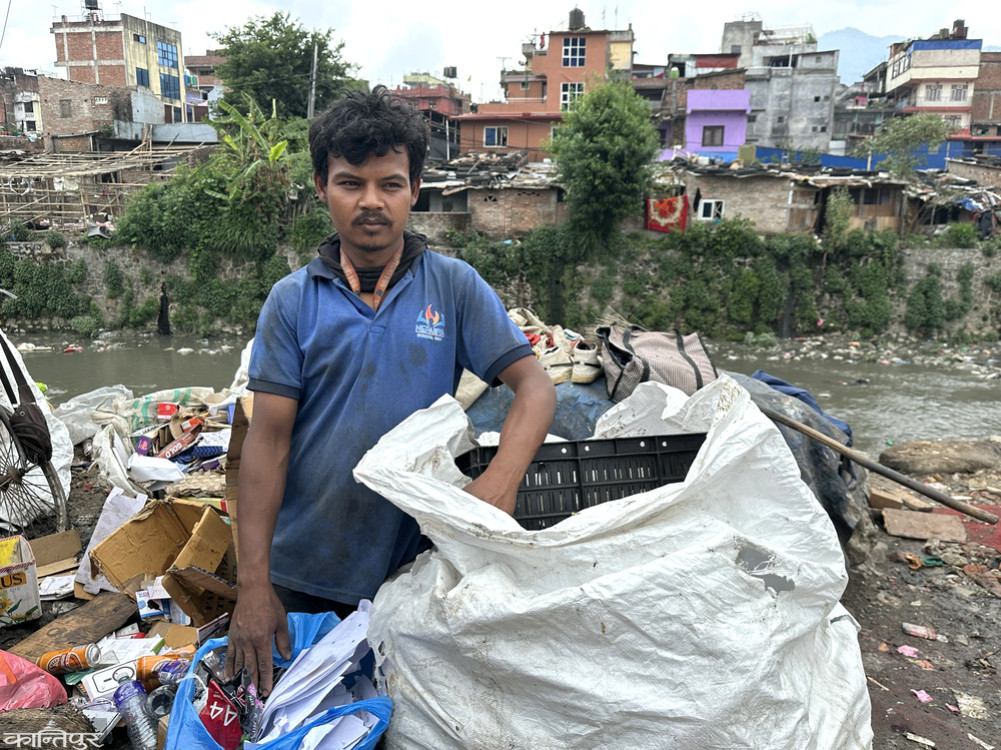
Another character who is working hard from morning to evening in his own country to run a family is Deepak Bhujel.
28-year-old Bhujel Gongabu is seen sorting out biodegradable and non-biodegradable waste on the side of the road near the new bus park. He lives in Sarlahi New Road-2 and has been working in a private organization for the past 7 years. He starts at 6 am every day and goes to different places in wards 16 to 26 of Kathmandu Metropolitan City to sort out waste. He is accompanied by 3-4 other friends. Deepak feels that every job is the same. However, he said that he feels uncomfortable when he has to go into the garbage pit every day. ‘All jobs are the same. I have been able to support my family with the money I earn while living here. I feel happy,’ he said, ‘but I have to work in the garbage that is being thrown away every day. It is difficult. Without doing that, the house cannot function.’
Deepak lives in Dharmasthali, Kathmandu with his wife and two daughters. He has a 9-year-old and 3-year-old daughter. He said that the salary he receives every month makes it difficult to support his family. ‘Inflation has increased rapidly.’ He said, ‘I can only afford to pay for the rent, my daughter’s school fees and rations.’ He said, ‘Sometimes I don’t have any money left for rations. I look for loans, sometimes I bring the rest to the place where I buy things. I pay when I get the money.’
Deepak says that the high prices have made it difficult. ‘I can’t touch anything now. Now I dream of living in Nepal with my family and eating whatever I want.’ He said, ‘But with the rising inflation, it seems like there is no other option but to go to the Gulf.’
Although Deepak does not know much about Labor Day, he says that he wants all work to be respected and that the youth can get a job according to their wishes in their own country. ‘I want a good job in my own country. I want the price to come down, and I want to be able to eat two meals a day with my family, that’s all I need,’ he said.
000
Near Dharahara in Sundhara, Kathmandu, 38-year-old Goma Neupane was walking with small and large Nepali flags in her hands and a black bag on her shoulder. She has been earning money by selling flags for a year. Goma, who lives in Nardevi-5, Kailali, has a life full of loss and struggle.
Goma, who lost her mother when she was 5, lost her husband last December. She says that life has been very difficult after the death of her 40-year-old husband. Goma came to Kathmandu 2 years ago on her husband's advice for the future of her children. She has two daughters and a son. One daughter is 18 years old and is just appearing for her Plus Two exams. Another daughter, 15 years old, has passed her SEE exams. Her 12-year-old son is studying in class 6. Till Mangsir last year, the husband and wife's earnings were barely enough to support the family. The money she earned from diving was enough to cover ration expenses. The money her husband earned was enough to pay her children's school fees. 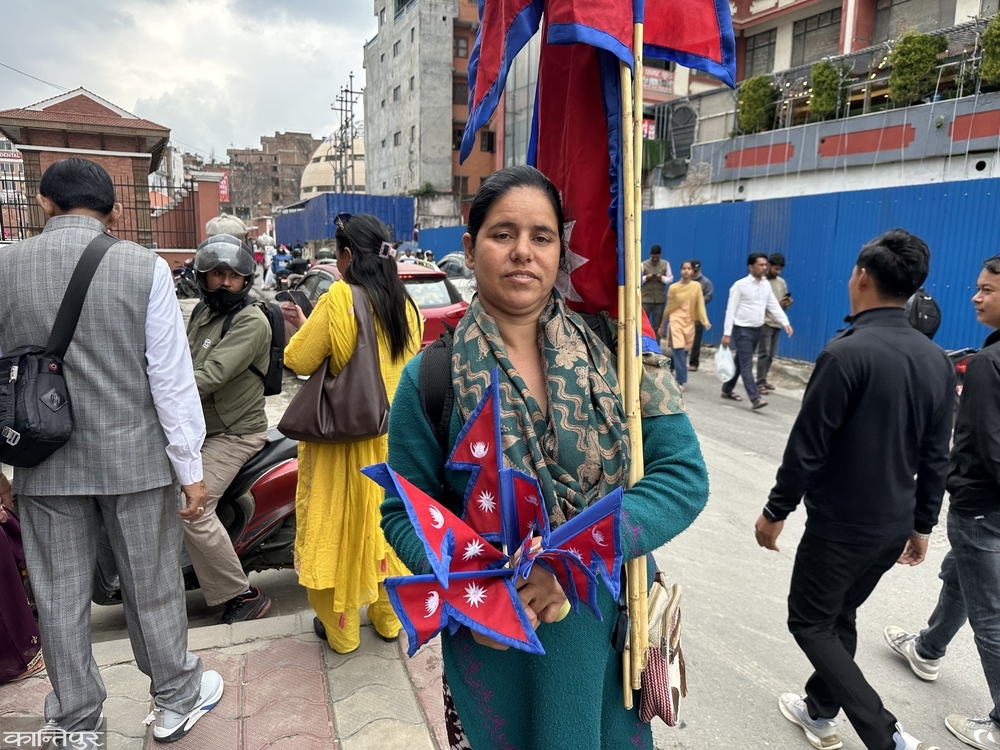
Goma's husband was a carpet merchant. He would bring goods by investing 7 to 8 lakhs at a time. He would travel from village to village with carpets and do business. On 25th Mangsir, while he was going to sell goods, he suddenly fainted. He was taken to the hospital but did not regain consciousness. He was brought to Kathmandu and kept on a ventilator for 22 days. He spent 1 million rupees hoping to regain consciousness, but he did not wake up. On December 15, the hospital declared him dead. ‘The light of my life went out from that day,’ she said. ‘What happened to my husband all of a sudden?’ The doctor had said that it was a disease that affects 2 out of 100,000 people.’
Goma was repeatedly wiping away tears from her eyes. Her income is not what it used to be. She takes 20 flags, big and small, and sends her children to school at around 11 am. ‘Earlier, it was a business. Now, it’s not so much. How many days it takes to sell 20 flags. I don’t know,’ she said.
She says it’s very difficult now. ‘I have to pay 8,000 rupees a month for the room rent.’ There are debts for the children's school fees, ration expenses, and her husband's treatment,' she said, 'He also has debts for buying a carpet. The cost of living has increased dramatically. Everything in life has come at once.' She says that it is difficult to earn even 15,000 rupees a month. 'You have to walk around carrying the flag. There is no sales. It seems that you would have earned money if you had done other work.' She says that she thought of going to the village after not being able to meet the expenses of Kathmandu. 'I can't do it here, now they don't listen to my children telling me to go to the village. Everyone from the village comes to Kathmandu to study. They say we will go to the village,' she said, 'One daughter says she will study B.A. Nursing. It is getting expensive. I have said I can't.' I can't think of anything .'
She hopes that if she could educate her children well, they would be able to earn and pay off the loan in a few years . 'I can't do anything now . It is said that children earn and pay off the loan .' Goma also said that she did not know anything about Labor Day . She also said that she wanted inflation to come down like everyone else .
000
Public transport runs in various places in Kathmandu from dawn to dusk . The story of the worker who tries to support his family by driving from dawn to dusk is no different from that of other professions .
With comparatively low income and the high cost of living in the city, most of the time of the driver is spent on the road. They spend their time from dawn to late at night taking common people to their destinations . One of them is Sonam Tamang . Mulpani, a microbus driver on the Jadibuti route. Tamang, 30, has been working as a driver for 10 years. Sonam says he is proud of his work. However, he is saddened by the fact that he does not earn as much as he used to. ‘Earlier, there was no place for a person to stand.’ Now, even with just two people, he has to do the same thing,’ he said. ‘What can we do, people are no longer there. We cannot just drive. We have to drive when our turn comes.’ 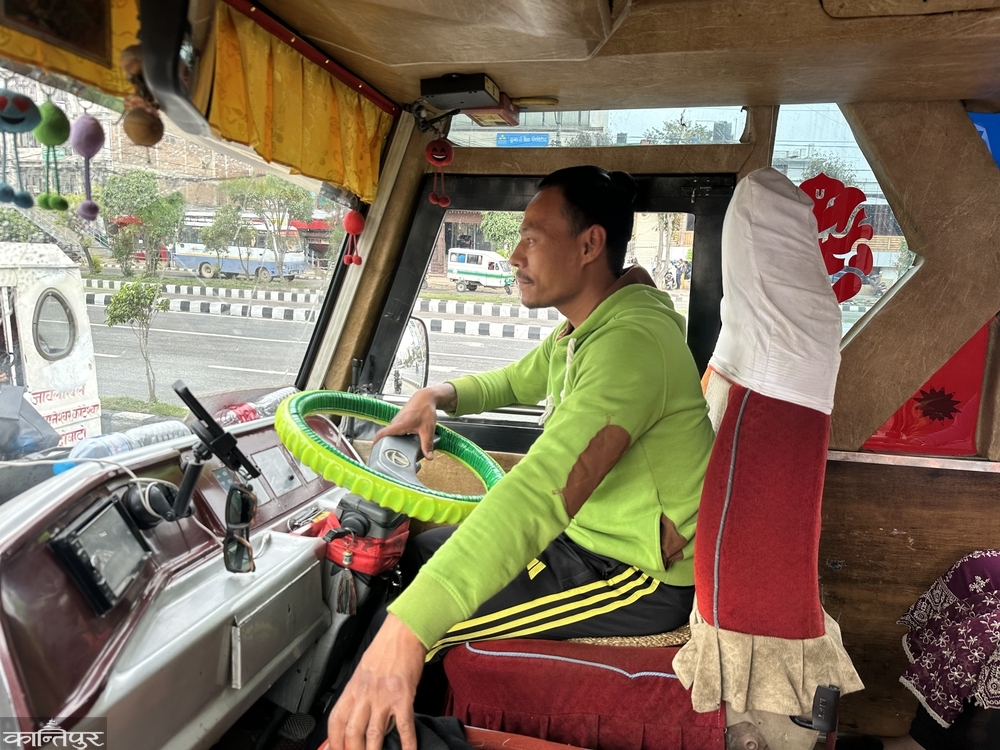
Sonam says that it is difficult to raise money to buy diesel. ‘The price of diesel and petrol has increased a lot. Income has decreased even more where it should have increased. It has become very difficult.’ He said that due to low income, it is difficult to raise money to pay the money to the moneylender. ‘Now, the little money that we have can be used to buy diesel.’ "We have to pay Rs 11,000 a month to the committee," he said, "and it's not enough to pay the money to the moneylender and even for our own allowance." Sonam also says that she wants the price to go down like everyone else.
000
The co-driver of the car driven by Sonam was his wife Sushila. Sushila used to work as a co-driver in Nepal Yatayat. She became a co-driver in Sonam's car for a day when there were no passengers in Nepal Yatayat. Sushila, 31, has been working in Nepal Yatayat for 2 years. 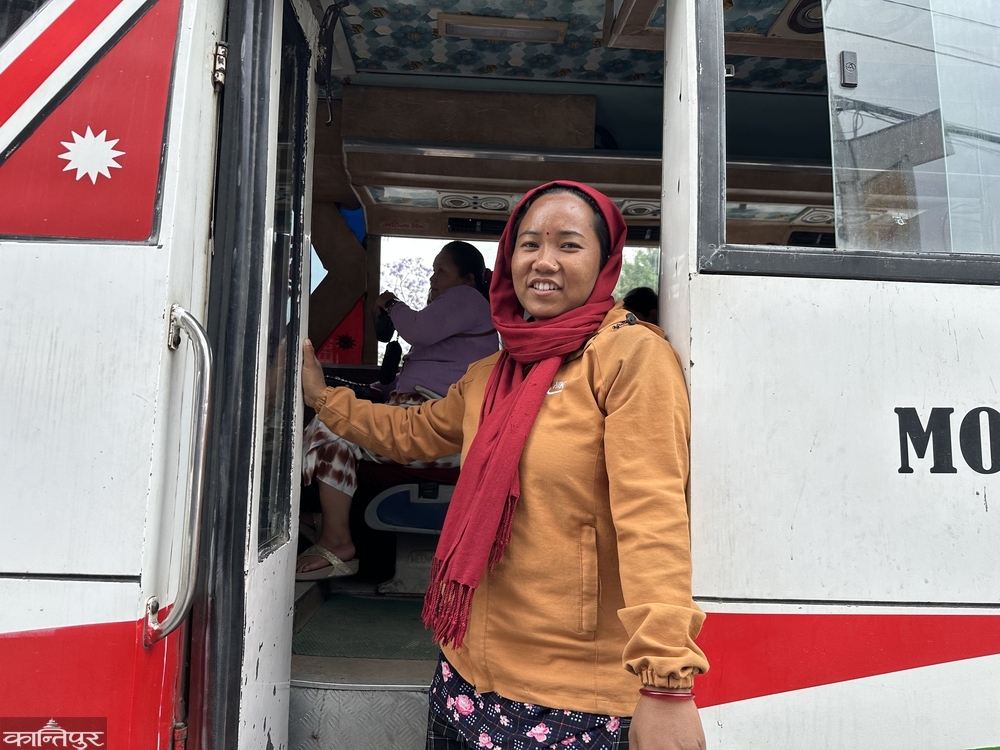
Sushila, who hails from Kavre, came to Kathmandu 12 years ago. They have three daughters. Sushila says that they both manage their household with the money they earn. She says, "It's so expensive. No matter how much they earn, it's not enough." Ration expenses, room rent, and educating their daughters are all that the two of them earn.'
They had also bought their own car. Sushila said that after the car she bought with the intention of making a profit turned into a loss, she sold it and became a co-driver in someone else's car. Like others, Sushila also does not know that today is Labor Day. She says, 'My daughters say they will study as much as they want. I want to teach them as much as they want. If I can do this much, it will be enough.' She is worried about when the rising cost of living will be controlled and when will daily life be easier.