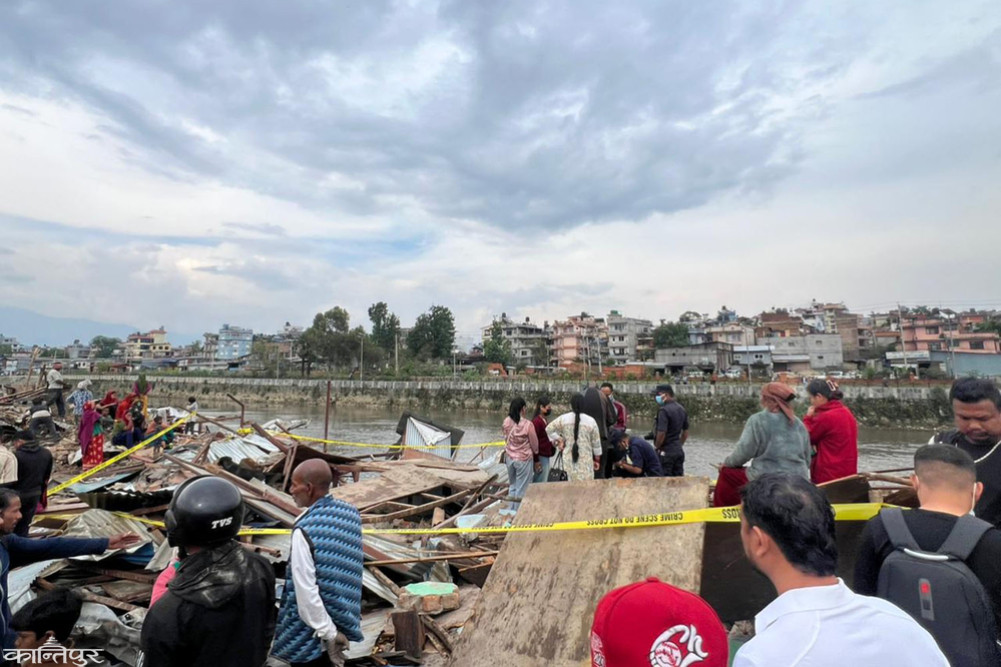
Indra Bahadur Rai, a resident of the Sukumvasi settlement, was walking around on Friday morning, saying, ”How can you watch a bulldozer demolish your house!” A short time later, he was found floating in a nearby river.
We use Google Cloud Translation Services. Google requires we provide the following disclaimer relating to use of this service:
This service may contain translations powered by Google. Google disclaims all warranties related to the translations, expressed or implied, including any warranties of accuracy, reliability, and any implied warranties of merchantability, fitness for a particular purpose, and noninfringement.
The sky over Kathmandu had been hazy since Friday morning, and it was raining heavily. Breaking through the gloomy weather, a bulldozer entered the slums of Balkhu at exactly 7 am with a loud noise. The huts started collapsing one after another. A stampede broke out in the slums. While the state bulldozer was displacing the residents of the slums, the Bagmati-Balkhu River was flowing near the same slum, hiding a disturbing secret.
Santosh Tamang was one of the displaced people who was collecting the debris and scattered belongings of the houses destroyed by the bulldozer. While he was sorting out the belongings of his destroyed house, his eyes suddenly fell on the nearby river. Something black in the murky water was floating.
‘At first, I thought it was a pile of black plastic garbage, it is normal for garbage to flow in the rivers of Kathmandu,’ Tamang told Kantipur, ‘But, the object slowly rolled over in the water. After it rolled over, a hand came out. And then I felt like I had fallen from a cliff, it was a man!’
After seeing the man floating in the river, Santosh quickly shouted and informed the locals and the police stationed there. The police team that had arrived to provide security for the displacement of the settlement and control the riot immediately reached the river bank. With the help of the locals, the police brought the body to the bank and placed it on the rubble of the recently demolished house. The man was already out of breath.
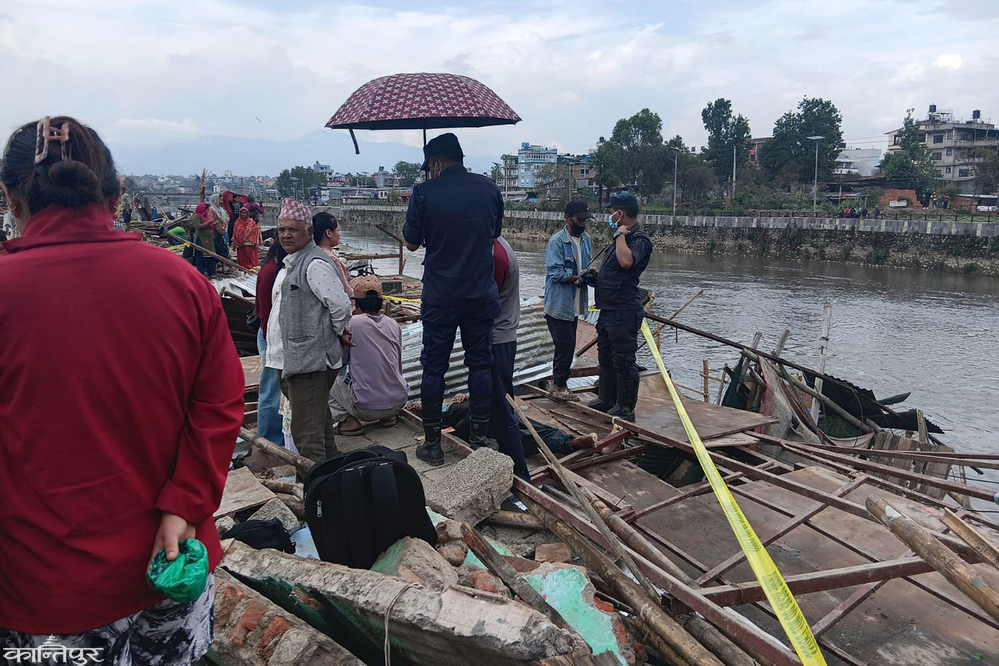
‘Does anyone know him? Is there any relative here?’ The police asked the crowd before taking the document. No one could recognize the person. It was another big shock for the locals who were in fear of the bulldozer and the pain of losing their homes.
Journalist Urmila Gwama Tharu had arrived at the scene to report. She saw the tragic scene with her own eyes. ‘When I reached the scene, there were only police and a few locals. The body was placed next to the collapsed huts. The police were asking if there was anyone who could identify the body,’ Tharu said. ‘After a while, a young man came crying through the crowd, saying, ‘I am your son.’ Then the atmosphere became even more shocking.’
000
The deceased was 61-year-old Indra Bahadur Rai . His life was spent carrying a heavy load on the streets and alleys of Kathmandu. He had entered the Kathmandu Valley from the hilly region of Khotang in search of a better future and family happiness. If we are to believe the statements of his neighbors, it had been more than two decades since he started struggling in Kathmandu. Later, he and his family started living in the slums of Balkhu.
Indra Bahadur's workplace was the Balkhu fruit market. He earned his living by carrying hundreds of kilos of fruit crates on his back in that market every day. According to Indra Bahadur's neighbor, 50-year-old Prajwal Limbu, he was extremely hardworking. 'He used to work as a heavy loader in this fruit market.' We all respectfully called him Rai Dai,' Limbu said, 'His shoulders and shoulders supported the family.'
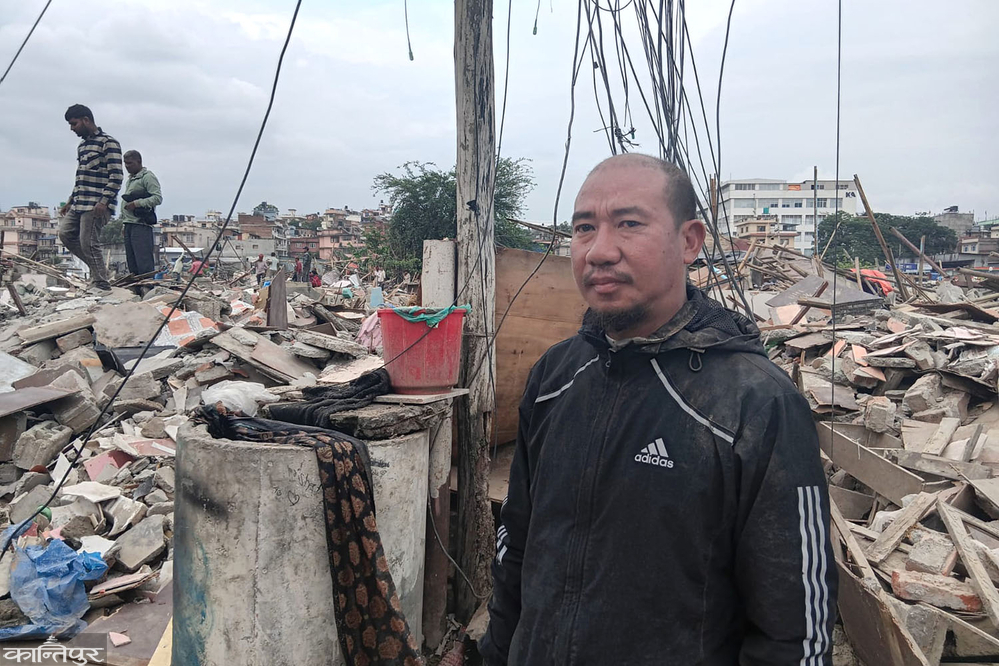
Indra Bahadur has four daughters and a son. He raised his five children in a shack in a slum in an expensive city like Kathmandu. ‘Rai Dai lived near our house,’ said his neighbor Limbu. ‘He raised his children here, carrying a heavy load of water. His blood and sweat were connected to this slum and the fruit market.’
000
The shack that Indra Bahadur considered the safest place in his life was sure to be run over by a state bulldozer on Friday. Even though the notice to evacuate the slum had been given in advance, the pain of his years of residence being turned into mud in an instant had already eaten away at Indra Bahadur.
His wife Sarita Rai, who was found at the scene, was distraught with grief. Sarita, who stood near the rubble with her face wet with tears, was not in a position to speak much. She said, breaking down, ‘He was worried since morning after the dozer started working on the house. He had been walking around wildly since morning. Now...’
The 61-year-old man did not have the strength to see the small shelter he had built with his life’s hard work and sweat collapse before his own eyes. According to local Prajwal Limbu, Indra Bahadur had been extremely stressed since Friday morning. ‘How can I watch my house being demolished!’ He had been walking around wildly in the settlement saying.
Another local who was found at the scene narrated a heartbreaking scene of ‘Rai Dai’s’ final state, ‘He had been walking wildly since morning, carrying a heavy bag under his arm. He had only one thing on his face – I cannot watch my house being demolished.’
Since he had always been in the habit of drinking alcohol, the locals did not take his deranged condition seriously. ‘We didn’t care much because the old man was drinking, but it was written to see this,’ the neighbor said regretfully.
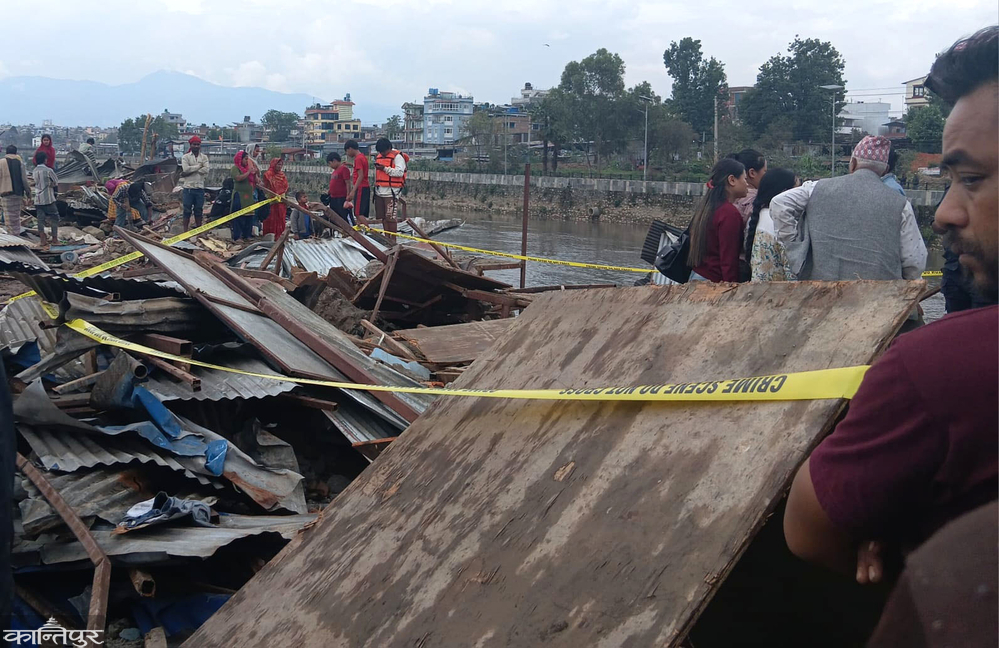
Various speculations were being made at the scene about how Indra Bahadur died. No one has been able to say exactly what happened in the river that noisy morning when it was raining and the dozer was running. Some locals who met at the scene have claimed that he jumped into the river after not being able to bear the pain of his house collapsing. ‘It was raining in the morning, that’s when he jumped.’ We saw it from here,’ a woman claimed.
Some locals have also assessed that he fell or fell into the river. ‘He may have slipped and fallen while running to the riverbank due to the dozer’s rush or stress,’ another local said.
The District Police Range Kathmandu has said that it is taking the incident seriously and is investigating further. ‘A police team found him dead after seeing him floating in the river,’ Kathmandu Police said, ‘After the incident report and post-mortem examination, the body has been sent to Tribhuvan University Teaching Hospital (Maharajgunj) for a post-mortem to determine the exact cause of death.’
The real cause of Indra Bahadur Rai’s death will be revealed only after the post-mortem report and a detailed police investigation. ‘Whatever the reason, one truth is that when a dozer is used in the name of state development and urban beautification, the lifeline of a poor citizen who was serving this city by carrying a heavy load has been snapped,’ said a local.
Indra Bahadur Rai, who was building the future of his five children on the basis of Namlo, will never be seen carrying a heavy load in the Balkhu fruit market. Not only will his children have a collapsed house, but the emptiness of his fallen father will forever remain on the banks of the Balkhu River.