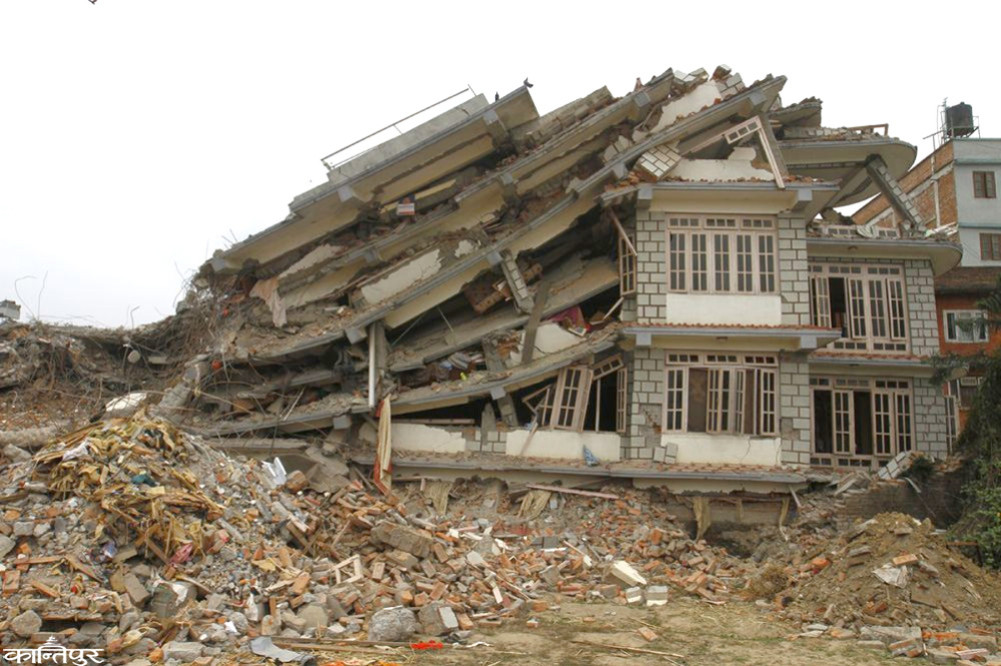
Private homes, schools, archaeological buildings, and various government buildings destroyed by the earthquake are in the process of being reconstructed.
We use Google Cloud Translation Services. Google requires we provide the following disclaimer relating to use of this service:
This service may contain translations powered by Google. Google disclaims all warranties related to the translations, expressed or implied, including any warranties of accuracy, reliability, and any implied warranties of merchantability, fitness for a particular purpose, and noninfringement.
Even if you try to forget, you can't forget Baisakh 12. Every year, Baisakh 12 Nepali society returns to the past. The memory of the 2072 BS earthquake once jolts you.
Even after a decade since the earthquake, the wounds have not healed. In the streets of the capital, on the slopes of the hilly villages, the destroyed houses have still not been rebuilt. Where more memories than houses were destroyed. Even after a decade, Nepalis are still waiting for reconstruction.
The reconstruction of private houses, schools, archaeological buildings and various government buildings destroyed by the earthquake is in progress. On Saturday, Baisakh 12, 2072 BS at 11:56 am, a 7.6 Richter scale earthquake with its epicenter in Barpak, Gorkha, 8,979 people lost their lives. 22,309 were injured in the earthquake.
The earthquake caused complete damage to about 1 million private homes, 7,553 schools, 49,681 classrooms, 544 health facilities, and partial damage to 653 health facilities.
Similarly, 415 government buildings, 920 cultural heritage sites, including 170 World Heritage Sites, and 383 buildings of security agencies were damaged. 3,212 water supply structures, 53 roads, and 299 human settlements were damaged.
The Implementation Unit (Buildings and Housing) under the Department of Urban Development and Building Construction and its subordinate bodies have also made public the details of the projects executed. According to the unit's engineer, Kishore Bikram Shahi, out of 835,185 beneficiaries identified for private housing reconstruction, 834,267 have received the first installment.
Of those who received the first installment, 770,774 (92.45) have received the second installment and 744,045 (89.25) have received the third installment, he said. Although the unit has set a target of completing 99 percent of the work by this year, only about 89 percent of the reconstruction work has been completed.
The unit has also clarified the reason for not being able to fully proceed with the payment process under the private housing reconstruction. According to the unit chief, Jhapar Singh Bishwakarma, the payment process remained incomplete as all the beneficiaries identified in the initial phase did not submit their applications to the concerned government bodies within the stipulated time.
'Beneficiaries who applied for the completion of private housing construction in our office by mid-Ashar 2079 have been paid,' he said, 'There was no problem in the case of service recipients who submitted their applications within the stipulated period. But since some beneficiaries have not contacted the district office by that period, it has not been possible to pay them all.'
According to Bishwakarma, the payment process for some of the beneficiaries who were initially registered has not been contacted yet. In addition, Bishwakarma said that the reconstruction work has also been delayed due to problems in land acquisition in some places under the integrated settlement construction plan.
Although the government has tried to accelerate the reconstruction, implementation is being delayed due to challenges such as administrative procedures, beneficiary participation, and land management.
Although the government has prioritized post-earthquake reconstruction, the unit has stated that private housing construction work is yet to be completed due to such challenges at the implementation level.
The unit has stated that the private housing construction work has not been completed with the Rs 3 lakh grant provided by the government and the general public who do not have the capacity to invest further has also started construction work late.
According to the unit, the number of government buildings that were partially damaged and repaired after the earthquake in various districts is 253. The number of models constructed to operate government offices after the earthquake in various districts is 288.
The number of community buildings built for temporary residence in 10 different districts after the earthquake has been constructed for 756 families, of which 50 (the rest are being used for various purposes) has been reported by the unit.
The number of government buildings completed with the assistance of the government and the Asian Development Bank is 151. Out of a total of 11 Rana-era buildings, eight are completed and three are undergoing strengthening work. The number of archaeological heritage projects being protected and reconstructed with the assistance of India is 28.
Similarly, there are 12 projects under construction, while 97 projects have been completed in various districts towards integrated settlement development. 1,126 health buildings have been constructed after the earthquake.
The 62nd Annual Report of the Auditor General stated that 31 districts, including 14 that were most affected by the 2072 BS earthquake and 17 that were least affected, were the project areas for the sustainable and planned reconstruction of earthquake-damaged structures and the rehabilitation and relocation of displaced persons and families. The
report pointed out that the sustainable and planned reconstruction of earthquake-damaged structures and the rehabilitation and relocation of displaced persons were not effective. The
report states, 'A total of Rs. 231.61 billion has been spent on private housing reconstruction with agreements signed with 834,821 people and Rs. 1.74 billion.31 million has been spent on strengthening 33,905 people, totaling Rs. 233.35 billion.'
Stating that by mid-Asad 2081, the first installment of 558, the second installment of 375, the third installment of 1,548 beneficiaries towards reconstruction and the second and final installment of 1,072 beneficiaries towards strengthening are yet to be paid, the report has suggested that the beneficiaries who have not received the first, second and final installments after the grant agreement should be monitored to ensure that the grant money is utilized properly.
Experts in the infrastructure sector say that policy uncertainty, the role of construction entrepreneurs and the financial capacity of beneficiaries have also been the main obstacles in the reconstruction after the earthquake. Gajendra Thapaliya, an expert in this field, said that due to the lack of policy clarity on 'to reconstruct or not to reconstruct', there has been confusion in the implementation from the beginning, which has affected the overall process. 'Some did not proceed with the construction work even after receiving the installment money, and the problem has also been compounded by the tendency not to come to collect the money on time,' he said.
He said that the increasing construction costs and the weak financial capacity of many beneficiaries were also other main reasons for the delay in reconstruction.
Although more than Rs 400 billion was announced at the donor conference organized to raise funds for post-earthquake reconstruction, the support as announced was not received. The Gorkha earthquake caused extensive damage in 14 districts including Okhaldhunga, Dolakha, Ramechhap, Sindhupalchowk, Kavrepalanchowk, Sindhuli, Bhaktapur, Lalitpur, Kathmandu, Rasuwa, Nuwakot, Dhading, Gorkha and Makawanpur.
Seismic risk persists
Experts have said that despite the 2072 earthquake teaching many lessons, Nepal is still not free from seismic risk. According to Dr. Lokvijay Adhikari, Chief of the National Seismology and Research Center under the Department of Mines and Geology, despite some improvements in the decade after the earthquake, there is still a lack of preparedness and public awareness. 'The 2072 BS earthquake taught us a lot about what to do, what not to do, and how to stay safe,' he said, 'but I worry that even with so much human loss, we will forget again.'
The country is at risk of earthquakes. He said that the seismic risk is especially high from Kathmandu to the Chure region. After the earthquake, the building code of conduct was implemented, awareness has increased to strengthen the structure, and improvements have been seen in some places, but the standards are still not fully followed.
'Although the standards have been implemented in government buildings, implementation at the private and local levels is still not complete,' he said, 'Awareness has increased among the public, but it is not enough.'
Dr. Adhikari also expressed concern about the tendency for public awareness about earthquake risk to be focused only on limited days. 'We remember only on days like Baisakh 12, but the risk is always there,' he said. According to Adhikari, the main weaknesses are the lack of earthquake education in the curriculum, lack of regular practice, and ineffective implementation of preparedness programs. "The fact that earthquakes are not happening now does not mean that the risk has decreased, but rather that the risk is always there," he said.