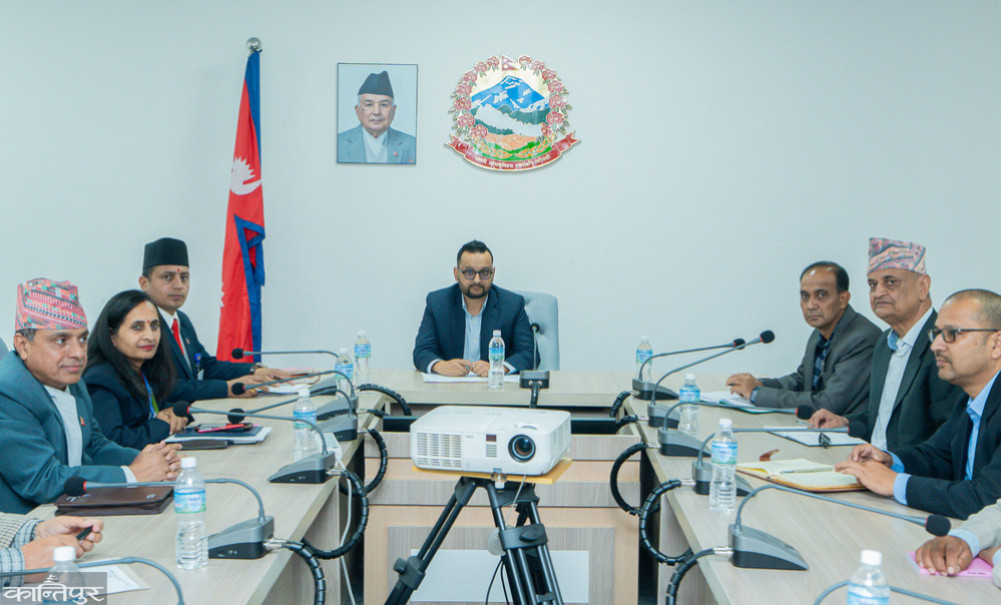
Only the National Janamorcha and the LOSPA submitted their suggestions within the one-week period set by the task force, while the rest are still under discussion.
We use Google Cloud Translation Services. Google requires we provide the following disclaimer relating to use of this service:
This service may contain translations powered by Google. Google disclaims all warranties related to the translations, expressed or implied, including any warranties of accuracy, reliability, and any implied warranties of merchantability, fitness for a particular purpose, and noninfringement.
Only two political parties have submitted written suggestions to the government-formed ‘Task Force to Prepare a Debate Paper on the Constitutional Amendment’. Other political parties are in discussions for suggestions.
The task force had sent a letter to nine parties on 30 Chaitra asking them to provide the issues to be included in the constitutional amendment within a week. According to task force member-secretary Leeladhar Subedi, only the Rastriya Janamorcha and the Loktantrik Samajwadi Party (LOSP) have submitted suggestions so far.
‘We had asked the nine parties in the federal parliament for suggestions on the constitutional amendment,’ Subedi said. ‘The major political parties have not submitted their suggestions. When we contacted them, they informed us that they are in the process of preparing it.’ According to him, the Congress has informed that it has formed an expert committee on its own to amend the constitution. The Congress is ready to make suggestions after its report.
The task force has also prepared a plan to prepare a discussion paper by incorporating the views of experts and other stakeholders on the issue of constitutional amendment. The task force has also made a plan to prepare a debate paper on the constitutional amendment by including the opinions of experts and other stakeholders. ‘It seemed that it would take some time for suggestions to come from political parties. We are currently preparing a basis paper by incorporating the views of stakeholders and experts,' said Subedi, member secretary of the task force.
The task force includes Mohanlal Acharya from the Rashtriya Swayamsevak Sangh (RSS), Bhishmanath Adhikari from the UML, Dev Prasad Gurung from the NCP, Gyan Bahadur Shahi from the RPP, and Manoj Bhatta from the Janamorcha. Similarly, Dhruvraj Rai from the Shram Sanskriti Party, Surendra Kumar Jha from the Janata Samajwadi Party Nepal, and Abhash Labh from the LSP are members.
UML leader Adhikari, who is in the task force, said that they are in discussions within the party. He said that since the UML has already raised the agenda of constitutional amendment, they are prepared to discuss it and provide the topics. Gurung of the NCP said that his party has not received the letter sent by the secretariat of the task force.
‘It was said that a letter will be sent to the first meeting of the task force, please provide written suggestions,’ he said, ‘but the party has not received the letter yet.’ He said that after receiving the letter, discussions will be held within the party and the commitments made in the manifesto will be submitted in writing.
Parliamentary party leader Gyan Bahadur Shahi, who is a member of the task force on behalf of the RPP, said that discussions have been held within the party on this issue and it will be submitted within a day or two. ‘Our agenda is clear – abolishing the provincial structure, creating a Hindu nation and bringing in a king. There is also an agenda to abolish bodies that recruit political workers such as the Constitutional Council and the Judicial Council. There are also issues of good governance, we will submit all of them to the task force.’
Point number 4 of the ‘100 agendas related to governance reforms’ approved by the Council of Ministers on 13 Chaitra mentions preparing a discussion paper for amending the constitution. The task force was formed accordingly. The Rashtriya Swayamsevak Sangh (RSS) had said in its election manifesto that it would prepare a 'discussion paper' on the proposals for constitutional amendment within three months of assuming power in order to establish a national consensus.
The issues to be submitted for initial discussion by the RSS were a directly elected executive, a fully proportional parliament, a system where MPs do not have ministers, non-partisan local governments, and a reformed provincial structure. In their election manifestos, the Congress, the NCP, the Shram Sanskriti Party, and the RPP had mentioned the issue of constitutional amendment.
16-member expert committee in the Congress
Point number 4 of the '100 agendas on governance reforms' approved by the Council of Ministers on 13 Chait mentions preparing a discussion paper for amending the constitution. The Congress has formed a 16-member expert committee under the coordination of party Vice President Pushpa Bhusal to study and make suggestions on the issue of constitutional amendment. The committee includes senior advocates Radheshyam Adhikari, Harihar Dahal, Prem Bahadur Khadka, Upendra Keshari Neupane, Sher Bahadur KC, Yadunath Khanal, Gopal Krishna Ghimire, Yogendra Bahadur Adhikari, Dinesh Tripathi, Sitaram KC, and Lalit Kumar Basnet. Advocates Ran Bahadur Thebe, Sharmila Shrestha, Jhalmaya BK and Raju Katuwal are also members.
The committee is said to prepare a draft to address the problems and challenges seen in the implementation of the constitution, federalism and inclusiveness, and the promises made by the party in the Gen-G rebellion elections. The committee will also study the demands of identity and good governance and submit a blueprint for reforms to be made in the constitution.
The Nepali Congress has stated that since the constitution has been promulgated 10 years ago, it is necessary to amend it according to public sentiment and that the committee has been formed to make the constitution more dynamic without affecting basic issues such as republicanism, federalism and civil rights.
What can be the common ground?
Experts have been raising the need to amend some provisions of the constitution for a long time. They say that amendments should be made especially on issues such as the form of governance, inclusiveness, and the electoral system. There are also calls to make the Vice President the Speaker of the National Assembly.
Constitutional expert Bipin Adhikari says that it would be appropriate to move forward with the constitutional amendment by determining the common issues of all parties. He says that the parties should decide on issues such as whether the Chief Minister will be directly elected by changing the provincial structure, whether or not to establish a constitutional court in place of the constitutional bench, reducing the number of MPs in the provinces and the House of Representatives and increasing inclusion, and making the elections more proportional.
Adhikari says that the parties can also formulate a common opinion on the issues of the President's authority and the Constitutional Commission. 'It would be good if the working group took forward the discussion saying that these are the issues on which the parties have a common opinion, these are the issues in dispute,' he says.
Constitutional expert Chandrakant Gyawali also says that the parties should move forward with finding a common ground on the issue of amending the constitution. 'It would be good to take the points of disagreement to a public discussion,' he said. According to Gyawali, it would be appropriate for the parties to first form a common position on issues including provincial structure, electoral system, inclusiveness, number of MPs, and the National Assembly.