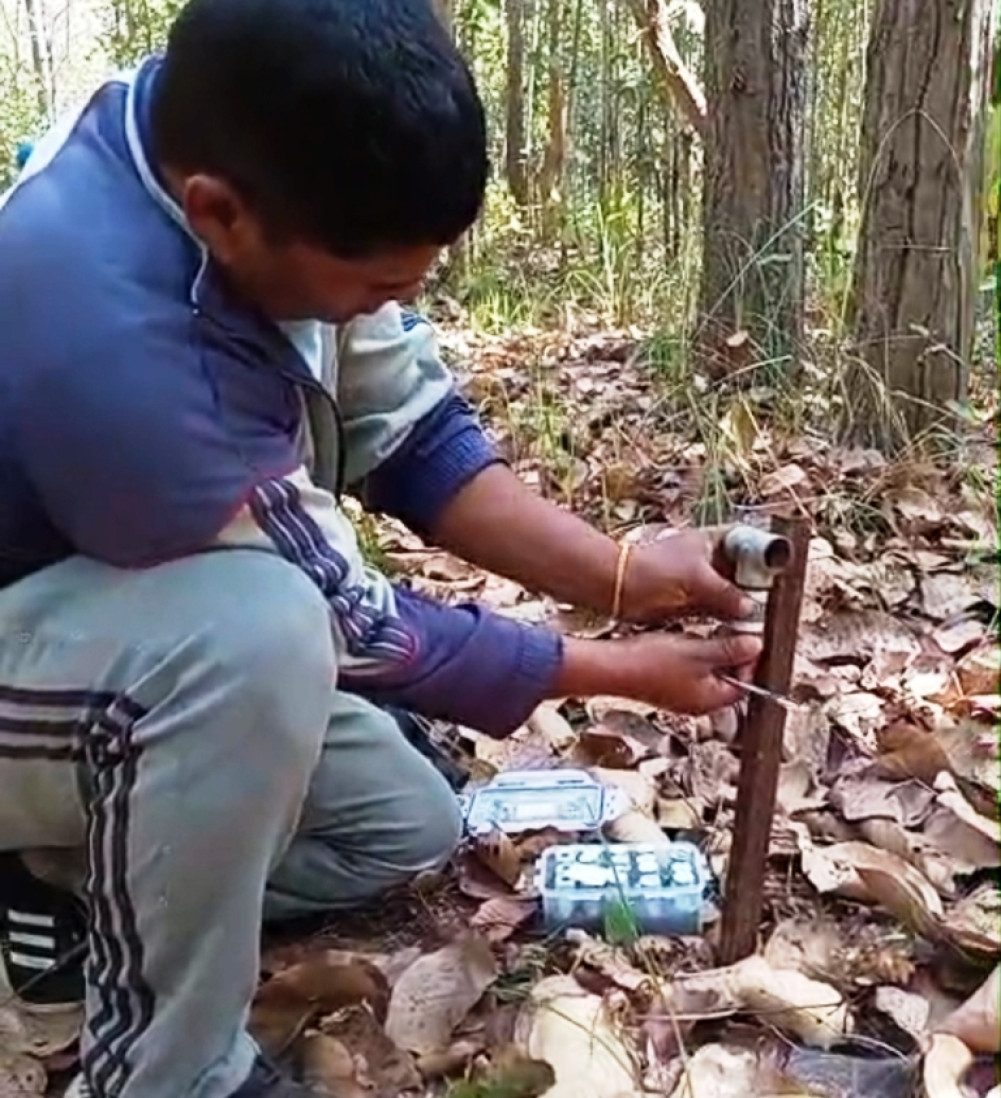
Five chemicals that smell like tiger urine are being studied in 30 locations.
We use Google Cloud Translation Services. Google requires we provide the following disclaimer relating to use of this service:
This service may contain translations powered by Google. Google disclaims all warranties related to the translations, expressed or implied, including any warranties of accuracy, reliability, and any implied warranties of merchantability, fitness for a particular purpose, and noninfringement.
To deter leopards, tigers and other wild animals from entering settlements, a trial is being conducted by placing artificially scented chemicals in the community forest on the Khata Biological Trail in Madhuban Municipality, Bardiya. After leopards and tigers attack settlements around the national park and in the buffer zone, people are dying every year, and a phased trial is being conducted to find new solutions.
The trial is being conducted with the support of the Terai Ecosystem Conservation Program and in coordination with the Division Forest and Khata Community Forest Coordination Committee. The Division Forest Office has stated that the second phase of the trial is being conducted by placing five types of chemicals that smell like tiger urine in 30 places in the community forest.
‘Tiger marks its territory by urinating.’ With that smell, another tiger will not enter that area,’ said Vijayraj Subedi, head of the Division Forest Office, Bardiya. ‘Last year, 10 types of chemicals were placed in 30 places and tested for 5 months.’ Based on the results, more tests are being conducted this time.'
According to Subedi, this is the first time in Nepal that the 'chemical' brought from South Africa has been tested. If the test is successful, leopards and tigers can be stopped from entering the settlement. Subedi says that since the 'chemical' will be placed in pipes, it will not affect other biological areas.
Hari Gurung, chairman of the Khata Community Forest Coordination Committee, said that the chemical was being tested in 30 places in the community forest near the settlement on 14 Chaitra. A camera has been placed along with the 'chemical' for the four-month study. The wildlife will be studied by looking at the camera.
In recent years, leopard attacks have increased in Bardiya. Due to the increased fear of leopards, locals are afraid to go to the fields during the day. Shiv Bahadur KC, information officer at the Division Forest Office, said that 11 people have died due to wild animal attacks since last Shrawan. ‘This year, 8 people have died from leopard attacks, 1 from elephant attacks and 2 from tiger attacks,’ he said, ‘16 people were injured in leopard attacks.’
In the last fiscal year, 4 people died in leopard attacks across the district. 13 were injured. According to the data of the Division Forest Office, 2 people died and 2 were injured in leopard attacks in the district in 2078/79.
Division Chief Subedi informed that due to the ‘chemicals’, even wild animals that are afraid of tigers and leopards do not come close. According to him, in the tests conducted last year, it was found that leopards and wild boars ran away from a distance and tigers returned near the place where the ‘chemicals’ were kept. ‘The tests of these chemicals have been successful in South Africa,’ he said.
Here too, preparations are underway to send the chemical to the place where it was produced for a ‘report’ check after this year’s four-month trial. Subedi said that if the trial is successful, it can be kept in settlements near the forest to protect it from tigers and leopards. According to Bharat Bhatta, program manager of the Terai Land Conservation Program, Banke, once the chemical is placed in a ‘T’-shaped pipe, the smell will remain for a month. ‘If this trial is successful, the damage caused to settlements by wild animals will be reduced. Investment in structures like wire fences will also be reduced,’ he said.
The Khata Biological Trail, spread over 202 square kilometers, is bordered by Bardiya National Park and wards 4, 5 and 9 of Thakur Baba Municipality to the north. There is Barbardiya 1 to the east, Rajapur 10 to the west and India’s Katarniaghat Wildlife Sanctuary to the south.