Health, agriculture, and public life have been affected as temperatures have reached around 40 degrees in many parts of the country. Experts have advised to remain alert and take precautions.
We use Google Cloud Translation Services. Google requires we provide the following disclaimer relating to use of this service:
This service may contain translations powered by Google. Google disclaims all warranties related to the translations, expressed or implied, including any warranties of accuracy, reliability, and any implied warranties of merchantability, fitness for a particular purpose, and noninfringement.
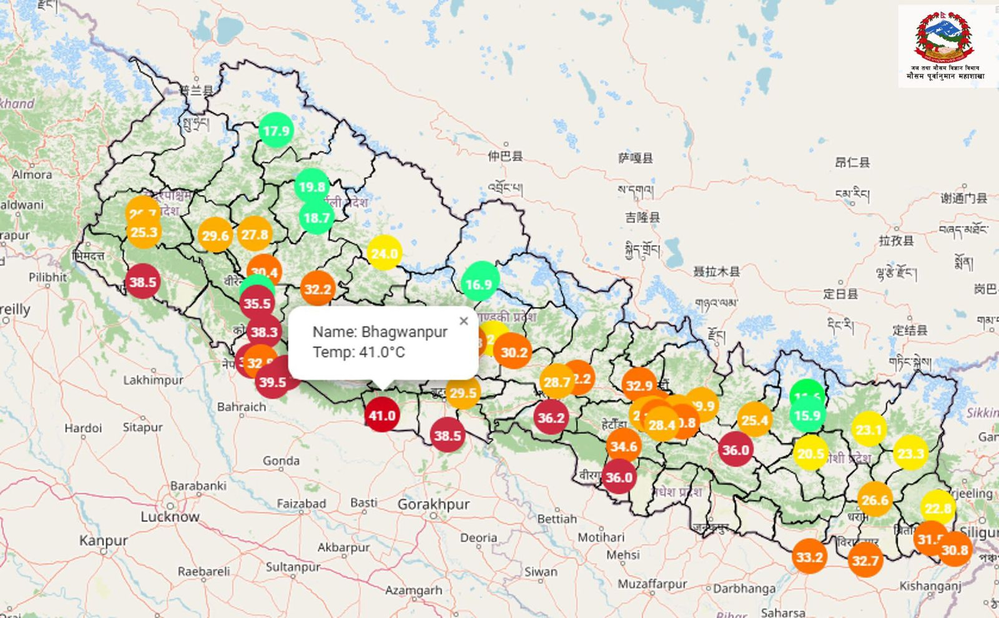
The temperature has increased in most parts of the country in the past few days. The Department of Hydrology and Meteorology has projected that there is a possibility of a heat wave in the Terai districts.
According to the data released by the department this afternoon, the temperature has reached 41 degrees Celsius in Kapilvastu and 39 degrees Celsius in Banke. The department has stated that the day is hot in the Terai areas of Madhesh Province, Bagmati, Gandaki, Lumbini and Sudurpaschim Provinces, as well as the valleys and gorges, and there is a possibility of a 'heat wave' in the western Terai areas of Sudurpaschim and Lumbini Provinces.
The department has requested to stay updated on the latest information and take necessary precautions. The department's meteorologist Sanjeev Adhikari informed that the extremely hot conditions will continue in the Terai districts, especially until Wednesday. 'There is a possibility of a heat wave, especially in the Terai, valleys and gorges, from today to Wednesday,' he said. 'However, the possibility of a heat wave is currently low in the Koshi Province as clouds are visible. There is a high possibility of heatwave, especially in the western region of Lumbini Province, Dhangadhi and other Terai districts of the Far West, Nepalgunj, Dhangadhi and other places.''
Noting that the temperature reached around 40 degrees Celsius this afternoon in Dipayal in the Far West, he said that this temperature is unusual for there. Rajendra Sharma, Senior Hydrologist at the National Disaster Risk Reduction and Management Authority, urged timely preparation and awareness as seasonal events like heatwaves are increasing with climate change.'' 'To reduce the impact of heatwaves, we have formulated a procedure and sent it to the relevant intergovernmental body for implementation. We are also holding necessary discussions for effective implementation,'' he said.
'Measures should be taken to maintain a cool environment in time, ensure access to clean and hygienic drinking water, and take special care of children, the elderly, pregnant women and the sick,'' he said. ''Similarly, it is equally important to make necessary precautions in hospitals, schools and public places.''
What are the health effects?
Public health expert Dr. Sameer Adhikari said that heat stroke can cause problems such as rapid heart rate, decreased breathing and blood pressure, severe headache, burning eyes, dizziness and fainting.
'Heat stroke can also have long-term effects, causing problems in the brain and blood system,' he said, 'Children and the elderly are most affected. Drink enough water, stay in cool shade, and avoid alcohol and smoking.'
Similarly, the Ministry of Health and Population has stated that body temperature may exceed 104 degrees Fahrenheit, and the skin may become dry, red and hot. Pediatrician Dr. Ramhari Chapagain suggested that children should be vigilant as heat stroke or extreme heat can affect their health.
The World Health Organization's 'Study on the Trends of Heat Waves in Nepal and Public Perceptions of Health Risks' has concluded that heat-related problems have increased due to climate change. According to the study, the trend of increasing temperatures has continued to increase due to climate change, rapid urbanization and air pollution. This is having a negative impact on human health as well as other sectors.
Analyzing data from 33 weather stations across the country from 1987 to 2016, the number of hot days has increased. The World Health Organization has stated that there has been a change in the pattern of summer nights, pre-monsoon and monsoon rainfall, especially in the southern part of the country. According to the study, the need to increase public awareness, expand health safety measures and strengthen adaptation strategies at the local level to deal with rising temperatures has been pointed out.
Impact on agriculture, risk of reduced production
It is stated that the increase in extreme temperatures can also affect the agriculture and animal husbandry sectors. According to agricultural expert Dilliram Sharma, excessive heat and drought can seriously affect agricultural production. Due to drought, crops in particular start to dry out, flowers fall and fruits do not grow properly, which can cause financial losses to farmers.
'If the drought hits when vegetables are flowering or fruiting, growth is stopped, and there is no good production,' he said. 'At this time, corn has already started to set seed in some places, and even if the corn sets seed, it does not become plump, so production may decrease.'
He suggested that cultivating it inside plastic tunnels (polyhouses) would help in reducing risks. Since the agriculture and animal husbandry sectors are directly affected by climate change, stakeholders say that a long-term plan is needed to reduce such risks. Experts have suggested improving irrigation management, proper provision of shade and water, paying attention to animal health and adopting climate-friendly agricultural practices during the summer.
How to avoid it?
The authority has suggested avoiding going out during the day, drinking plenty of water and fruit juice, and consuming ‘Jeevan Jal’ if sweating excessively. If you have to go out, cover your head, use an umbrella, take a cold shower, and work in the fields only in the morning or evening.
In addition, the Ministry of Health and Population has urged people not to consume alcohol, consume less caffeinated beverages (tea, coffee, soda), and avoid drinking sugary drinks.
What is heatwave?
According to the Preparedness, Action, and Rapid Response Action Plan for Extreme Heat or Heatwave, the weather conditions caused by extreme heat are called heatwaves. It is mentioned as ‘heatwaves’ in Nepal’s Federal and Provincial Disaster Risk Reduction and Management Act.
According to the Department of Hydrology and Meteorology, hot days are distinguished based on temperature during the period from Chaitra to Bhadra. If the maximum temperature reaches 90 percent of the previous 30 years, it is called a hot day. The procedure states, 'When hot days persist for three or more consecutive days, it is classified as a mild heat wave, if there are very hot days, it is classified as a moderate heat wave, and if there are extremely hot days, it is classified as an extreme heat wave.'

