Due to above-average rainfall last Chait, the number of forest fires has decreased to 79 compared to the previous year.
We use Google Cloud Translation Services. Google requires we provide the following disclaimer relating to use of this service:
This service may contain translations powered by Google. Google disclaims all warranties related to the translations, expressed or implied, including any warranties of accuracy, reliability, and any implied warranties of merchantability, fitness for a particular purpose, and noninfringement.
Every year, the month of Chaitra is at high risk of forest fires. But last Chaitra, the number of fires decreased only slightly. The pre-monsoon rainfall was above average, which is why the number of fires decreased in Chaitra compared to the same period last year.
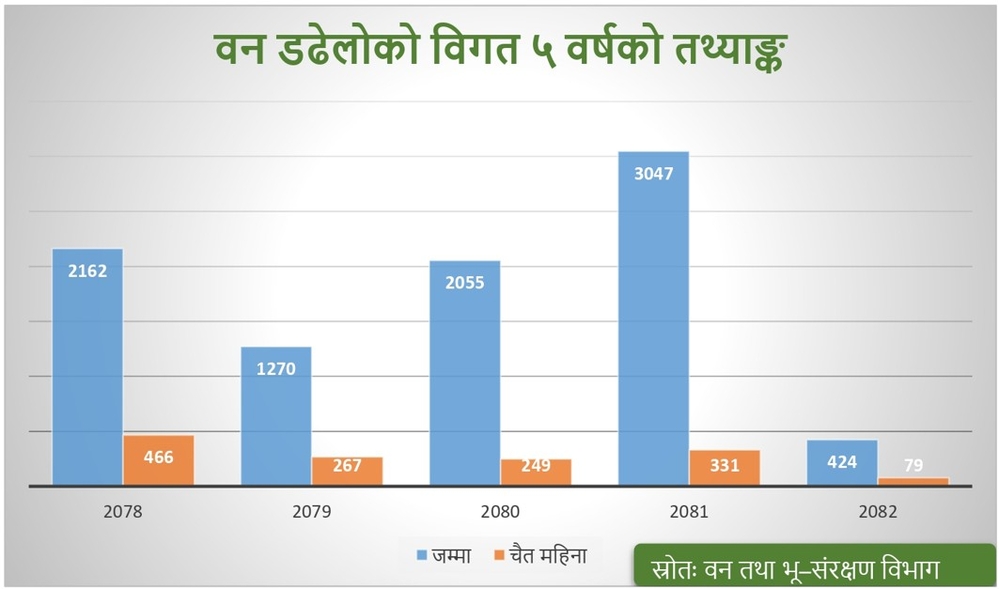
According to the Department of Forest and Soil Conservation, 466 fire incidents were registered in Chaitra 2078. This number decreased to 267 in Chaitra 2079. It increased again to 249 in Chaitra 2080 and 331 in Chaitra 2081. In Chaitra 2082, only 79 fire incidents were registered, the lowest ever.
Overall, there were 2,162 fire incidents in 2078, but it decreased to 1,270 in 2079. In 2080, It had reached 2,055 in 2018 and 3,047 in 2019. In 2019, 424 incidents were registered. Dr. Govinda Prasad Sharma, Secretary of the Ministry of Forest and Environment, said that the number of forest fires has decreased this year due to the rains before the onset of the monsoon. 'There was no major problem of forest fires this year.' However, a meeting held at the Office of the Prime Minister and the Council of Ministers on Wednesday discussed how to manage forest fires,' he said. 'Procurement of drones for forest fire control was also raised.' The meeting also decided to manage the necessary resources for the prevention and response to monsoon-related disasters from the allocated budget of the concerned ministry and to demand the insufficient resources from the Ministry of Finance.'
Monthly analysis shows that the highest number of fires occur in Baisakh. In 2018, 1,204, in 2019, 609, in 2020, 1,000,000, in 2021, 1,000,000, in 2022, 1,000,000, in 2023, 1,000,000, in 2024, 1,000,000, in 2025, 1,000,000, in 2026, 1,000,000, in 2027, 1,000,000, in 2028, 1,000,000, in 2028, 1,000,000, in 2029, 1,000,000, in 2020, 1,000,000, in 2021, 1,000,000, in 2022, 1,000,000, in 2021, 1,000,000, in 2022, 1,0 In 2007 and 2008, 1,904 incidents occurred in Baisakh alone. In Baisakh of 2008, the number of fires decreased to only 173. Data shows that a significant number of fires occur in Jestha as well.
The report on forest fires released by the Department of Forest and Soil Conservation has shown that the risk of fires has increased in recent times as an environmental challenge. According to the report, about 89 percent of the total incidents occur from Falgun to Baisakh.
Long-term data has shown 2073 as the most serious fire year. The risk of fires is high in recent years as well. A significant number of fire incidents have been recorded, especially in 2078 and 2081.
Director General of the department Dhirendra Kumar Pradhan said that the incidence of forest fires will increase due to rising temperatures, long dry periods and human causes due to climate change. 'The risk of forest fires is high due to the long winter dry period, low humidity, high temperature, wind speed, the practice of burning agricultural residues and increased human activity in the forest area,' he said.
In particular, Baisakh is seen as the most risky month, in which about 57.7 percent of the total incidents occur.
Here are the forest fires by province
From a provincial perspective, Lumbini province has been the most affected by fires in recent years. In Lumbini, which had 482 fires in 2078, this number increased to 698 by 2081. In 2082, this number has decreased to 44.
In Karnali, the number of forest fires also increased from 314 in 2078 to 575 in 2081. But in 2082, 57 forest fires were registered.
Similarly, in Sudurpaschim Province, there were 389 forest fires in 2078 and 525 in 2081, but 131 fires were registered in 2082.
In Bagmati, there were 303 forest fires in 2078 to 475 in 2081, but this number has decreased to 76 in 2082. In Gandaki, there were 249 forest fires in 2081, but this number has decreased to 35 in 2082. Similarly, in Koshi, there were 287 forest fires in 2081, but this number has decreased to 31 in 2082.
In Madhesh Province, there were 238 forest fires in the previous year, but this number has decreased to 50 in 2082.
The data shows that the highest number of fires occurred in the Far West in 2082 and the lowest in the Koshi Province. The data of the Department of Forest and Soil Conservation has recorded a high number of fire incidents, especially in 2073 BS, 2078 BS and 2081 BS.
Shanti Mahat, spokesperson for the National Disaster Risk Reduction and Management Authority under the Ministry of Home Affairs, informed that an economic loss of about Rs 917.9 million was caused due to forest fires in the five years from 2077/78 to 2081/82 BS.
Above-average rainfall even before the monsoon
Meteorologists say that due to above-average rainfall even before the onset of the monsoon, the dryness has decreased and the incidence of natural disasters such as forest fires has decreased.
According to David Dhakal, a meteorologist at the Department of Water and Meteorology, above-average rainfall has been recorded in the pre-monsoon period till Friday. 'Although there is usually about 30 percent rainfall during this period, this year there has been 44.3 percent rainfall,' he said.
Out of the 20 meteorological stations under the department, Jumla has received average rainfall, while most other places have recorded above-average rainfall. Dhakal informed that a total of 101.4 millimeters of rainfall has been recorded so far, saying that this has helped reduce the dry conditions and reduce the risk of forest fires.
According to the National Action Plan for Forest Fire Control, Preparedness and Response 2082, the risk of forest fires has also increased due to the expansion of forest areas due to lack of proper management and utilization. Based on past incidents, most forest fires appear to be caused by humans.
The action plan mentions that the causes of forest fires include the tendency to set fires for grazing (30 percent), by smokers (15 percent), by hunters (7 percent), by forest feasts, campfires, etc. (7 percent), by children playing (6 percent), by illegal woodcutters (5 percent), by encroachers (5 percent), by felling of trees (5 percent), by unknown causes (4 percent), by burning logs (4 percent), by herb collectors (3 percent), by burning logs (3 percent), and for farming (1 percent).
Overall, 64 percent of forest fires are started intentionally by people, 32 percent by negligence, and four percent by unknown causes.

