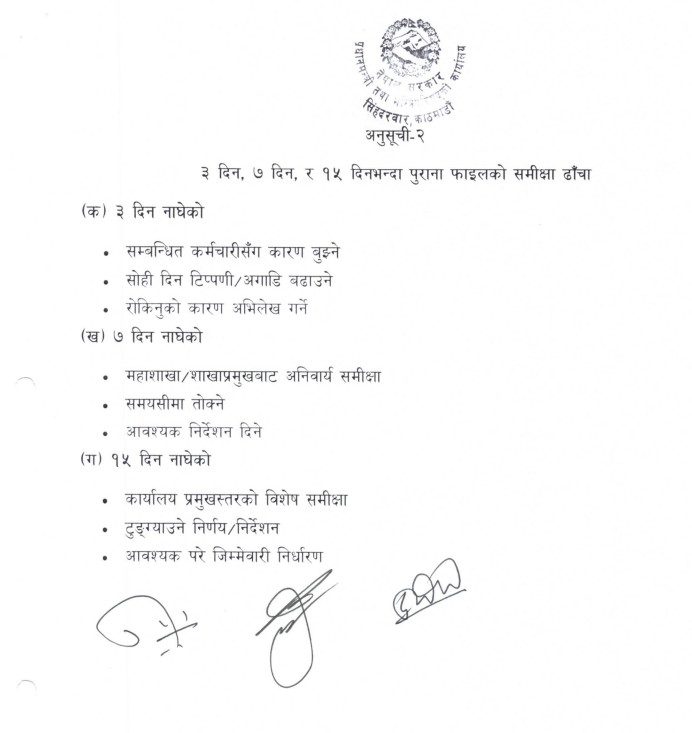
The guidelines state that if a file is held for more than seven days, the reason for the delay should be determined at the division head or office head level.
We use Google Cloud Translation Services. Google requires we provide the following disclaimer relating to use of this service:
This service may contain translations powered by Google. Google disclaims all warranties related to the translations, expressed or implied, including any warranties of accuracy, reliability, and any implied warranties of merchantability, fitness for a particular purpose, and noninfringement.
The problem of file jamming in government offices has not been resolved, causing unnecessary hassle to service recipients. From general administrative work to citizenship, recommendation, land revenue and other service processes, there have been delays.
Even general files have been stuck in the relevant branch for weeks or months. Service delivery is being affected due to staff shortage, lack of internal coordination and procedural complexity. Such delays have been weakening the trust of citizens in the government system.
The government is launching a campaign to solve the problem of file jamming in government service delivery. The government is going to launch the ‘Zero Backlog File Campaign’ so that files do not get stuck for a long time and work is done quickly. The government has already approved the guidelines-2082 regarding the campaign, which will be conducted from today until next Baisakh 7.
The Office of the Prime Minister and Council of Ministers has written to all ministries, commissions, secretariats, offices of the Chief Minister and Council of Ministers and local levels and asked them to implement the campaign and send a report.
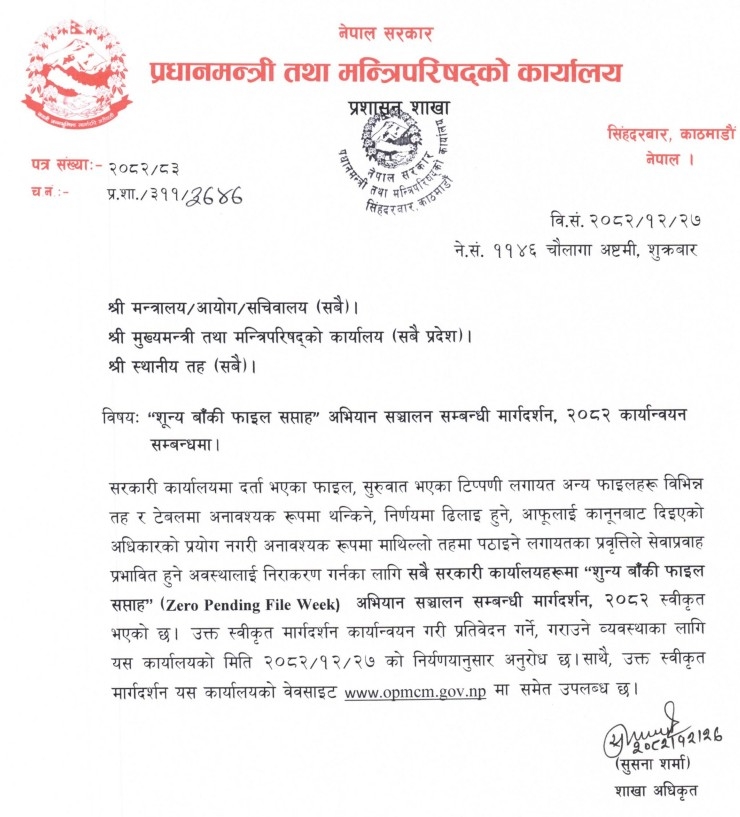
The Prime Minister's Office has stated that it is launching a campaign to immediately resolve the issue, saying that files containing comments prepared for government work are being kept at various levels.
The Prime Minister's Office spokesperson Hemraj Aryal informed that the campaign is being launched to immediately resolve the issue, especially since files containing comments prepared for government work are being kept at various levels. 'This is an issue related to good governance, even though it is now being called a week-long process, the process of reform is ongoing,' he said.
According to him, during the campaign, each file should include the registration number, comment, subject of the file, the table or responsible employee or official, the date the file was at the table level, the file number, the progress status of the file, the reason for the delay and the expected date of the decision. The guideline states that the aim is to increase speed, transparency and accountability in service delivery.
If a file is held for more than seven days, the guideline states that the head of the division or office head should review such files and find out the reason for the delay.
The guideline, made public by Branch Officer Susana Sharma on Friday on behalf of the Office of the Prime Minister and Council of Ministers, aims to discourage the tendency of sending files unnecessarily to higher levels without using the authority granted by law and create a situation where the service flow is not affected.
The guideline has a provision to automatically review any file if it is held for 7 days and 15 days. If the file is held for more than 15 days, it will have to be finalized by requesting a lump sum of documents. In cases where work is not done, it is mentioned that the file should be closed or finalized by explaining the reason.
There is a provision for a central-level or office-level coordination committee to implement the guideline. There is a provision for a zero remaining file week committee headed by the office head. The work of the heads of departments, divisions and branches has also been specified. Officials of the Prime Minister's Office have said that it is expected that once the work is finalized, the person who will be given responsibility will also be identified and the responsibility will increase.
During the campaign period, each office will have to prepare a daily report. After the campaign ends, the offices under the federal ministry will have to submit a report to the concerned ministry, the ministries to the Prime Minister's Office, the local levels to the Ministry of Federal Affairs and General Administration, and the offices under the provincial government will have to submit a report to the concerned provincial Chief Minister and Council of Ministers. The report will mention details related to pending, new files, completed files, remaining files older than 15 days, main problems and suggestions for improvement.
The most problems are in the ministries including forest, energy, land management, roads. 'There is a tendency in our ministry that a crowd of employees will gather in one room but not a single file will be decided throughout the day,' said a joint secretary of the Ministry of Federal Affairs and General Administration, 'This ministry does not need the post of six joint secretaries.' Three people are enough. A day passes without approving a file. No one talks about solving the problem.’
The secretary-level decision to finalize government files within 15 days had been made many times before. There was also a decision to send the unresolved files to the higher level with an explanation of the reasons. But effective implementation has not been possible on this or that pretext.
Officials of the Prime Minister’s Office say that the commitments made by the secretaries under the campaign to maintain good governance are often not fulfilled. ‘Many efforts have been made in the name of good governance before, but a big problem was seen in the implementation.’ This time, we expect that since the situation has changed, it will not be the same as in the past,’ say officials of the Good Governance Division of the Prime Minister’s Office.