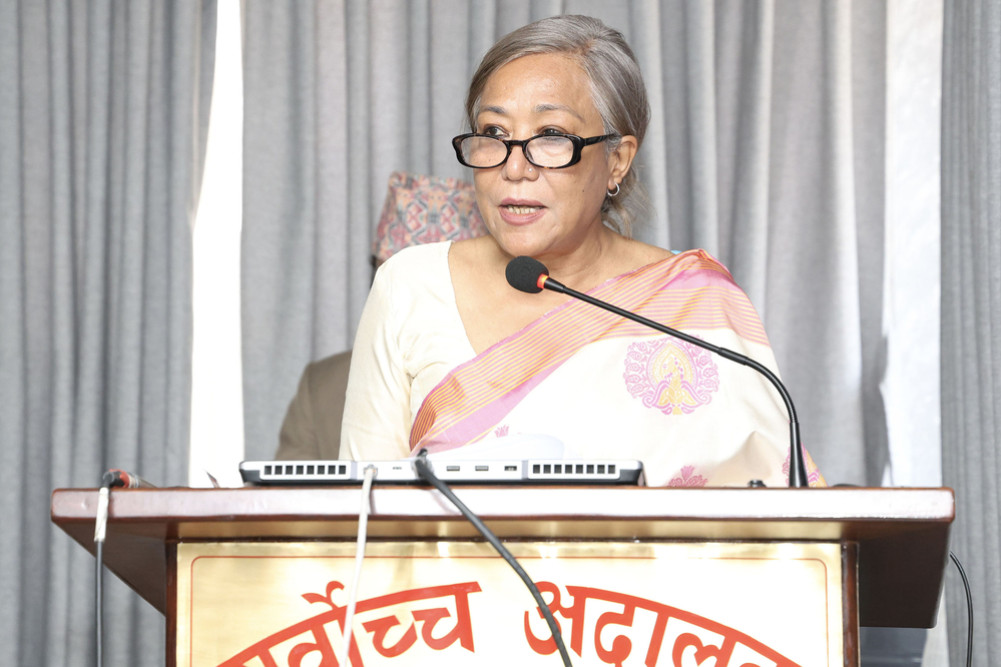
”The Constitutional Bench is the heart of the federal democratic republic, ironically! Today, this same bench is under pressure from workload and procedural delays.”
We use Google Cloud Translation Services. Google requires we provide the following disclaimer relating to use of this service:
This service may contain translations powered by Google. Google disclaims all warranties related to the translations, expressed or implied, including any warranties of accuracy, reliability, and any implied warranties of merchantability, fitness for a particular purpose, and noninfringement.
Acting Chief Justice of the Supreme Court Sapna Pradhan Malla has said that she is working to end the tradition of adjourning the hearing due to 'inability to see' or 'lack of time'.
She made it clear that she will not only dispose of cases quickly but also resolve constitutional uncertainties in a timely manner and guide the state organs. 'Respect for public opinion is paramount in a democracy, questions raised over the legitimacy of elected representatives should not remain unresolved for years,' she said. 'Therefore, the action plan will be taken forward in such a way that all election-related disputes and issues will be given priority and a final decision will be made. A decision after the validity of the term of office has expired will have no meaning.'
Malla said this while inaugurating a separate web portal related to the Constitutional Bench at a program organized at the Supreme Court today. A ‘web portal’ related to the Constitutional Bench has been launched for timely resolution of constitutional disputes, transparency and accountability. She said that the portal has been launched for strengthening the Constitutional Bench, protecting the Constitution and transparency in justice.
'The Constitutional Bench is the heart of the federal democratic republic, the final interpreter of the Constitution, ironically! Today, this same Bench is under the pressure of workload and procedural delays. Our steps will be focused accordingly to make it more active and credible,' she said.
She said that from now on, it has been ensured that the Constitutional Bench will be held on two days a week to make it more organized. She said that at least one-third of the cases pending in the Constitutional Bench would be disposed of within the next three months and that the state machinery would be guided towards cooperation rather than conflict by providing clarity on the rights between the Union and the provinces.
Stating that live broadcasting is a good medium to bring serious debates on constitutional interpretation to the reach of the common citizen, she added, 'We have already practiced 'live streaming' of important decisions, but currently there is a complexity due to the lack of a structure. Now we will form a task force to establish a system to expand it extensively.'
Currently, 27,147 cases are pending in the Supreme Court, while 282 cases are pending in the Constitutional Bench. Some of them are more than 8 years old, while only 73 cases are more than 5 years old.
Article 137 of the Constitution of Nepal, Provisions (1) relating to Constitutional Benches, provides for a Constitutional Bench in the Supreme Court. The bench shall consist of the Chief Justice and four other judges appointed by the Chief Justice on the recommendation of the Judicial Council.
Article 133 of the Constitution provides for this bench to hear disputes regarding jurisdiction between the Union and the provinces, provinces and provinces, provinces and local levels and local levels, disputes relating to the election of members of the Federal Parliament or Provincial Assembly, and disputes relating to the disqualification of members of the Federal Parliament or Provincial Assembly.