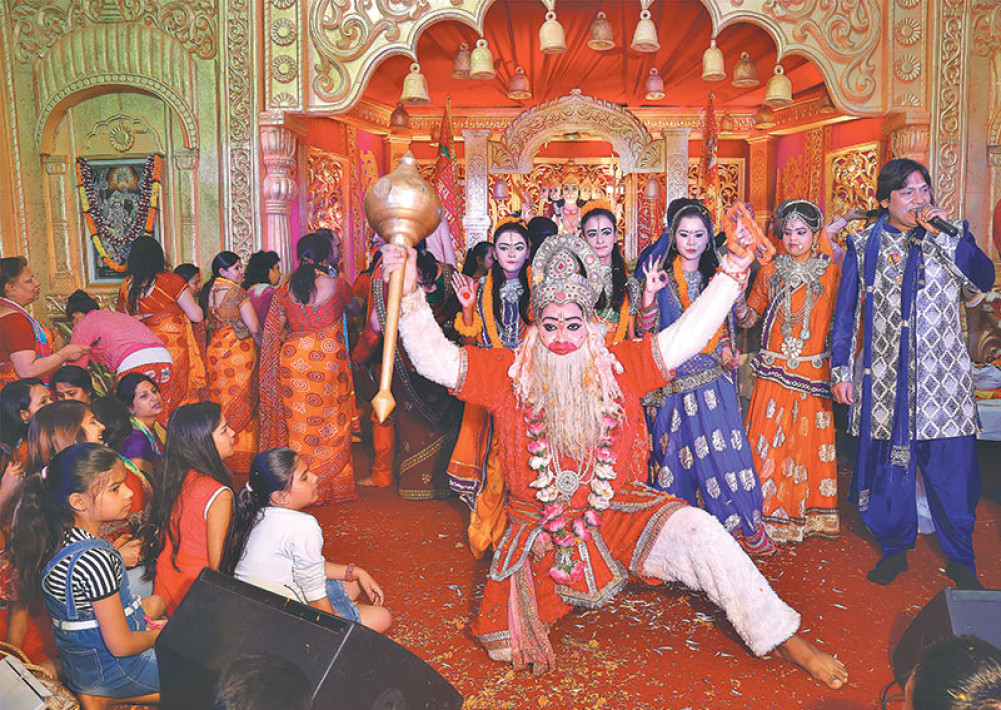
On this occasion, Hanuman idols and temples across the country are worshipped and processions are taken out.
We use Google Cloud Translation Services. Google requires we provide the following disclaimer relating to use of this service:
This service may contain translations powered by Google. Google disclaims all warranties related to the translations, expressed or implied, including any warranties of accuracy, reliability, and any implied warranties of merchantability, fitness for a particular purpose, and noninfringement.
The birth anniversary of Hanuman, a devotee of Ram, celebrated every year on the full moon day of Chaitra Shukla Purnima, is being celebrated across the country today by organizing various programs.
It is believed that worshipping Hanuman on the full moon day of Chaitra Shukla Purnima will grant strength, wisdom, knowledge, and deliverance from sorrow and hardship. On this occasion, special worship is performed at Hanuman temples across the country, including the statue of Hanuman at Hanumandhoka, the Hanuman Temple at Pashupati, and the Panchamukhi Hanuman in Gokarneshwor Municipality. In the Panchamukhi Hanuman Temple near the Nasal Chowk of Hanumandhoka Durbar, only priests perform worship.
According to Sanskrit grammar, the word Hanuman has been formed by adding the suffix ‘matup’ to the root ‘hanu’. Hanu means chin. It is formed from the root ‘han’. The root ‘han’ means violence or speed. Therefore, the word Hanuman means fast-moving power. Another meaning of Hanu is also said to be obedient.
That is why it is said that Hanuman was a devotee of Lord Ram. The scriptures mention that the incidents in the life of Lord Rama made Hanuman a most respected 'god'.
Fear is the basic instinct of man. The name of the power that protects from the wrath of evil spirits is Hanuman. Earlier, the name of a monkey was considered inauspicious. Elephants were considered auspicious. Hanuman started being worshipped as a 'Mangalmurat' or as a remover of troubles. Therefore, experts say that the tradition of reciting 'Hanuman Chalisa' for everyone from children to the elderly to get rid of fear began.
Hanuman is considered the son of Vayu. It is believed that Hanuman can assume any form. In the Shatrudra Samhita, Hanuman is considered the eleventh form of the eleven Rudras. It is said that the Rudras came into existence even before the development of the Hanuman sect.
Thus, there is a classical opinion that Hanuman existed before the Ramayana. The Ramayana is the most authoritative source of information about Hanuman. In the Vedic classical texts, it is also described that Hanuman was also born as an incarnation of Shiva to help Ramchandra, who was born as an incarnation of Vishnu.
In the Avanti Khanda of the Skanda Purana, it is explained that there is no greater being in the world than Hanuman. It is described that there is no one greater than Hanuman in the fields of Parabrahm, enthusiasm, mind, glory, kindness, sweetness, policy, seriousness, cleverness, virility, patience, etc.
On this auspicious day, men, women, children, and the elderly bathe in the holy river and observe fasts and worship. Hanuman is also called Bajrang Bali, because Hanuman's body was like a thunderbolt. Hanuman is known as the son of the wind.
Pandit Balmukunda Devkota says that it is mentioned in the classical texts that by meditating on Hanuman, who is five-faced, extremely radiant, powerful, in the form of the five elements and the five Rudras, and in the form of the most terrible Raudra, all tasks are completed.
It is believed that worshipping Hanuman will give one freedom from diseases, obstacles, fear of the king, obstacles of natural forces, lustful forces, ghosts, negative elements, wind, river, fire, the wrath of demonic forces and even from the evil one.
Hanuman attained closeness to Rama through Bhakti Yoga and Karma Yoga. In the Vaishnava sect, Hanuman is also worshipped to attain various yogic powers. Hanuman had eight types of yogic powers: Anima, Mahima, Garima, Laghima, Prapti, Prakamya, Ishitva and Vashitva. Hanuman is also remembered in the form of Parabrahm and Raudra.
The idol of Hanuman is painted with vermilion. Vermilion plays a role in building a well-organized body of bones and flesh. On this occasion, today, worship is performed in Hanuman idols and temples across the country and a procession is taken out. Hanuman is specially worshipped on Tuesdays and Saturdays.