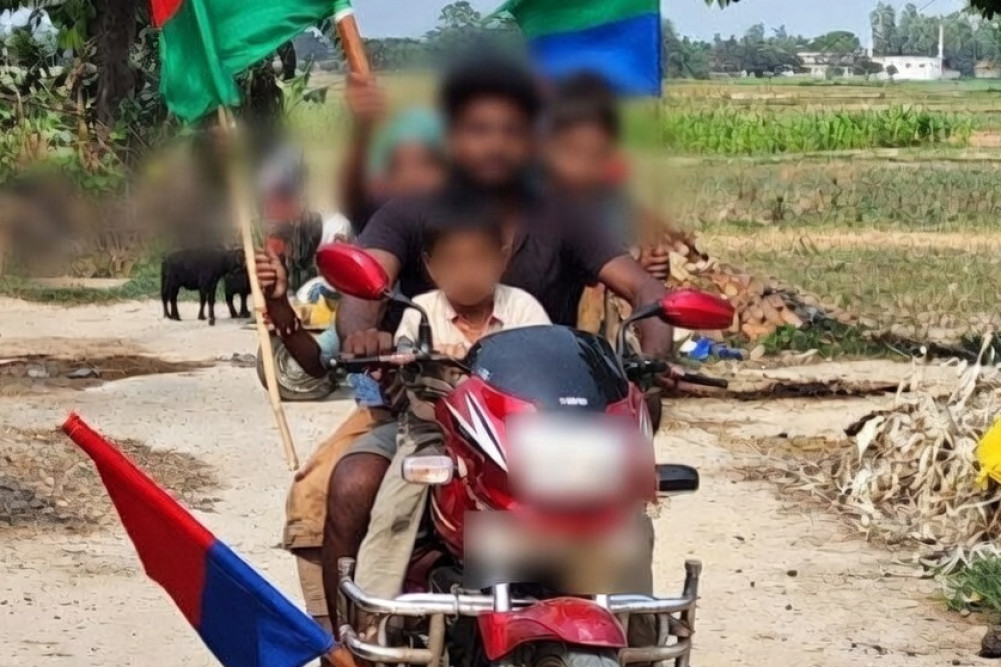
The report states that in some cases, children have been used to create promotional videos and social media content to solicit votes or convey messages supporting a particular party.
We use Google Cloud Translation Services. Google requires we provide the following disclaimer relating to use of this service:
This service may contain translations powered by Google. Google disclaims all warranties related to the translations, expressed or implied, including any warranties of accuracy, reliability, and any implied warranties of merchantability, fitness for a particular purpose, and noninfringement.
The study report on the implementation of the election code of conduct regarding child rights in the 2082 House of Representatives member election has shown that 350 violations were registered before and after the election.
The National Campaign for Children's Peace in Nepal (CJPN) has stated that 286 incidents related to children were registered before the election based on on-site observations conducted by its member organizations, reports received from the provincial network, media monitoring and monitoring of the 'digital platform'. The report mentions that 19 incidents occurred after the election.
A 4-year-old girl was hit by a vehicle on Magh 22 during the election campaign in Mathiyatol, Ishanath Municipality-4, Rautahat. On Falgun 19, 2082, a 15-year-old girl Asha Bhujel and an eight-year-old boy Sushil Majhi were injured when a suspicious object placed on a bridge exploded in Mithila Municipality-9, Dhanusha District. There were also incidents of security forces entering schools in Phidim, Panchthar, and Annapurna rural municipalities in Kaski before the election with weapons. The study found that activities such as making children participate in rallies and public meetings carrying flags and symbols, raising political slogans, distributing campaign materials, wearing political costumes, and participating in song and dance programs were carried out during the pre-election political campaign. In some cases, the report mentions that children were used to create campaign videos and social media content to solicit votes or convey messages of support for a particular party. The study showed that activities such as making students participate in rallies in school uniform, political leaders visiting schools, conducting election programs near schools, and using buses have challenged the ability of schools to be child-friendly and politically neutral places. According to campaign chair Tilottam Poudel, such activities directly violate the election code of conduct.
The report has pointed out that activities such as parents making videos seeking votes through children, influential people on social media using children in political content, children repeating political messages or criticizing rival parties, and deriving financial benefits from video content put children at risk.
The Election Commission had taken action in relation to some violations. The Shram Sanskriti Party has been fined Rs 25,000 for violating clause (d) of sub-section (1) of Section 13. The Commission has stated that Shakti Bahadur Basnet, a candidate from Jajarkot Constituency No. 1, has also been fined Rs 25,000 for violating the same provision. Compared to the pre-election period, there were fewer incidents of direct violations involving children on polling day. There has been a structural challenge regarding the widespread use of school buildings as polling stations. Out of 10,967 polling stations across the country, about 9,450 were set up in schools. The study suggests that political parties, state bodies, communities and families all need to play a responsible role. Political parties are recommended not to use children in election campaigns, rallies, publicity materials and digital materials, to adopt child-friendly election practices that respect children's rights, and not to hold election activities in schools and child-centered places. The report recommends that the Election Commission effectively monitor the code of conduct prohibiting the use of children, include child rights awareness in voter education programs, strengthen legal provisions for the government and policymakers, and formulate guidelines to prevent the political use of children in digital media. The
campaign urges security agencies, families, schools and communities to play their role. The study was conducted in collaboration with 107 member organizations from 50 districts, provincial committees from all seven provinces, the Association of Community Radio Broadcasters, various networks in the children's sector and civil society. Technical assistance was received for the study from the international non-governmental organization Save the Children.