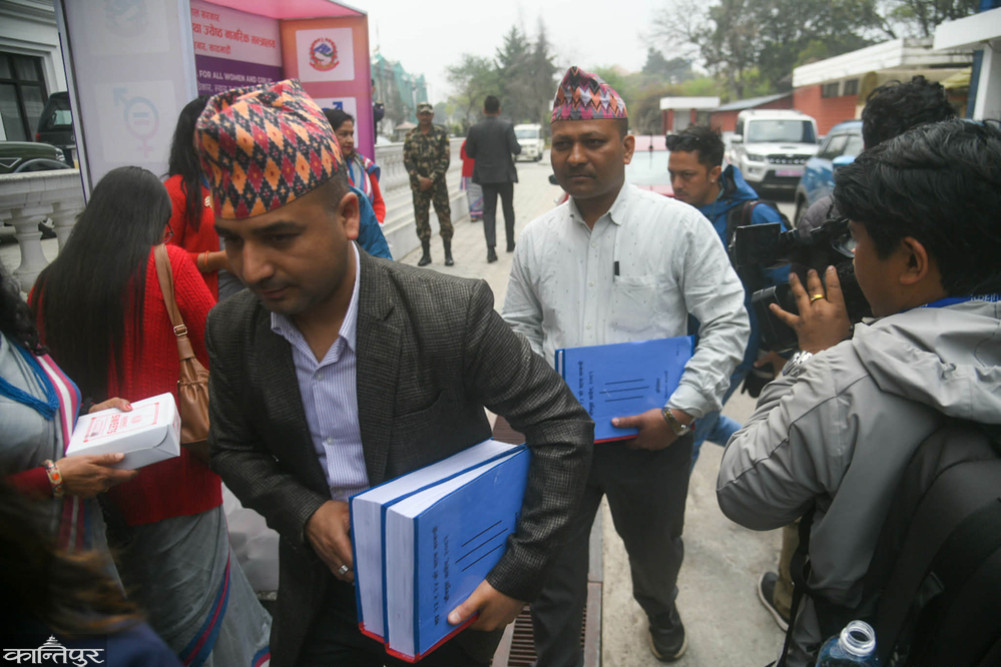
The commission members mentioned in the report the role of the then Prime Minister Oli, Home Minister Lekhak, the Security Council, and the Nepali Army.
We use Google Cloud Translation Services. Google requires we provide the following disclaimer relating to use of this service:
This service may contain translations powered by Google. Google disclaims all warranties related to the translations, expressed or implied, including any warranties of accuracy, reliability, and any implied warranties of merchantability, fitness for a particular purpose, and noninfringement.
The report of the 'Inquiry Commission on the Incidents of Bhadra 23 and 24, 2082' has pointed out that there was a serious security lapse on Bhadra 23.
It has been concluded that security weaknesses were seen from the beginning of the protest and recommended that those involved be brought to justice.
Commission member Vigyanraj Sharma said that weaknesses were seen in the Parliament building premises from the beginning. He said, 'There have been weaknesses in everything from placing barricades in the Parliament building premises. On Bhadra 23, the police should have stopped the protesters in front of the Everest Hotel, which was prohibited.' However, due to poor security preparations, they broke the barricades and moved forward.
Before the Gen-G protest reached the Parliament building in Baneshwor, the police could not do anything there except spraying water from a water cannon for a while at 11:45 pm. It has been found that the police did not even resort to lathi charge. Instead, due to the weakness of the police, the police started firing tear gas indiscriminately after Gen-G started entering the parliament building.
A member of the committee says that the police were found to have fired deadly weapons immediately.
At that time, the Kathmandu Police Chief was SSP Bishwa Adhikari. The report has been prepared after analyzing the role of everyone. A member of the commission said that the role of the political leadership has also been analyzed in the report.
‘The role of the then Prime Minister KP Oli, Home Minister Ramesh Lekhak, the Security Council, and the Nepali Army has been written about,’ the member said, ‘But since it has to be implemented, we will not tell you about those who have been recommended for action right now.’
Spokesperson Sharma has also confirmed that action has been recommended. However, he said that the responsibility for implementation lies with the government.
After submitting the nearly 900-page report, the commission’s coordinator Gauri Bahadur Karki made a brief statement to the Prime Minister. After that, Prime Minister Karki thanked the commission team. "You have completed your work, now what should we do," Karki said.
According to the commission, two separate days of analysis, study and action have been recommended on 23 and 24 Bhadra. The commission has also conducted a detailed study on the arson. For that, at least 200 people have been questioned, statements have been taken, and victims have been interviewed. The commission also worked by taking the opinions and suggestions of experts.
Statements and other matters have been included in the schedule. Members of the commission say that the report has reached 9,000 pages after including those details.