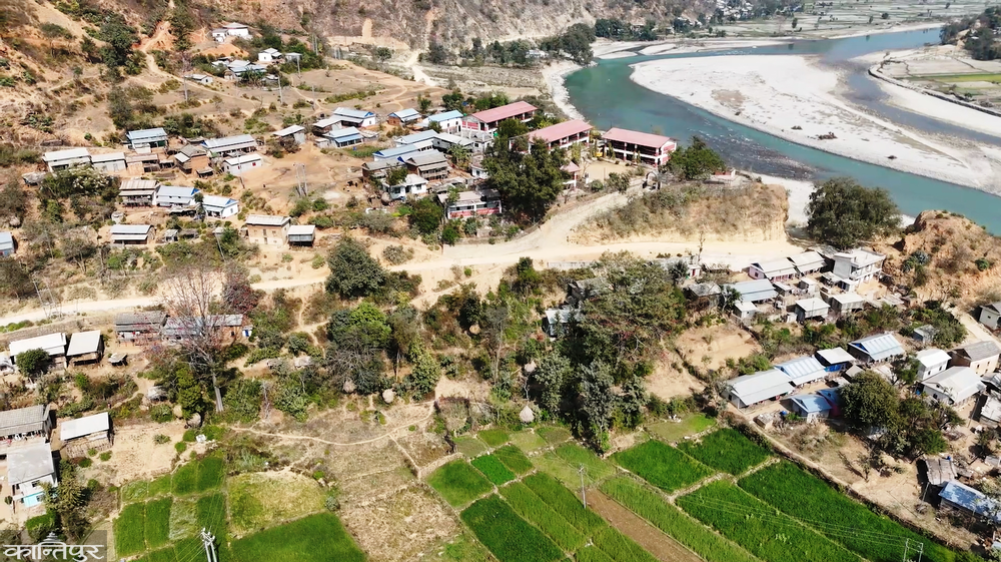
The cities and villages have been heated up with speeches, processions and slogans. But Rajgaun on the banks of the Tamakoshi is still the same. Silent, neglected and waiting. But hope still lives on.
We use Google Cloud Translation Services. Google requires we provide the following disclaimer relating to use of this service:
This service may contain translations powered by Google. Google disclaims all warranties related to the translations, expressed or implied, including any warranties of accuracy, reliability, and any implied warranties of merchantability, fitness for a particular purpose, and noninfringement.
The sound of the Tamakoshi flowing nearby can be heard. But for years, the Majhi community of Rajgaun, Khandadevi Rural Municipality-4, has been forced to pay a fee to quench their thirst. When dust blows, they stop breathing, when it rains, the road disappears, and half a year is spent in a brick kiln for employment. The Majhi settlement of Rajgaun, which has been away from the attention of the state and leadership for years, is still struggling for basic needs.
According to Majhe Saba Ramechhap, there are 673 Majhi community members from 117 households in Rajgaun. There are 10 permanent and 8 temporary government employees. 33 youth here are in foreign employment. Rajgaun is carrying the dream of free drinking water, employment and paved roads. The Majhi community here complains that the sweet assurances of the leaders who come to their doorsteps in every election disappear as soon as the voting is over.
Even as the February 21 House of Representatives elections approach, this settlement has not been a priority for candidates. Purna Bahadur Majhi, 72, of Rajgaun, says that even though the Tamakoshi flows near his house, he is forced to pay money every month to quench his thirst.
‘The Koshi flows under our house,’ he says, ‘but we have had to pay money for years to quench our thirst.’ The irony of having to buy water even while living near the river is visible not only in his words but also in his eyes. The obligation to pay a monthly water bill of two hundred to a thousand rupees is not an earning hand. Only the elderly remain in the houses. ‘What can we do now, we cannot carry water from the Koshi,’ he sighs heavily.
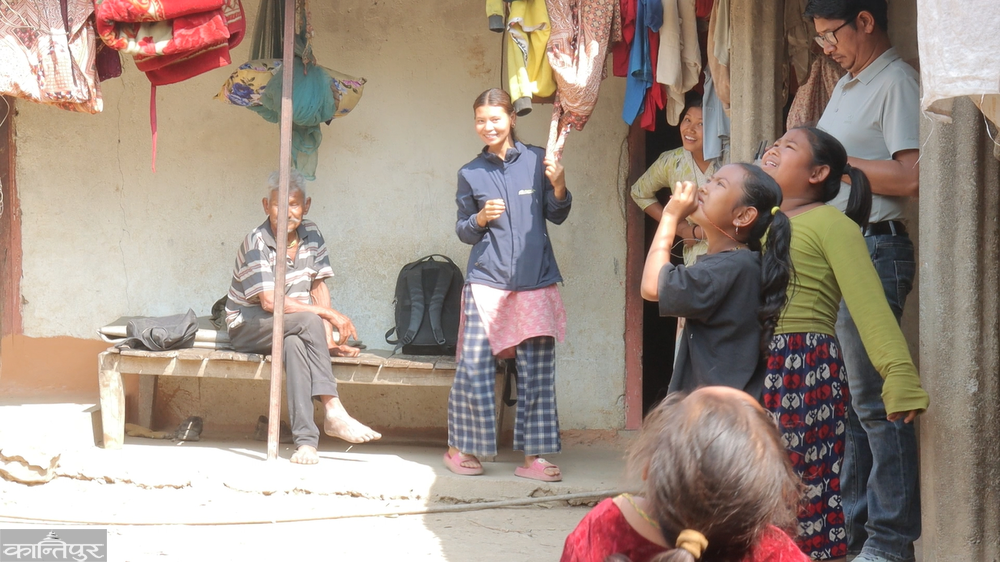 Purna Bahadur recalls, ‘In the previous elections, the leaders who were seeking votes had made sweet promises of paved roads and free drinking water. But as soon as the voting is over, it seems like those promises have been washed away with the Tamakoshi River. They will not return to the Koshi.’
Now, the temperature is rising again for the House of Representatives elections to be held on Falgun 21 across the country. Speeches, processions and slogans have heated up the cities and villages. But Rajgaun on the banks of the Tamakoshi is still the same. Silent, neglected and waiting. But hope still lives on.
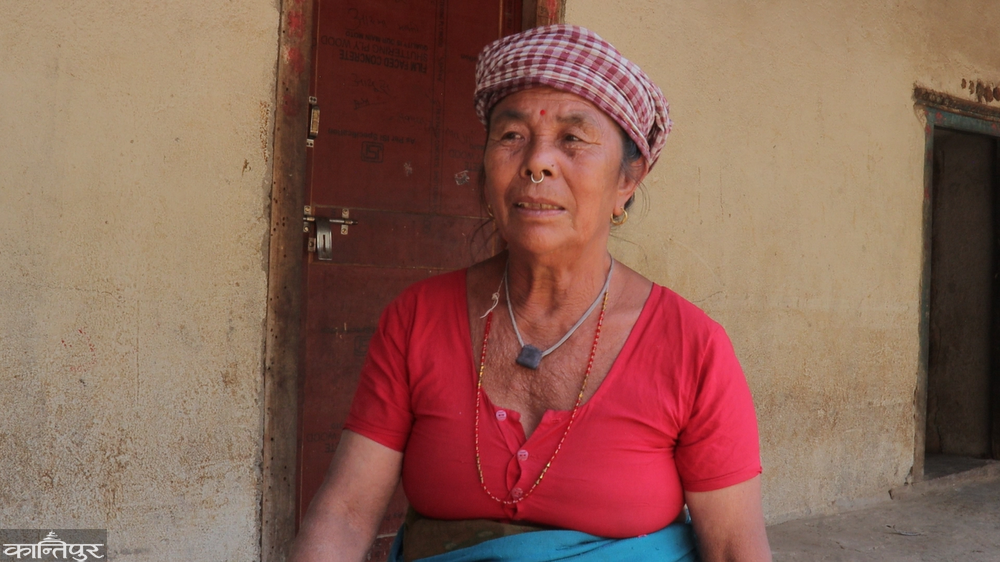
Another local, Ratnamaya Majhi, a 70-year-old who is forced to drink water from the lift after paying a fee, has the same complaint. ‘The Koshi flows nearby,’ she says, ‘but even drinking water has to be paid. I have paid up to Rs. 3,000 for drinking water when I pay for two or three months at a time. The condition of the roads is the same. Even while eating, it is covered in dust. There is no development work in our area.’
She said that the reason for the lack of development is that there are no people who can speak up and raise their voices. The obligation to pay for drinking water even while living on the banks of the river, dusty roads and neglected settlements. All these are the problems faced by the Majhi community of Rajgaun. Another major problem here is employment. The only employment option for the Majhi community of Rajgaun is the brick kiln. Since there is no sustainable source of income in the village, most of the families here are forced to leave the village for half the year and work as laborers in the brick kiln.
Samjha Majhi, 20, of Rajgaun says, ‘There is no way to earn money in the village. Therefore, almost all households have to go to the kiln to make bricks for about six months a year. Most of the time, there are not many people in the house. This is also our obligation. We have to support our family with the money earned from the kiln.’
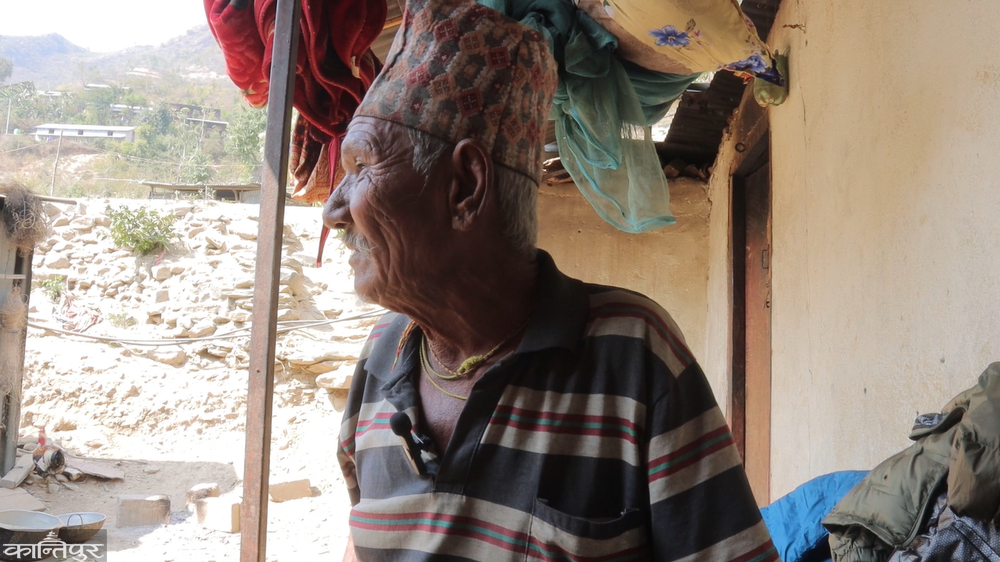 In the absence of farming, small industries or local employment opportunities, wage labor has been the basis of livelihood for generations. This cycle of Rajgaun, where people sweat in brick kilns for six months of the year and struggle in the village for the rest of the time, has not been broken. Samjhana says that employment is still a dream for the Majhi community of Rajgaun, who only figure in development plans.
According to the National Census 2078, the population of the Majhi community in Ramechhap district is 6,288. The traditional settlement of the Majhi community is especially around Sunkoshi and Tamakoshi. There are eight municipalities in Ramechhap; Bhatauli, Mugitar and Wadare of Manthali Municipality-7, Jakhanitar and Gaikhura of Ward No. 8, Karambot of Ward No. 2, Manthali of Ward No. 1, Nabughat, Masantar, Hattitar, Kunauri and Seleghat areas of Ward No. 6. The Majhi community also resides in Lubhughat of Khandadevi Rural Municipality-1, Sitkha, Dafkha of Kothbase Ward No. 3, Puchighta and Rajgaun of Ward No. 4, and Ratatar, Dhaneghat and Hardeni of Ramechhap Municipality-9. The Majhi community is also spread in Likhutamakoshi and Sunapati Rural Municipality of the district.
The Majhi community, who live on the banks of Tamakoshi and Sunkoshi rivers that flow through Ramechhap, has been forced to quench its thirst by paying money for years, says Shree Bahadur Majhi, acting president of the Nepal Indigenous Nationalities Federation, Ramechhap. According to him, there is a population of more than 7,000 Majhi community in Ramechhap district. ‘The Majhi community, who belong to the marginalized community, have to pay money even for basic needs like drinking water,’ he says, ‘As you can see, almost all the Majhi settlements are on the banks of Tamakoshi and Sunkoshi. But we are forced to quench our thirst by buying water drawn from the same Koshi through a lift system.'
 According to Shree Bahadur, the municipality and rural municipality have been repeatedly requested to provide free drinking water facilities to the Majhi community. But so far, no response has been received to those requests. 'There are not many other demands,' he says, 'We have asked many times to provide free drinking water only, we have also submitted applications. But the result is zero.'
On the contrary, in some places, the Majhi community is providing water at its own expense to schools, health institutions and even ward offices. 'What can we say now when we see this situation?', he asks, 'The fate of having to buy water even while living near the river has become the identity of the Majhi community.'