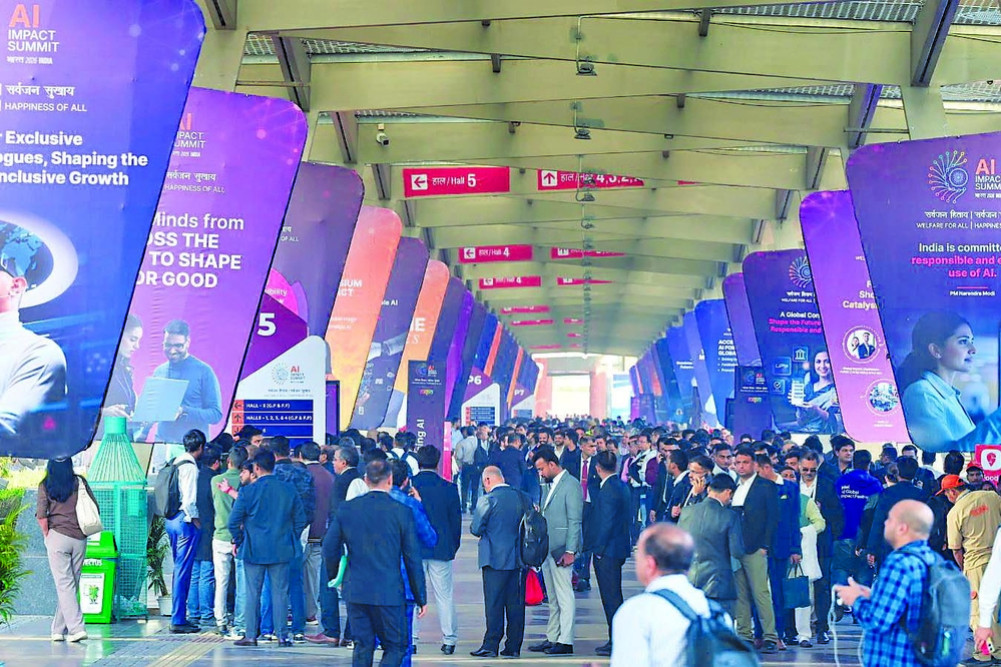
CEOs of 37 major companies are participating, including Google CEO Sundar Pichai, OpenAI's Sam Altman, Anthropic's Dario Amodei, and Reliance's Mukesh Ambani.
We use Google Cloud Translation Services. Google requires we provide the following disclaimer relating to use of this service:
This service may contain translations powered by Google. Google disclaims all warranties related to the translations, expressed or implied, including any warranties of accuracy, reliability, and any implied warranties of merchantability, fitness for a particular purpose, and noninfringement.
Indian Prime Minister Narendra Modi on Monday inaugurated the ‘Global AI Impact Summit’ at Bharat Mandapamma in New Delhi, calling it a ‘decisive moment where the Global South will shape the future of technology.’ Addressing delegates at the five-day conference, he also asserted that India will not be a passive consumer of Artificial Intelligence (AI) but will be a driver of innovation, inclusion and global standards.
The conference is being called the largest AI gathering ever. CEOs of 37 major companies, including Google CEO Sundar Pichai, OpenAI's Shyam Altman, Anthropic's Dario Amodei and Reliance's Mukesh Ambani, are participating. French President Emmanuel Macron, Brazilian President Luiz Inacio Lula da Silva and Spanish Prime Minister Pedro Sanchez attended on Monday. Modi said their presence gave added importance to the conference's objective of creating a 'common roadmap for global AI governance and collaboration'.
According to the conference organizers, representatives from more than 45 countries, hundreds of startups and research institutions are participating. This is the first AI conference to be held in the Global South after previous world-class AI meetings in Bletchley Park in the UK, Seoul in South Korea and Paris in France. Prime Minister Modi is scheduled to hold a secret meeting with CEOs later this week. It is expected to discuss investment commitments of about $100 billion.
In preparation for the conference, the Indian Embassy in Nepal had also organized an event titled ‘AI for Inclusive Growth: Preparing Nepal for the Future of AI’ in collaboration with AI Association Nepal in November. At the event, officials from both countries also expressed their commitment to enhance cooperation in areas such as Digital Public Infrastructure (DPI) and Artificial Intelligence (AI). Amitabh Nag, CEO of Digital India Bhasini Division, who was in Nepal for the event, clarified that Bhasini’s work is focused on removing language barriers and bridging the digital divide.
The AI Impact Summit will bring together heads of state from various countries and the entire AI ecosystem (government, industry, researchers, academia, startups and students), said Anirban Sharma, who is also the director of India’s Digital Society Initiative. The summit aims to build a shared vision on how powerful technologies like AI can be used for the greater good of humanity. The Indian government has encouraged Nepali youth to participate in initiatives like ‘AI for All’, ‘AI by Her’ (for women innovators) and ‘YouvaAI’ organized for the AI Impact Summit in India.
Although the prime ministers of Bhutan and Sri Lanka have been invited to the conference, the prime minister or ministers of Nepal do not appear on the list of invitees. Joint Secretary Adesh Khadka, who is also the head of the Information Technology Division of the Ministry of Communications and Information Technology, is participating in the conference from Nepal. He is participating in a panel session on Tuesday. Representatives of the AI Association Nepal are also in Delhi. The discussions at the conference are said to focus on three main topics – AI governance frameworks, economic opportunities and risks brought by automation, and the role of emerging markets in creating global standards. Delegates are scheduled to debate topics ranging from the impact on employment, child safety, to a ‘sovereign AI’ strategy that prioritizes local control over data and algorithms.
This conference is considered important for India from both diplomatic and economic perspectives. The Indian government has invested more than Rs 10,000 crore under the ‘India AI Mission’ to build research centers, develop skilled manpower, and create regulatory structures.
Indians expect the conference to accelerate further investment and cooperation in AI and technology. The conference is also considered important geopolitically. India, which established the concept of digital technology infrastructure by chairing the 2023 G-20, is trying to lead the way on how to regulate new technologies through this year’s AI conference. Some observers have called the Delhi gathering a ‘Bretton Woods moment of the Silicon Age’, indicating that the rules of the digital economy will be rewritten. (With the help of the agency)