Experts on Nepal-China relations say that the problem of grazing, which has displaced Nepali livestock keepers, is the result of Nepal's weak diplomacy.
We use Google Cloud Translation Services. Google requires we provide the following disclaimer relating to use of this service:
This service may contain translations powered by Google. Google disclaims all warranties related to the translations, expressed or implied, including any warranties of accuracy, reliability, and any implied warranties of merchantability, fitness for a particular purpose, and noninfringement.
The business of farmers in the Himalayan region is in crisis after Chinese security personnel did not allow sheep and goats to graze in the border area, violating the ‘Border Grazing Agreement’ that has been in practice between Nepal and China for decades.
On 4th Shrawan 2082. Bir Bahadur Bohora of Saipal Rural Municipality-3, Kanda and Pasang Tamang of Ward No. 4, Dhuli had reached the Tibetan plateau to graze horses and mules. That day, they were mistreated by Chinese security personnel.
Bohora and Tamang could not understand why they were mistreated in the same way as they were beaten. Whereas 14 years ago, a ‘China-Nepal Agreement’ was signed between the governments of Nepal and China on border grazing. The second point of the agreement signed on 30th Push 2068 mentions that border residents can graze within 30 kilometers of the border.
Bohora and Tamang had gone to graze horses and mules in Bains, about 17 km from the second border post of Urai Bhanjang. The Chinese security personnel set fire to the tent they had set up to stay. There were clothes, food and utensils. There were horse reins, clothes for the back and saddle. All of them went up in flames.
‘They were very angry. They came and started beating us without saying anything. They set fire to our tent,’ said Bir Bahadur Bohora, a victim of the Chinese security personnel, ‘We told them what we did wrong. They did not understand the language and became even more angry.’
Sabbalya Raut, 68, of Saipal Rural Municipality-2, Jima, had reached Nepal 6 km from Bains with more than 550 sheep. He also shared his experience of being mistreated by the Chinese security personnel. He said that he escaped by crying after the attempted assault. He said, ‘I folded my hands so that the old man would not be beaten.’ He used to go to this place every year during the rainy season since the age of 16 52 years ago. But he had never experienced such mistreatment before.
According to local sheep and horse breeders who have faced different treatment from the Chinese side, in recent years, the Chinese side has started banning entry into Tibet, saying that grazing sheep and horses will destroy the forest.
Farmers in Bajhang, who raise a large number of sheep, take their sheep to Doti through Bajhang and the lower part of Baitadi in winter from Kartik to Falgun. During the rainy season, from Chaitra to Bhadau, they take their sheep to various forests under Burang County in Tibet Autonomous Region of China, crossing the Nepal-China border at Urai (5220 m) in Bajhang. From Asar to Bhadra, they stay in Tibetan land to graze their livestock.
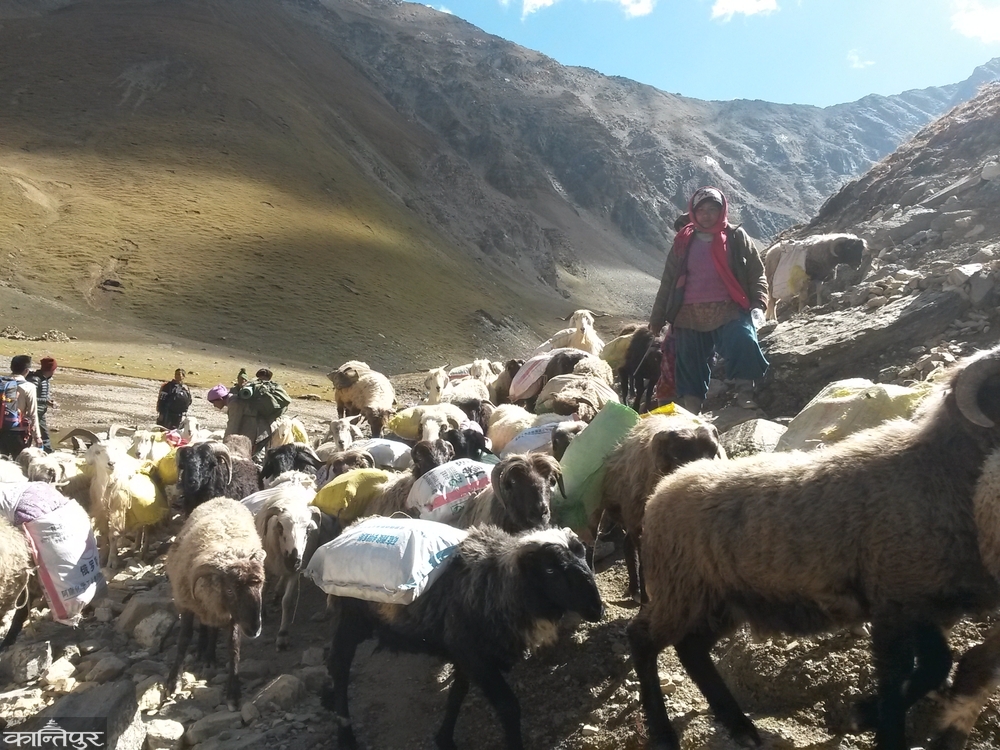
Although a small space is sufficient for mules, horses, and donkeys, it is not enough for sheep and goats. Depending on the number of sheep, grazing in one forest can be completed after four to five days or a week to ten days, and the sheep must be moved to another forest with grazing.
Professional sheep farmers raise between 200 and 1,500 sheep and goats in a single flock. ‘If there is a very large herd, grazing in a small forest can be completed in one or two days,’ says Sabalya. ‘Since the forests have to be traversed in many places, someone will see them somewhere or the other. It is not possible to graze them in secret.’
Especially from Asar to Bhadra, when the monsoon is active in Nepal, there is comparatively little rainfall in the Tibetan region. Since grazing in areas with low rainfall makes livestock healthier, people from not only Bajhang but also from districts such as Humla, Jumla, Mugu, Kalikot, Bajura, Darchula, and others take their livestock to the Tibetan region for grazing. Most of those who go this way are sheep and goat breeders.
‘If they graze on this side (Nepal) during the rainy season, half of the sheep and goats will die of disease,’ said Arjun Singh of Jayaprithi Municipality-1, Pimi. ‘The sheep and goats that graze on that side (Tibet) will be agile and fat even in winter.’
When the sheep and goats graze in places with heavy rainfall during the rainy season, they suffer from various diseases including fever, drooling from the nose and mouth, mouth sores, hooves rotting, diarrhea, and hair loss, which causes great loss. Therefore, even if it is illegal, they are forced to graze in the forests of Tibet.
‘If we don’t take them there, forty to fifty sheep and goats will die of disease in one rainy season. "If we go, we are afraid that they will chase us away," he said, "or we will have to stop raising sheep. Otherwise, farmers are forced to go in fear to protect their property."
The situation was not like this even before Corona. The livestock farmers of Bajhang used to go to the Tibetan area for two to three months every year with their livestock. From Saipal Rural Municipality alone, the forests there were filled with eight to ten thousand sheep and goats and more than a hundred sheep herders.
'There were no restrictions for us. Wherever we went, it felt like our own village,' says Kalu Dhami of Saipal Rural Municipality-1, Dhalaun, who has been going to Tibet with sheep and goats since 2040 BS. 'I have friends in every village there. Wherever I went, it felt like I was staying in my own house. That is not the case these days.’
Narrating that people who go to Tibet from Bajhang to graze their livestock take rice, lentils, timur, khusarni, and nigala products for sale and return from Taklakot market with shoes, clothes, salt, and Tibetan liquor, he said, ‘Nowadays, they don’t even let us enter the village. If we need to meet our friends, we have to call them to Taklakot market.’
He said that the strictness being imposed on Nepali livestock keepers by China has not only affected the business that has been going on for generations but also the friendship relationship. Not only Kalu of Dhalaun village of Saipal rural municipality, but almost all the people in the municipality have friendship relations with some or the other locals in the Tibetan village. Most families have friendship relations with more than one person from different villages in Tibet.
Sheep farmers in Bajhang's Talakot, Masta, Khaptadchanna, Chhabis, Durgathali rural municipalities and Bugal and Jayaprithi municipalities also have friendly relations with some people in Tibetan villages. Some families have had such relations for seven or eight generations. The residents of the border villages of Tibet still speak Nepali and communicate with those who have left Nepal in Nepali.
Until 15/20 years ago, trade between Tibet and Bajhang was also good due to the friendly relations linked to animal husbandry. In the rainy season, animal husbandry used to reach Bajhang with local products. In the winter, Tibetans would visit villages in Bajhang to bring wool and salt and sell them. When they returned, they would bring grains like rice, wheat, chillies, and timur.
Now, this trade has stopped due to the strict restrictions imposed by the Chinese government on Tibetans entering Nepal. ‘Even seven or eight years ago, my friends used to come to Dhalaun (to their house) every winter. They used to stay here all winter,’ says Kalu, ‘now they are not allowed to come to Nepal either.’ He said that the Chinese government has been monitoring the border by installing CCTV cameras across the border to a place called Thadadhunga near the border of Bajhang and China.
Until a decade and a half ago, Tibetans also used to bring their livestock (horses, cattle, sheep and goats) and live in places like Kalanga, Satukhane, Grafu, Chora in Saipal rural municipality for three months of the rainy season. ‘Most of them used to bring horses and cattle,’ says Kamman Bohra, 70, of Dhalaun, ‘they used to have a fixed place to make pasture every year. They are still there.’ But now, he said, Tibetans have stopped coming. ‘Is it because the government there doesn’t allow them to come? Because all the facilities are available. "It's been a long time since I've stopped coming," he said.
Bajura's livestock farmers are in even more trouble
Samnel Gurung of Bichhiya, a mountainous rural municipality in Bajura, is now 69 years old. When he was 10 years old, he first reached Taklakot with his father's herd of sheep and goats after walking for about 12 days. He still remembers bringing salt in exchange for the timur, khursani, and satu he took from home.
He has no idea how many times he has been there since then. For many years, he used to go to Taklakot to graze sheep and buy salt. In recent years, he used to carry sheep to Bajura to carry clothes, Chinese shoes, and alcohol, and from there, he would take herbs from local traders.
Having reached Taklakot on his own many years ago, he even managed to establish a bond with Pema Tundup of Sitisyang village near Taklakot. Recently, the Tibetan administration has banned the entry of residents of unconnected districts to Taklakot, but still he used to take sheep to the other side of the Chinese border security post at Lubu near Sitisyang. His friends would take alcohol, shoes and clothes from Taklakot to there. From there, he would return home after loading them on the sheep.
Gurung, who is well-versed in the Tibetan language, has not been able to go near the village openly with sheep like before in the last 10 years. Three years ago, 11 sheep farmers from Bichhiya and Pashdusain of Budhinanda Municipality who had reached Lubu with sheep were beaten up by Chinese Border Security Force personnel. They were asked to return their sheep immediately because they entered their border without a permit (pass). Since then, those who go to graze sheep from Bajura, including Samnel, have been grazing sheep in the border area only secretly.
‘Earlier, there was a place where we could pitch our own tents and graze sheep. Even people did not interfere with the place where we pitched our tents. What a time it has come now. We have to go like thieves,’ he said, ‘I am very hurt that the Chinese government has banned the place where we have been grazing sheep for generations.’
According to locals, people from Bajura’s Bichhiya, Rugin, Pashdusain and other villages are involved in sheep farming and have been voting for grazing since the time of their ancestors, but now there is a problem. ‘We have to graze sheep from the sidelines,’ said Samnel.
A thousand-year-old tradition
The nomadic pastoralism, friendship, and trade between Bajhang and the Taklakot Bazaar and border villages under present-day Burang County, China, dating back to about a thousand years ago can be found in various records. 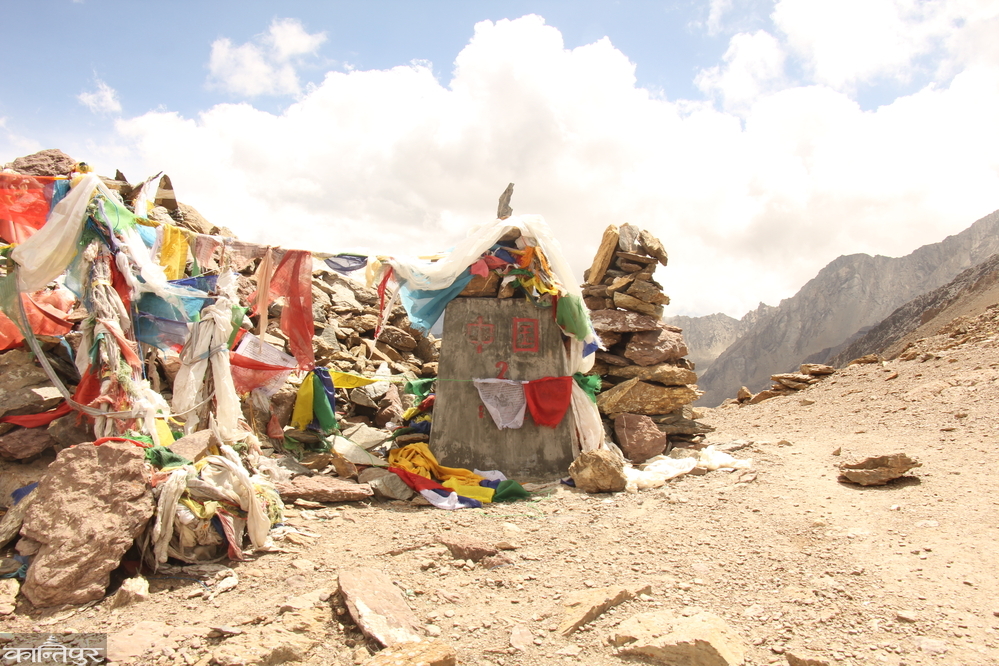
Documents still exist today that Tibetans came to Bajhang to trade and that the then Bajhang state collected wool, salt, and gold in return for grazing sheep and cattle.
‘I have seen with my own eyes that in 2015 BS, when Lalit Singh, the brother of Kalki Singh, the ruler of Talkot, tried to seize the Sirto (salt, wool and gold) coming from Tibet, claiming that he would have his own share, he was arrested by the soldiers of the Bajhangi king and imprisoned in a horse-drawn carriage in Chainpur,’ said Bishnu Bhakta Shastri, a former professor at Jayaprithi Campus, who is also a researcher of the history of Bajhang, recalling an interesting incident involving a dispute over the Sirto. ‘The case regarding the Sirto dispute had even reached the Doti court. After the court decided not to raise the Sirto, Lalit Singh was also released. The raising of the Sirto has also been stopped.’
According to locals, even until 2054 BS, the road to Tibet via Saipal rural municipality was very busy during the rainy season. People from Bhoti used to use that route to travel towards Nepal, carrying wool and salt on horses, sheep and carts.
At present, Saipal Rural Municipality, in Chora, Kalanga and Grafu, there used to be a market every rainy season. The locals of Bajhang used to sell their products made of satu, khursani, timur, reeds, herbs and wooden items there. Earlier, trade was done through barter, but recently, cash transactions were used. This practice was discontinued after Chinese traders stopped coming due to the Maoist conflict in Nepal.
Such a market, which would last for three to four months, would be crowded with people doing up and down (up and down). Afilal Bista, 77, of Lugada, Talakot Rural Municipality-6, recalled that he too had gone to the market to bring salt and wool and sell the goods from there.
He said, ‘Those who had the job of fetching water (from Mansarovar), those who could walk and carry heavy loads could reach Puras (Burang), but those who had to return home quickly and could not walk at high altitudes would buy goods from the markets on Nepali soil and return.’
Weak diplomacy
Experts on Nepal-China relations say that the problem of grazing that has displaced Nepali livestock keepers is the result of Nepal’s weak diplomacy. विश्व मानचित्रमा उसको उपस्थितिको परिदृश्य एक दशकअघिको तुलनामा मात्रै हेर्ने हो भने पनि निकै फरक भइसकेको छ,’ उनले भने, ‘आफ्नो राष्ट्रिय स्वार्थ अनुसार चीनले आफ्ना नीतिहरूमा परिवर्तन गर्नु स्वाभाविक हो, तर नेपालले उसको बदलिँदो अवस्थालाई मध्यनजर गरेर आफ्ना सरोकारका विषय राख्नु पर्थ्यो । त्यो हुन सकेन ।’

चीनका लागि नेपालको प्रतिनिधित्व गरेर जाने कूटनीतिज्ञ र राजनीतिक नेतृत्वले जनसरोकारका विषयमा कूटनीतिक पहल गर्न नसक्दा सीमावर्ती क्षेत्रका बासिन्दाले भोगिरहेका चरिचरन लगायत थुप्रै परम्परागत अभ्यासहरू चीन सरकारको जानकारीमा समेत नहुने गरेको उनको भनाइ छ ।
परराष्ट्र मन्त्रालयका अधिकारीहरू ‘दुईपक्षीय सम्बन्धको विषय’ भन्दै यो विषयमा प्रतिक्रिया दिन पन्छिने गरेका छन् । २०६८ सालमा भएको ‘सीमावर्ती चरिचरन सम्बन्धी चीन–नेपाल सम्झौता’ अहिले पनि सक्रिय रहेको बताउने मन्त्रालयकै एक अधिकारीहरूले पर्याप्त कूटनीतिक पहल नभएका कारण नेपालले आफ्ना सवालमा चीन सरकारलाई विश्वासमा लिन नसकेको र नेपाली सीमावर्ती क्षेत्रका बासिन्दाले परम्परादेखि अपनाउँदै आएका आर्थिक, सामाजिक र सांस्कृतिक सम्बन्ध र अभ्यासहरूमा समस्या देखिएको बताए ।
‘यस्ता विषय नेपाल सरकारको जानकारीमा नभएका होइनन्,’ नाम बताउन नचाहने मन्त्रालयका ती उच्च अधिकारीले भने, ‘समस्याहरू छन् । रिपोर्टिङ पनि हुन्छन् । समाधानको ठोस पहल गर्नका सवालमा हामी चुकिरहेका छौँ ।’

