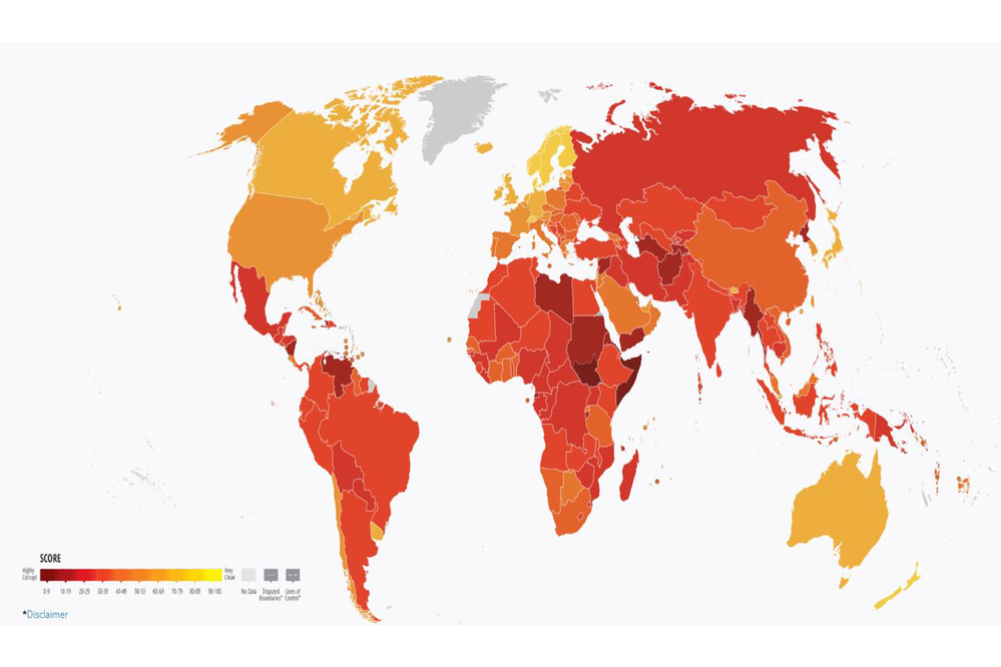
According to Transparency International Nepal, Denmark is at the top of the list of least corrupt countries, while South Sudan and Somalia are at the bottom. Similarly, Bhutan is at the top of the list of least corrupt countries in South Asia.
We use Google Cloud Translation Services. Google requires we provide the following disclaimer relating to use of this service:
This service may contain translations powered by Google. Google disclaims all warranties related to the translations, expressed or implied, including any warranties of accuracy, reliability, and any implied warranties of merchantability, fitness for a particular purpose, and noninfringement.
According to the Corruption Perceptions Index, 2025, released by Transparency International Nepal (TI), Nepal has scored 34 points this year as well. The index indicates that there has been no significant improvement in the state of corruption control, while the score remains the same as last year.
Nepal is in a weak to moderate position with 34 points out of 100 in the index covering 180 countries of the world. According to the index, zero points indicate a highly corrupt country and 100 points indicate a highly transparent country. According to the details released by TI Nepal, the index for Nepal is based on data from international organizations including the World Bank, World Economic Forum, Bertelsmann Foundation, Global Insight, World Justice Project, V-Dem, etc.
Bhutan is a leader in controlling corruption in South Asia
Among the South Asian countries, Bhutan has scored the highest 71 points, while India has scored 39, Maldives 39, Sri Lanka 35, Pakistan 28, Bangladesh 24 and Afghanistan 16 points. Neighboring country China has scored 43 points. TI has concluded that corruption remains a serious problem in most South Asian countries except Bhutan. Political instability, weak governance, abuse of public office, impunity and lack of transparency have been cited as the main reasons for the lack of improvement in the index. The
report states that despite increasing public movements, youth activism and citizen pressure, it has not been translated into concrete policy and structural reforms. TI Nepal has concluded that the risk of corruption is still high in public service delivery, contracting, tax system and judicial process. TI Nepal has emphasized the need to strengthen political will, full implementation of the law, an independent judiciary, transparent administration and citizen participation to control corruption. TI has prepared the index assessing the state of corruption around the world and includes 182 countries this year.
The global average score has dropped by one point to 42 compared to last year. According to the index, 100 points indicate a very transparent situation and 0 points indicate a highly corrupt situation. The number of countries that scored more than 80 on the index has decreased from 12 a decade ago to just five in 2025. According to TI, corruption control has been deteriorating in more than 50 countries since 2012, while only 31 countries have shown improvement. Overall, two-thirds of the world's countries have scored less than 50.
Denmark has the lowest corruption, South Sudan has the highest
Denmark has topped the index for the eighth consecutive year as the country with the lowest corruption with a score of 89. South Sudan and Somalia are on the list of the most corrupt countries with a score of nine.
TI Nepal President Madan Krishna Sharma said that Nepal's score remaining stable at 34 this year, like last year, is an indication that governments have not taken concrete action against corruption. Nepal has been evaluated based on good governance data from six international organizations as of August 2025.
According to Chairman Sharma, the country has suffered huge losses of money and people due to corruption in Nepal, good governance has become weak, and dissatisfaction among citizens has increased. 'In this background, the recent Gen-G and youth movements were focused on corruption,' he said. 'Strong commitment of political leadership, full implementation of laws, adherence to international commitments, and strengthening of regulatory bodies are indispensable for controlling corruption.'
Former Chairman Padyini Pradhananga emphasized that it is the need of the day to elect honest and committed leadership through the upcoming elections who will not be involved in corruption. TI Nepal General Secretary Sagar Raj Sharma emphasized that Nepal has not been successful in the field of corruption eradication and emphasized that it is necessary to take initiatives from all sectors to eradicate corruption in the coming days.