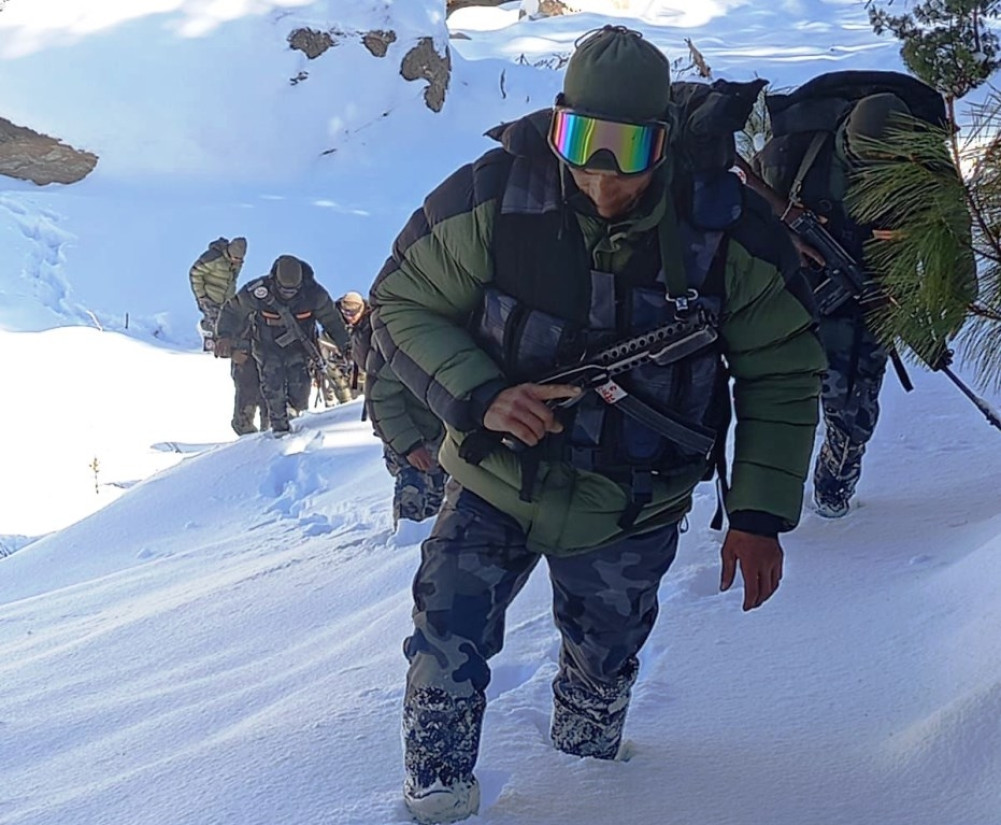
The Armed Police Force Nepal No. 50 Gulma in Chhangru, Byas Rural Municipality-1, Darchula is completely covered in snow. The security personnel are carrying out their daily lives amidst the white mountains all around, the frozen courtyard, and the snow-covered roofs.
We use Google Cloud Translation Services. Google requires we provide the following disclaimer relating to use of this service:
This service may contain translations powered by Google. Google disclaims all warranties related to the translations, expressed or implied, including any warranties of accuracy, reliability, and any implied warranties of merchantability, fitness for a particular purpose, and noninfringement.
It is not easy to move forward in freezing cold and heavy snow with boots buried in them. Every step is fraught with danger. Their steps do not stop even amid slippery ground, the possibility of avalanches, and near-zero temperatures.
The Armed Police Force Nepal No. 50 Gulma in Chhangru, Byas Rural Municipality-1, Darchula is completely covered in snow. The security personnel are going about their daily lives amidst the white mountains, frozen courtyards, and snow-covered roofs.
The temperature in this area ranges from minus 6 degrees to 23 degrees Celsius. Currently, about one and a half feet of snow has accumulated around the Gulma. The village is completely deserted. Snow falls as soon as the clouds appear. The surrounding mountains are high, the peaks of the mountains are visible in the distance, and the cold wind is blowing.
This is not a scene from an adventure trip, this is the daily life of the security personnel deployed on the Himalayan border. The Armed Police Force has been deployed to protect the border without risking their lives in the cold. Water has been frozen in the drinking water pipes for a month with the cold and snowfall.
Armed Police Force No. 50's Gulmapati Phanindra Shahi, who is using water from Tinkar River after the water in the pipe stopped flowing, said. 'We are drinking water from the river right there after the water in the pipe has frozen. The river is near the Gulma. In the cold, there is no other option but to bring water from the river and boil it or eat it by melting snow,' he said.
Keeping warm by lighting a fire inside the Gulma is the daily routine of the residents here. When the temperature drops below zero, their hands and feet become numb. In the meantime, the patrolling of the border area by the Armed Police Force has not stopped. Security personnel led by Deputy Superintendent of Police Phanindra Shahi and Armed Police Force Inspector Shailendra Chaisir take risks and monitor the border area every day. Superintendent Shahi says, 'This is a sensitive area. We are deployed to protect the tri-country border. Kalapani, Lipulekh and Limpiyadhura fall in this area. Pillar No. 1 of the Nepal-China border is also here. It seems normal to have regular duty in the cold when fulfilling the responsibility given by the nation.'
The lack of road transport and infrastructure in a remote mountainous area like Chhangru is still a big challenge. Not only the locals, but also the security personnel deployed here are deprived of basic facilities. There is still Indian dependence even for bringing rations. There is no road on the Nepal side. The Nepali Army is constructing a road from Byas-4 Tusarpani to Chhangru under the Darchula-Tinkar road. The road construction work from the Nepal side has now reached Dumling.
Although there is a road in the Indian side, it is currently blocked due to snowfall. India has expanded the road from Kalapani to Lipulekh. Regular traffic has been disrupted in the area for a month now due to snowfall and ice. For Indian security personnel, rations are regularly transported by helicopter. Two helicopters are used to deliver supplies to the Kalapani area daily. Heaters, warm clothes and weather-appropriate facilities are available in their barracks, but there is no road to Nepal.
Although the footpath is operational, it is currently closed due to snowfall. The Armed Police Force depends on the rations brought before the snowfall. The security personnel have been affected by the lack of roads for normal movement. 'We are trying to clear the road by regularly clearing snow to reach Budi Dopakhe,' said DSP Shahi.
The Armed Police Force has been continuously patrolling from Chhangru towards Gaga area. When the snow subsided, regular patrols used to be conducted up to the Kalapani source, but now it is not possible to reach the upper areas due to thick snow. The relationship between security personnel on both sides of Nepal-India is cordial. Despite the loud slogans about Kalapani-Lipulekh in the center, security personnel living on the border exchange information on border crimes and meet regularly. Last month, the Armed Police Force BOP in Tinkar was shifted to Chhangru.
The security personnel were shifted down because the Tinkar area receives twice as much snowfall as Chhangru. The BOP had been patrolling the border area with China. The BOP was established in Tinkar only a year ago.
With the onset of Mangsir, Tinkar village is completely deserted. Tinkar is the last village bordering China. The Nepal-China border pillar number one is from here. A few families still live in Chhangru. According to Ward No. 1 Chairman Ashok Singh Bohara, Rai Singh Aitwal has been given the responsibility of a watchman to look after the village.
The ward has provided him with a monthly salary of Rs 15,000 for 6 months to prevent incidents like theft and smuggling. This village, which borders India, is located about 10 kilometers below Kalapani.
Protecting the border by lighting a fire in a snow-covered forest is not only a duty for them, but also a matter of pride. DSP Shahi says, 'This is a responsibility given by the nation. We also hold counterpart meetings at least twice a month.'
On 2077 Jestha 7, the government had issued a Chukche map including the territory encroached by India, including Kalapani, Lipulekh and Limpiyadhura. Then, on Asad 29, the cabinet meeting decided to establish the forest. Forest number 50 was established in Chhangru on Asoj 9. Due to its geographical remoteness and harsh weather, this mountainous region has always been a challenging and sensitive one for the state.
Armed Police Guard from the plains of the Terai to the Himalayas
The Armed Police Force has recently expanded its patrol and security presence from Lali in Lekam Rural Municipality-3 of Darchula to Byas Rural Municipality-1, which borders the India-China border. The Armed Police Force, which was limited to the district headquarters Khalanga until 2077 BS, has now spread from Lali in Lekam to Tinkar in Byas. Units have been added to the border area with the publication of the Chukche map. The government established Battalion No. 44 in Khalanga and transferred Battalion No. 50 there to the Chhangru-Gaga area of Byas.
There are 10 border crossings connecting Nepal with India in Darchula. Mahakali Municipality-4 Khalanga, Ward 9 Dattu, Malikarjun Rural Municipality-7 Joljibi, Ward 6 Baku, Lekam Rural Municipality-3 Lali has a border crossing connecting Nepal with India.
Similarly, Byas Rural Municipality-1 Sitapul, Ward 2 Mal, Ward 4 Sunsera Malghatte, Ward 5 Tigram and Ward 6 Badugaun are border areas connecting two countries. Of these, a wooden bridge has been built on the Mahakali River in Byas Rural Municipality-1 Sitapul, while suspension bridges have been built in all the remaining places. A BOP of the Armed Police Force has been established in Byas-1 Chiyalek targeting Tinkar Bhanjyang connected to China. According to Gunaraj Neupane, the Ganapati of 44th Battalion, he said that a security unit has been mobilized to cover 10 checkpoints with India and Tinkar checkpoint with China.
The proposed border security unit is currently operational in Joljivi, while BOPs have been established in Dattu and Lali. Tinkar Chiyalek and Dumling BOPs of Rapla are operational under Battalion No. 50 in Chhangru. According to the Armed Police Force, Darchula has a 198-kilometer border with India and a 75-kilometer border with China.