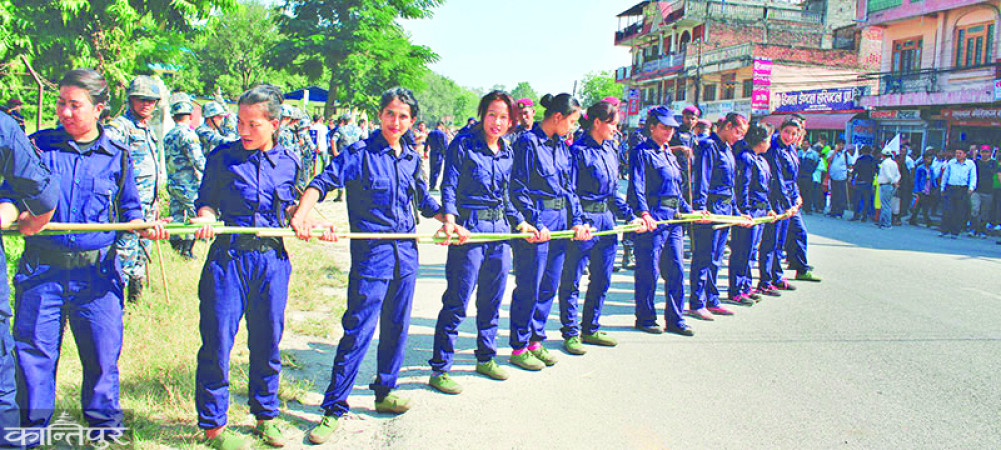
149,090 election police officers, including 133,980 under the Nepal Police and 15,110 under the Armed Police, are deployed for election security.
We use Google Cloud Translation Services. Google requires we provide the following disclaimer relating to use of this service:
This service may contain translations powered by Google. Google disclaims all warranties related to the translations, expressed or implied, including any warranties of accuracy, reliability, and any implied warranties of merchantability, fitness for a particular purpose, and noninfringement.
Election police, who will be recruited to provide security for the House of Representatives elections to be held on February 21, will be deployed in the field from February 25.
The election police officers who will be deployed under the Nepal Police and Armed Police Force (APF) will be given appointment letters on 15th January and will undergo basic training for 10 days and then deployed in their designated work areas from 25th January.
Elections are being held on a single day for 275 seats in the House of Representatives elections, including 110 members in the proportional representation and 165 members in the direct representation. For that, 188,000 personnel from the Nepal Army, Nepal Police, Armed Forces and the National Investigation Department are being deployed for election security. In addition, 133,980 personnel under the Nepal Police and 15,110 personnel under the Armed Police are being deployed for election security.
Applications for recruitment were opened from all 77 districts of the police and armed forces units from 25th January, and about 200,000 people had applied for the election police by 3rd January. Their exams are currently being conducted. Election police selection is underway across the country and the manpower will be selected within a few days, said Nepal Police spokesperson DIG Abinarayan Kafle.
‘The election police selection process is currently underway, a set number of manpower will be selected and deployed for a period of 40 days,’ Kafle said. ‘Accordingly, they will be appointed on 15th Magh, then trained for 10 days and deployed in the field from 25th Magh, and after working for a month, they will be dismissed on 25th Falgun.’
The government had set a 40-day working period for the election police, with 10 days of training and the remaining one month being deployed under the police and armed forces for election security. Those recruited into the election police will receive the basic salary of the police and armed police personnel, as well as clothing and ration allowances.
According to the basic salary of a soldier, an election policeman will be provided with a salary of 869 rupees per day and 40 paisa for 40 days, ration allowance for 40 days as determined by the District Rate Determination Committee (varies according to the district), 846 rupees per person for one time to go and return to the place assigned to the election (transportation allowance), a lump sum of 1200 rupees for lunch expenses at the rate of 300 rupees per day for four days, and a one-time clothing allowance as determined by the police and the armed forces in that district according to the weather in the district.
All the amounts given in this way will be sent to the bank account of the concerned election police. If these personnel deployed in the election are injured in the course of their duties, the injured person will be provided with the compensation amount as determined by the government, and in case of death, the next of kin will be provided with the compensation amount as determined by the government.
It is also mentioned in the criteria approved by the Ministry of Home Affairs that those who do not go to the designated place before the election and do not complete their responsibilities will not be given any of the specified facilities. Similarly, if the election is canceled or postponed, even if they are in training, their appointment will automatically be canceled/suspended.