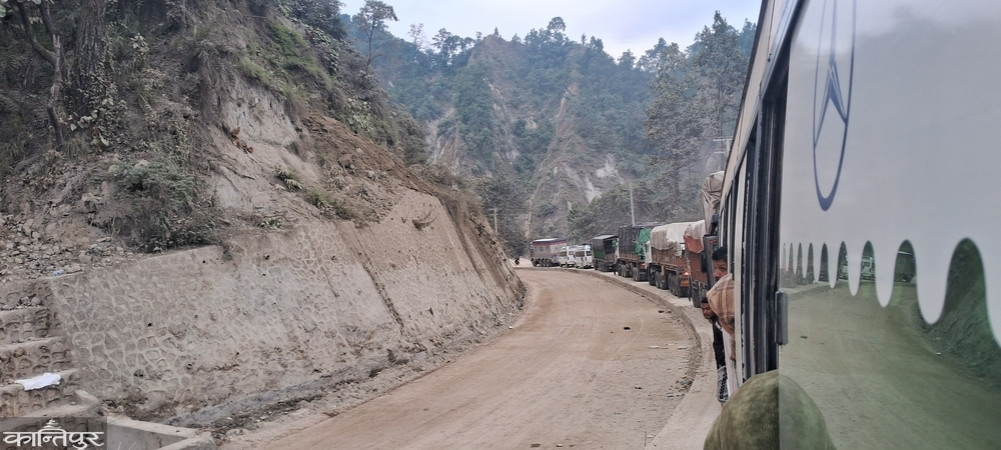
The road that was supposed to be built in 44 months has not been completed in 7 years. Commuters and locals are suffering due to the lack of timely road expansion.
We use Google Cloud Translation Services. Google requires we provide the following disclaimer relating to use of this service:
This service may contain translations powered by Google. Google disclaims all warranties related to the translations, expressed or implied, including any warranties of accuracy, reliability, and any implied warranties of merchantability, fitness for a particular purpose, and noninfringement.
If the work had been done as per the contract agreement, vehicles would have been able to operate freely on the Butwal-Narayangadh road section. It now takes at least six to seven hours to traverse this 114-kilometer highway, which used to take about three hours. During normal rains and cold waves, it takes up to eight to nine hours to traverse the Daunne section alone.
Binod Pariyar was returning home from Kathmandu in Butwal last Tuesday. He reached Dumkibas at 10 pm and it took him 10 hours to cover half of the Daunne section. Since it was an EV van, he had to overtake on narrow roads and cover 7 kilometers to the temple. After that, some passengers including Pariyar walked towards Bardaghat. Due to the traffic jam and muddy road, it was not easy to walk. They somehow reached Bardaghat after a two-hour walk. Then they looked for another vehicle and headed towards Butwal.
‘It took 12 hours to cross the 14-kilometer road even in normal cold weather. No one was seen arranging the vehicle lanes.’ The road was jammed, even walking to the destination was a disaster due to the mud and potholes,' said Pariyar, 'Between the forest and the mountains, there is neither food to buy, nor a place to defecate. How long will the passengers have to endure this suffering? Where is the government, what is it doing? There is no way out.'
This suffering, which is painful to hear, has been experienced by passengers traveling on the Daunne section time and again. Passengers traveling from the Daunne section to Rupandehi to the west and Chitwan to the east reach their destination in another vehicle, even if they have to walk for some time. However, long-distance passengers have no choice. Some passengers are forced to sit hungry in the jam for two days. For children and the elderly, traveling on this road section is no less than a punishment.
The suffering of the drivers along with the passengers traveling in this area is the same. Kiran Giri from Gulmi is a driver. He transports goods from markets and industries in the western region including Butwal to Kathmandu. When there is a traffic jam on the Daunne section and there is a problem with traffic, large vehicles including trucks are stopped at Bardaghat or Dumkibas. Since first priority is given to passenger vehicles, freight vehicles have to stop on the other side of the Daunne section for four days. 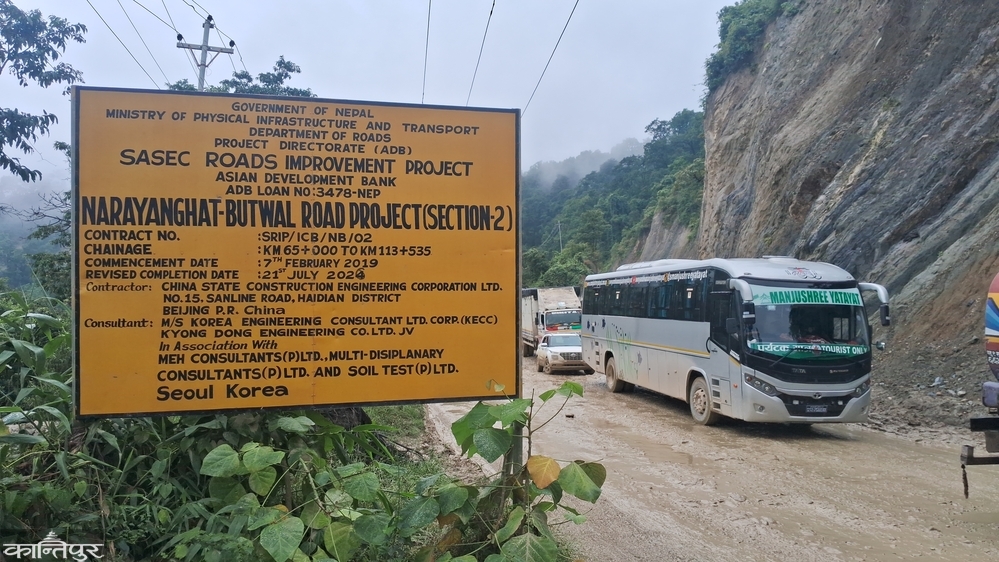
The drivers of passenger vehicles who travel on this road every day have health problems due to dust and have to suffer due to the daily traffic jams and poor road conditions. 'Along with the passengers, we have also suffered a lot. Unlike small vehicles, ours do not have AC. Dust gets inside all the vehicles,' Giri said, 'During the seven consecutive years of traveling on this section, dust has caused coughing and even breathing problems. If you don't wear a mask, you can't drive.'
Passengers are forced to stay in the forest of the Daunne hills, facing the fear of having to sit in traffic jams for hours and even during normal rains. While traveling on this road section, they have to travel only with weather information.
Confusion in the design of Daunne
There is still confusion about whether to blacktop or slope the 4-kilometer road of Daunne section. Out of the 14 kilometers of Daunne section, 4 kilometers fall in the eastern section and 10 kilometers in the western section. The contract agreement mentioned that all the roads would be blacktopped. However, later, when the blacktop in Daunne was not durable, washed away, and the road collapsed, the plan to slope the risk areas was implemented. So far, 2 km of the Daunne section has been paved on the east side, while 5 km of the 5 km on the west side need to be paved, 3 km of which has been paved and 2 km of which is being paved.
Pashupati Gyawali, chief of the Butwal Narayangadh Road Expansion Project West Section, said that by the second week of Magh, a decision will be made on whether to blacktop or slope the four-kilometer section. ‘Work is currently underway on Daunne.’ He said, ‘Although the work has been accelerated on this section, which has seen problems in traffic operation, it will take some time for the passengers to feel the work,’ he said. ‘Although the blacktop and slope have been approved for 10 km of the 14-km section of the Daunne section, we are in discussions on what to do with the four-kilometer section. The departmental minister has also shown great interest in the work on this road section and we aim to complete the work on the Daunne section by the upcoming Asad by blacktop or slope after January.’ 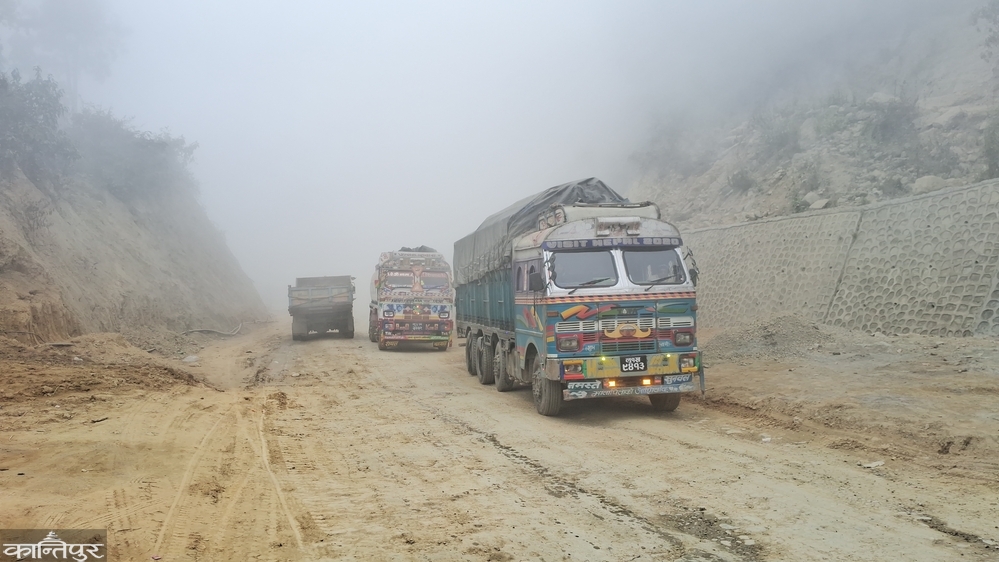
The construction of culverts and small and large bridges in the Daunne section, except for the two on the west side, is in the final stages. The construction company, China State Corporation, is currently working in two shifts on this section. The construction company is working both day and night and will complete the approved work received so far by the end of January, said engineer Vineet Koirala.
After the work approved so far is completed, the remaining four km will be worked on as per the instructions given by the project. Locals express doubts that the work will be completed on time as the work is still to be completed and there is still confusion in the design of the road.
The road has been blocked 32 times in 6 months.
Since the work started during the expansion of the Narayangadh-Butwal road, the most traffic has been blocked on the Daunne road section between Dumkibas and Bardaghat. According to the District Traffic Police Office, East Nawalparasi, the road has been blocked 32 times in the Daunne section from 1st Shrawan 2082 to 20th Poush. This also shows how difficult the journey on the Daunne road section is. Work is currently underway to erect walls, build culverts and make slopes on the narrow road.
Two-way traffic is being operated in a situation where only one-way traffic can be operated. The road is in poor condition. Potholes, mud and dust cause traffic to break down every day. Even if large vehicles break down in two or three places, when the road is one-way, there is a situation where you have to face a long traffic jam to cross this road section.
‘The condition of the road is not good. Since it is a main highway, the traffic pressure is high,’ said Kushal Bartaula, Chief of the District Traffic Police Office, East Nawalparasi, ‘We are working to manage traffic as much as possible.’ The long-term solution to reduce the suffering of this section is to speed up the construction of the road.'
Delay in work, government extends deadline further
The road that was supposed to be built in 44 months has not been completed even in 7 years. As commuters and locals continue to suffer due to the road expansion not being completed on time, the government has extended the deadline for the fourth time. Although the work was supposed to start in Chaitra 2075 and be completed in Shrawan 2079, the work has not been completed despite repeated extensions. After the work did not pick up speed even during the first extension, the deadline was extended for the second time until Shrawan 8, 2081. But after the work was not completed even for the second time, the deadline was extended for the third time until Shrawan 8, 2082. After the work was not completed during that period, the deadline has now been extended until mid-Shrawan 2083. So far, 74 percent of the work has been completed. The contract agreement has been signed by dividing the 114-kilometer road project into two sections. Work is underway in two areas under Section 'A' on the 65-kilometer road from Gaindakot to Daunne in eastern Nawalparasi and Section 'B' on the 49-kilometer road from Daunne to Butwal. The highway is being expanded at a total cost of Rs 16.9952 billion with the loan assistance of the Asian Development Bank (ADB).
Suffering due to lack of alternative
Passengers have been suffering for years due to the lack of an alternative route to cross the Daunne section of the Butwal-Narayangadh road section. The state has not paid attention to the road that can be used as an alternative. Although the Dadajor, Dumkibas road section of Binayi Triveni Rural Municipality in eastern Nawalparasi can be upgraded as an alternative to this road section, the local, provincial and federal governments have not shown interest.
It is considered easy for small vehicles to cross the Daunne section through Bhutaha, Sanbarat, Patuke, Dandajor to Dumkibas, but due to the lack of maintenance of this section, it is not easy to travel on the muddy and narrow road. Goods vehicles have to use the long-distance route. Of this 15-kilometer-long road, 4 kilometers are blacktopped, while the rest is unpaved and narrow, so only Scorpios and four-wheel jeeps are operating. This section cannot be used during the rains as there is no bridge over the Gangate River in the middle.
Although the Lumbini Provincial Government has taken forward work as an alternative route to Daunne, the work of widening the road has been delayed due to lack of sufficient budget. If work had been done on this section with diligence, there would not have been a situation where vehicles would have to stop and work on the Daunne section now. In the last five years, only four kilometers have been blacktopped from Bhutaha in Bardaghat to Aambas, which was taken as an alternative route. After that, there was no budget allocated for this section.
‘The state and provincial governments have not shown interest in the alternative route.’ The local level alone cannot do this work, said Shambhulal Shrestha, the head of Bardaghat Municipality. ‘If this road were to be upgraded, it would have been an alternative to the tourism development of the hilly region and the Daunne section.’
The Road Department and the Traffic Police do not formally suggest operating vehicles on this road section. When using the alternative route, the vehicle owner must obtain a route permit. The Road Department has said that vehicles going west from Narayangadh will have to go from Gaindakot in eastern Nawalparasi to Kaligandaki Corridor and exit at Palpa to Butwal.
Mini buses and passenger buses will be able to operate on this section. Large vehicles and freight trucks will have to exit at Muglin in Chitwan via Pokhara and Palpa to Butwal.