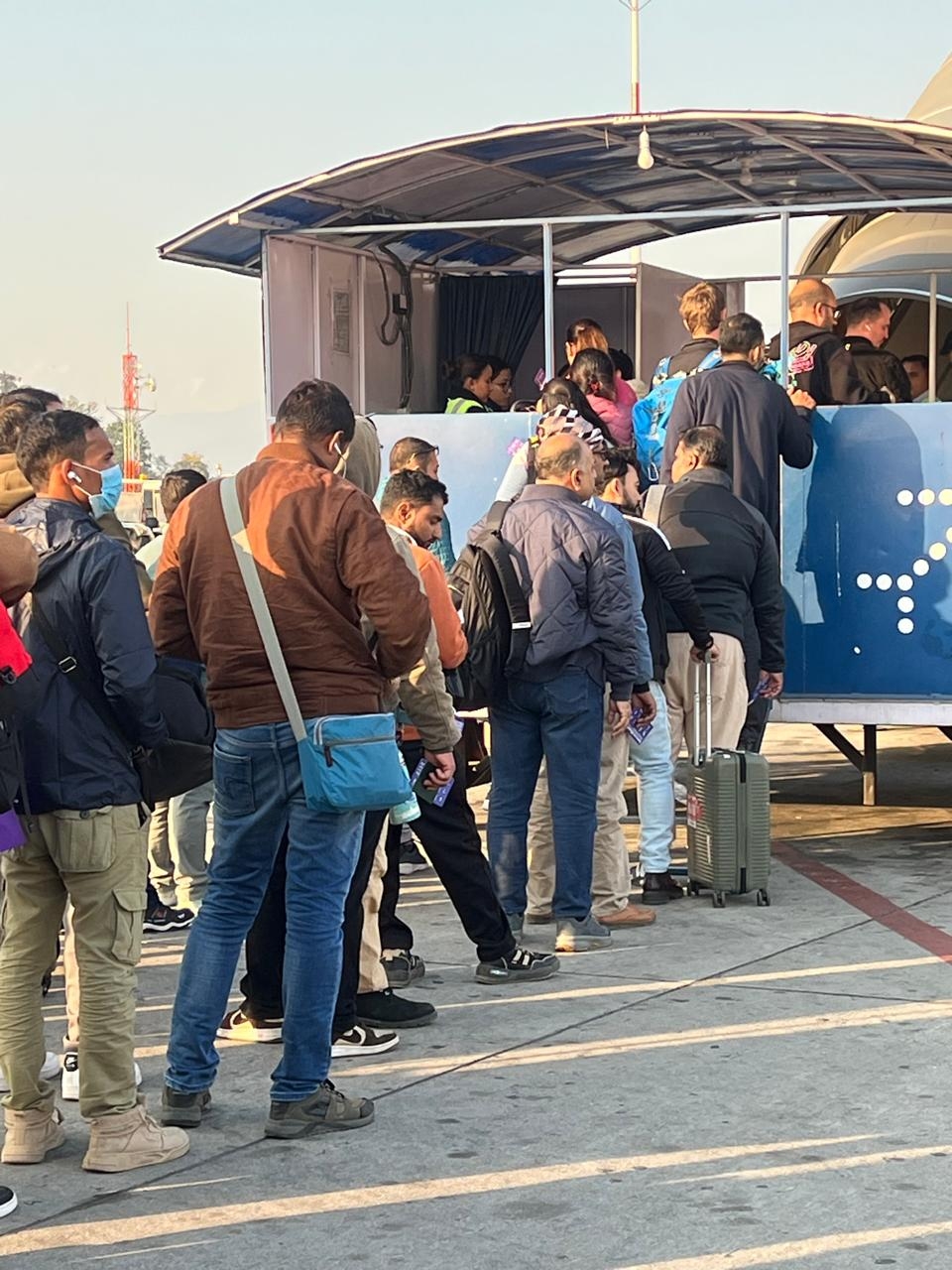
Before boarding an Indian flight after passing through immigration and security at Tribhuvan International Airport, passengers must enter a cabin box, where Indian security personnel check them. This is believed not to infringe on Nepal's sovereignty, as the checks are carried out after leaving Nepalese territory.
We use Google Cloud Translation Services. Google requires we provide the following disclaimer relating to use of this service:
This service may contain translations powered by Google. Google disclaims all warranties related to the translations, expressed or implied, including any warranties of accuracy, reliability, and any implied warranties of merchantability, fitness for a particular purpose, and noninfringement.
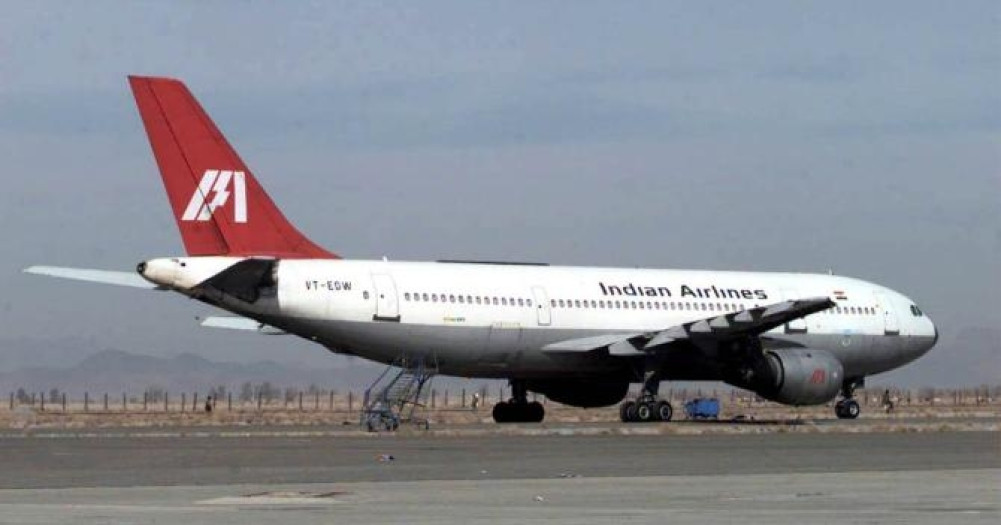
It has been 26 years since the hijacking of an Indian Airlines plane from Kathmandu, which caused a sensation around the world. Nepal has paid a heavy price for this incident, both in terms of passenger safety and the country's reputation. But what lessons has Nepal learned in the meantime?
In the backdrop of this incident, a separate security check has been arranged for Indian aircraft at Tribhuvan International Airport. Before boarding an Indian aircraft after clearing Nepal's immigration and security, passengers have to enter a cabin box, where Indian security personnel check them.
Since the check is done after leaving Nepal's land, it is believed that this does not interfere with Nepal's sovereignty. However, what initiatives did Nepal take on its own to make air security reliable? What improvements did it make in infrastructure and security strategy? To review this, we need to go back to the background of what Nepal had done wrong.
On the evening of December 24, Christmas Eve 26 years ago, Indian Airlines flight IC-814 was flying from Kathmandu to Delhi. The plane that was supposed to fly to Delhi at 1:50 pm was delayed from there. It was 4:27 pm when it took off from here. There were 8 Nepalese, 150 Indians and 178 passengers and 11 crew members on board the plane, including 11 crew members from various countries.
The plane entered Indian airspace at 4:47 pm. When the plane leaves Nepali airspace and enters Indian airspace, the captain says from the cockpit, ‘Good evening! I am the captain speaking... I am expressing my condolences and informing you that the plane has been hijacked. Trust me,’ Captain Devi Sharan promises, ‘I will try to get everyone home as soon as possible.’
Nepal was informed about the hijacking incident only three hours late. The investigation committee report states, ‘The Delhi control center received news that the plane had been hijacked by 5 hijackers. Since other media outlets also reported that the plane had been hijacked, it was confirmed that the Indian Airlines flight number IC-814, which was flying from Kathmandu to Delhi, India, had been hijacked.’
The plane, which was supposed to reach Delhi around 6 pm, landed at Amritsar airport in India at 7:17 pm. From there, Captain Devi Sharan was forced to take the plane wherever the hijackers told him to go. The plane took off from Amritsar and landed in Lahore, Pakistan at 8:42 Nepali time. After refueling there, it was taken to Kabul, Afghanistan at 10:55. However, since there was no equipment to land at night in Kabul, the plane was taken to Dubai, United Arab Emirates.
The plane landed in Dubai at 1:50 Nepali time. The hijackers freed 1 minor and 26 women from there. By then, a passenger, Rupen Katyal, had been stabbed to death. His body was taken off there. The plane was taken to Kandahar Airport, Afghanistan at 8:30 Nepali time the next morning. Only after reaching Kandahar did the hijackers clarify their purpose.
The hijackers demanded the release of 36 members of the Kashmiri separatist group, including Maulana Azhar Masood, who were in Indian jails as ransom. They also demanded 200 million US dollars. Azhar Masood, Mushtaq Ahmed Zargar and Mohammad Umar Saeed Sheikh, who were in Indian jails on charges of inciting terrorism, were in Indian jails. After six days of negotiations, the three of them were taken to Kandahar and released, and the hijacked plane was also released. The then Indian Foreign Minister Jaswant Singh himself had reached Kandahar to secure the release of the plane.
Jaish-e-Mohammed, the organization founded by Azhar Masood, who was released after the hijacking of a plane 26 years ago, has been implicated in the car bomb blast at the Red Fort in New Delhi, India, on November 24. Masood, a member of this group active in Kashmir, was arrested by Indian police in 1994 when he reached Srinagar on the basis of a fake passport. The involvement of this group was also seen in the attacks on the Indian Parliament in 2001 and in Pulwama in 2019.
According to the investigation conducted by the Nepali side, AA Sheikh (Chief), who was involved in the hijacking, had booked tickets from Gorkha Travels and Tours Pvt. Ltd. Kathmandu and SA Kazi (Burger) from Himalaya Travels. Similarly, Zahur Ibrahim Mistry (Bhola), Syed Shahid Akhtar (Doctor) and Rajesh Gopal Verma (Shakir) had booked tickets from Everest Express Tours and Travels. The report states that they had booked tickets as Indian citizens at that time.
‘In the case of Indian citizens, as per the agreement between the Government of Nepal and India in 1997, documents such as passport, driving license, voter certificate, ration card and recommendation from a government agency are accepted as official proof,’ the report says. ‘While getting the boarding card from the immigration, the hijackers had mentioned themselves as Indian citizens.’
Meanwhile, the day after the hijacking in Nepal, the Council of Ministers formed a high-level investigation committee under the leadership of retired Inspector General of Police Hem Bahadur Singh. The committee had to find an answer to the main question of how the hijackers got the weapons onto the ship. But the committee could not clarify whether the hijackers had guns or not.
According to the statements of passengers on board the ship, the hijackers were carrying what appeared to be pistols and bombs. The investigation committee said that the hijackers were carrying “objects that looked like lumps of earthenware.” “After reaching Kandahar, real pistols and hand grenades were found,” the report said, “they were different types of weapons from the ones used initially.”
The investigation committee has made two assumptions about how the hijackers got the “weapons” onto the ship. First, the hijackers may have taken advantage of the weak security management and hidden the weapons in their bags or on their bodies via the regular route and then took them through ‘screening’ and ‘walk-through’. Second, the hijacker may have passed the security check without weapons and reached the departure lounge and someone else may have given them weapons as planned at the same place or on the way to board the plane. However, the investigation conducted by the Nepali or Indian sides does not seem to have been able to determine any of these issues.
The possibility that the weapons were placed on the plane before arriving in Kathmandu is considered less credible in the investigation report. ‘Although the plane was not checked in the overhead wind after landing in Kathmandu, the possibility that such weapons were already placed on the plane may be low since security checks are carried out at the Indian airport before the plane takes off,’ the report says.
Similarly, it has been analyzed that not only the airport employees, but also officials of diplomatic missions in Kathmandu and persons with passes distributed by the airport Civil Aviation Office in large numbers continue to travel to and from the airport, which has increased the risk. The report says that no special security checks and surveillance of pass holders have been found.
It has also been pointed out that weapons could be given to people providing ‘catering’ services at the airport in Kathmandu, loaders or cleaners who walk through the corridor from the back of the ‘baggage hold’ to the corridor, and people with passes to move around the airport.
It is not clear how the weapons got on the plane at that time? Or whether there were guns on the plane or not? And since Nepal has not been able to convince strategically and diplomatically that Tribhuvan International Airport is safe, the security mechanism there has been conducting separate checks on every Indian plane going from Kathmandu to India. ‘The security check by Indian officials again when boarding after passing the Nepali security check means that they do not trust our security arrangements,’ says Tek Prasad Rai, a former Additional Inspector General of Police (AIG) who worked for a long time in the Nepal Police’s Special Bureau for Counter-Terrorism Affairs. ‘Nepal has also not been able to send a message that it has improved its security system in a reliable way.’
According to officers deployed at the Tribhuvan International Airport Security Office, much has changed technically compared to that time.
‘Closed circuit (CC) cameras have been added, scanners have become better,’ says an officer deployed at the airport, ‘But it is the high government level that sends the message that our airport is safe, not just modern equipment that will create a safe environment.’ Officers complain that the political leadership has not prioritized the issue of international airports linked to national security.
Not only India, but the United States has also been raising questions about Nepal’s airport security for a long time. The ‘Country Report on Terrorism’ issued by the Ministry of Foreign Affairs in 2021 stated that Nepal’s airport security system is very weak and inadequate, pointing out that it could be misused by those involved in terrorism. The US report stated that even if Nepal deliberately does not allow terrorists to enter, the weak security arrangements at the airport could be beneficial for international terrorist groups.
The US, which has repeatedly mentioned that Nepal is at risk of becoming an easy target for international terrorist groups, citing the airport security system and open borders as reasons, has stopped mentioning Nepal for the past four years. Officials claim that this was due to the 'lobbying' done by some senior Nepali police officers. 'After the hijacking incident, the security officers deployed at the airport are more sensitive, various teams including the Special Bureau have been deployed. Security information exchange has increased,' says former AIG Rai, 'Despite technical improvements, not enough work has been done on the mobilization of skilled personnel.'
According to another retired Superintendent of Police (SP) Tekunanda Eva Limbu, who worked for a long time in the Special Bureau, it is now almost impossible to bring in weapons as before. 'At that time, security checks were manual, now they are checked using many technical devices,' he says, 'but we have to be vigilant about the entry of foreign citizens, the visa system and other issues.'
The problem of entry passes inside the airport remains the same even after all these years. On 22 Mangsir, 2080, the customs office arrested Chandra Ghale with 14 kg of smuggled gold at the airport. After his arrest, he gave a statement to the investigating officers and revealed that he used to hide the smuggled gold in the toilet before it reached the immigration check.
‘At that time, it was found that the gold was kept in the toilet of a separate room designated as Commercially Important Person (CIP)’, says a customs officer involved in the investigation, ‘It was found that plumber Sher Bahadur Basnet, airport employee Ramesh Deula, AC mechanic Radhakrishna Shrestha and others conspired to extract the gold. It was found that they were extracting the gold through the path used to exhume the body.’
A committee was formed under the leadership of the then Chief Customs Officer Maniram Poudel to investigate this. The committee had asked for three months of CCTV records from the airport arrivals. However, only 21 days of ‘data’ were given to the committee, saying there was no backup.
The CCTV footage of some places requested by the committee was not provided, saying the cameras were broken. According to a member of the committee, the CCTV footage of the stairs leading to the CIP room was not made available as it was ‘out of service’. The developments in the gold scandal have also raised the possibility that a person with a pass could circumvent the security mechanism and transport goods.
Like the report on the hijacking of the plane, the report on the gold scandal also pointed out the problem of issuing passes. ‘The airport should make arrangements to keep employees working in service providers such as the Chamena Grih, currency exchange counter, CIP lounge, etc. under surveillance even when they are not on duty at the airport,’ the report said.
A high-level investigation committee was formed in 2074 BS under the leadership of Joint Secretary Ishwor Raj Poudel to investigate the gold smuggling scandal. This committee also stated that there were many weaknesses in airport security and that necessary steps should be taken to improve it. ‘प्रतिवेदनको सुझाव खण्डमा विमानस्थल सुरक्षामा देखिएका कमजोरीहरू बुँदागत रूपमै उल्लेख गरेर सुधार गर्न सिफारिस गरेका थियौं,’ समितिका तत्कालीन सदस्य पूर्वएआईजी वसन्त लामा भन्छन्, ‘तर, त्यो सुझाव कार्यान्वयन गर्नेतिर सरकारले चासो नै दिएको छैन ।’
समितिको प्रतिवेदनमा विमानस्थल सुरक्षा सुधारका लागि गर्नुपर्ने कामको सूची मात्र थिएन, विमानस्थल हुँदै लामो समयदेखि चल्दै आएको सुन तस्करीमा संलग्न रहेको शंका गरिएका २९३ जनाको सूची पनि थियो । व्यापारिक घरानाका सदस्यदेखि राजनीतिक दलका नेतासम्मका नाम उल्लेख भएको त्यो प्रतिवेदन सिंहदरबारभित्रै लुकाइएको छ । केपी शर्मा ओली नेतृत्वको तत्कालीन सरकारलाई बुझाइएको प्रतिवेदन अरू सरकारका पाला खोजी गर्दासमेत भेटिएन ।
१४ किलो सुन तस्करीको छानबिन समितिको प्रतिवेदनले पनि अन्तर्राष्ट्रिय रनवेको १ नम्बर ‘वे’ छेउ हुँदै आयल निगमको कार्यालय क्षेत्रबाट हिमालय एयरलाइन्सको कार्यालय तथा अन्य कार्यालयमा जाने सवारीसाधन निर्बाध आउजाउ भइरहेको उल्लेख गरेको थियो । समितिले कार्गोबाट परिचालन हुने ट्र्याक्टर, ट्रलीका लागि बनाइएको नयाँ रुटबारे समेत प्रश्न उठाएको थियो । यो रुट आयल निगमको कार्यालय नजिकको पार्किङ छेउ पर्ने भन्दै त्यस्ता सवारीसाधनलाई अन्य सवारीसाधनसँग सम्पर्क नहुने व्यवस्था हुनुपर्ने भनिएको थियो तर यसमा सरकारले ध्यान दिएको छैन ।
जहाज अपहरणबारे छानबिन गर्न २६ वर्षअघि गठित समितिले विमानस्थल सुरक्षामा खटिएका सुरक्षाकर्मीलाई पर्याप्त तालिमको अभाव समेत औंल्याएको थियो । ‘विमानस्थलमा आतंकवादमा संलग्नदेखि अरू विभिन्न कसुरका व्यक्तिले आउजाउ गर्न सक्ने भएकाले त्यहाँ कसरी परिचालित हुने भन्नेमा नियमित तालिम दिनु सधैं जरुरी हुन्छ,’ पूर्वएसपी लिम्बू भन्छन्, ‘त्यहाँ बस्ने सुरक्षाकर्मी नियमित पुलिसिङ गर्ने प्रहरी जस्तो मात्र होइनन्, उनीहरूमा विशेष सतर्कता र सावधानी चाहिन्छ ।’ विमानस्थलमा खटिने सुरक्षा संयन्त्र गुप्तचरी सूचना संकलनमा पनि सधैं चनाखो रहनुपर्ने उनी बताउँछन् । जसमा नेपालमा कमजोरी छ ।
नेपालमा गुप्तचरी सूचना फितलो छ र सूचनाअनुसारको रणनीति निर्माण पनि प्रभावकारी छैन भन्ने २३ र २४ भदौका घटनाक्रमले पनि स्पष्ट पारेका छन् । जानकार एक अधिकारीका अनुसार इन्डियन एयरलाइन्सको जहाज अपहरण हुनुअघि नेपाल प्रहरीको विशेष शाखाले कश्मीरमा आधारित आतंकवादी समूह लस्कर–ए–तोइवाको गतिविधि बढ्दै गएको सूचना पाएको थियो । त्यस बेला विमानस्थलको सुरक्षा कमजोर भएकाले विमानस्थलमा विस्फोट वा जहाज अपहरणजस्ता कुनै गतिविधि हुन सक्ने लिखित जानकारी गृह मन्त्रालयलाई गराइएको थियो । तर, त्यस सूचनालाई गम्भीरतापूर्वक नलिँदा जहाज अपहरण टार्न सकिएन ।
अहिले विमानस्थलमा त्यो बेलाभन्दा केही सुधार भए पनि बलियो गुप्तचरी संयन्त्रको अभाव, जोखिम विश्लेषण र पर्याप्त सुरक्षात्मक उपाय नहुँदा जोखिम अझै रहेको प्रतिआतंकवाद मामिला विज्ञ नारायण अधिकारी बताउँछन् । ‘त्यही सुरक्षा कमजोरीभित्र खेलेर विगतमा सुन तस्करी, मानव तस्करीलगायतका घटना भएका हुन्,’ उनी भन्छन्, ‘पटक–पटक भएको छानबिन प्रतिवेदन कागजमै सीमित हुनु, कतिपय सन्दिग्धलाई राजनीतिक संरक्षण गरिनु, प्राविधिक सुधार, दक्ष जनशक्ति व्यवस्थापन नहुनुले विमानस्थल सुरक्षा प्रणाली सुधार सरकारको प्राथमिकतामा नपरेको देखाउँछ ।’
अधिकारीको बुझाइमा विमानस्थलमा एकीकृत कमान्ड नहुनु, सम्बन्धित निकायबीच जिम्मेवारीको दोहोरोपन हुनुले पनि समस्या सिर्जना गराउँछ । गृह मन्त्रालयका एक उपसचिवका अनुसार, त्रिभुवन अन्तर्राष्ट्रिय विमानस्थलमा मात्र अहिले प्रहरी, सशस्त्र, अध्यागमन, भन्सार, बैंक, नोट सटही काउन्टरसहित गरेर १७० निकाय सक्रिय छन्,’ उनी भन्छन्, ‘कमजोरी हुँदा कसले जिम्मा लिने भन्ने पनि हुँदैन, त्यसैले एउटै गल्ती दोहोरिरहन्छ ।’
विमानस्थलमा प्रहरी, अध्यागमन र भन्सारका कर्मचारीबीच समेत सधैं असमझदारी हुने गरेको छ । प्रहरी अघि बढ्दा भन्सारले आफ्नो क्षेत्राधिकार मिचिएको महसुस गर्छ । भन्सारमा आफ्नो उपस्थिति नभएको भन्दै प्रहरीले सुन तस्करीलगायतका घटनामा निगरानी गर्न नपाएको गुनासो गर्दै आएको थियो । अहिले विमानस्थलको भन्सारमा सशस्त्र प्रहरीलाई समेत राखिएको छ ।
विभिन्न निकायबीच समन्वय कसरी गर्ने ? १४ किलो सुन तस्करी छानबिन गर्न गठित समितिले सुझाव दिएको छ, ‘विमानस्थलमा एउटा संयुक्त समन्वय कक्ष स्थापना गरेर सामूहिक रूपमा परिचालित हुनुपर्छ । ‘को–अर्डिनेसन एन्ड कन्ट्रोल रुम’ स्थापना भएमा आइपरेका समस्या समाधानका लागि कार्यक्षेत्रअनुसार जिम्मेवारी बाँडफाँट गर्न र जवाफदेही बनाउन सकिन्छ ।’