In 2000, Nepal was in the 'severe hunger' category on the Global Hunger Index. Although Nepal has made significant improvements over the past two decades, moving into the 'medium category', the situation is still not satisfactory. Nepal, which has set a goal of ending hunger by 2030, has fallen four places from last year to 72nd place.
We use Google Cloud Translation Services. Google requires we provide the following disclaimer relating to use of this service:
This service may contain translations powered by Google. Google disclaims all warranties related to the translations, expressed or implied, including any warranties of accuracy, reliability, and any implied warranties of merchantability, fitness for a particular purpose, and noninfringement.
Despite the goal of ending hunger in the next five years, the rate of hunger in Nepal has increased further in the last one year. According to the Global Hunger Index 2025 report, the hunger situation and child stunting rate in Nepal have increased.
This not only shows that progress in food and nutrition security is weak, but experts have pointed out that it is not possible to meet the ‘Zero Hunger’ goal of sustainable development by 2030 if the situation remains the same.
In this year’s Hunger Index report released by ‘Welt Hunger Hilfe’ and ‘Lee-Bird’ on Tuesday, Nepal has been placed as a country with ‘moderate hunger’. In the ‘Global Hunger Index’ (GHI), Nepal was ranked 68th out of 123 countries in 2024, but has fallen four places to 72nd this year. Nepal’s ‘GHI’ score has increased from 14.7 to 14.8. The report states that the hunger situation in Nepal is worsening due to the increase in the ‘Hunger Index’.
Similarly, the child stunting rate among children under the age of five has increased from 24.8 percent to 26 percent. The condition of not getting enough nutritious food for a long time is considered as child stunting.
‘The increase in the rate of stunting shows that hunger has affected the poor community, the purchasing power of Nepalis has decreased, health services have not been developed, maternal education has not improved, and environmental degradation has increased,’ said Bikash Deuja, a nutrition expert at ‘Welt Hunger Hilfe’, ‘This can be a warning bell for us. Increasing stunting indicates a risk situation.’
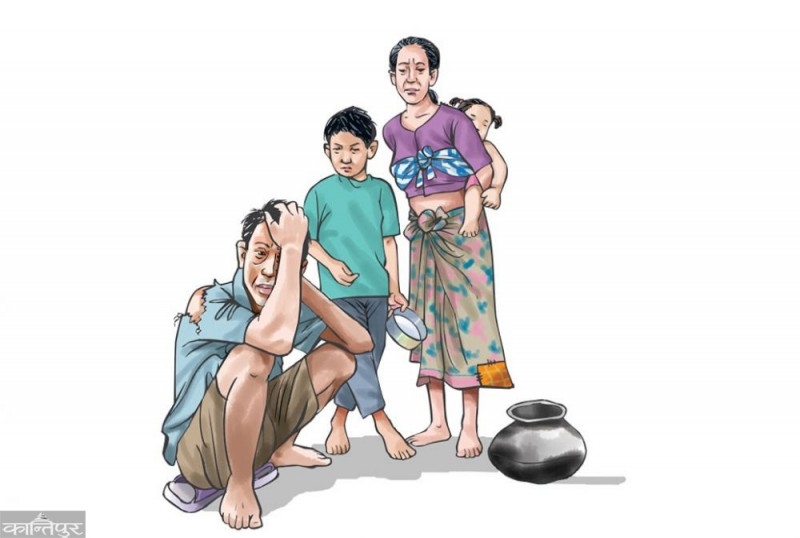
‘Welt Hunger Hilfe’, ‘Concern Worldwide’ and ‘Institution for International Law of Peace and Armed Conflict’ have been publishing such reports annually to measure the status of hunger and malnutrition. The report points out that the situation of malnutrition in Nepal is still complex as a public health challenge. Only 5.3 percent of the population in Nepal is undernourished or has low ‘calorie’ consumption. The report points out that the child mortality rate is 2.6 percent and child wasting is 7 percent.
Nepal was in the category of ‘severe hunger’ with a ‘GHI’ score of 37.1 in 2000. Looking at the period of two decades, Nepal has significantly improved its hunger situation. During this period, other South Asian countries have also made significant progress in reducing hunger. However, the rate seems to have slowed in recent years.
Nepal and Sri Lanka have moderate hunger levels, while India, Pakistan and Afghanistan are still in the severe hunger category. India has been questioning the ‘methodology’ or data collection method of the Global Hunger Index, claiming that its domestic food system is very strong and robust. India has been questioning the ‘methodology’ or data collection method of the Global Hunger Index. India has been questioning the fact that nutrition status is given more importance in calculating the total score of the four indicators of ‘GHI’ – nutritional status, malnutrition, stunting and child mortality.
‘Nepal has reduced its GHI by 5.8 points since 2016, bringing the hunger situation from critical to moderate,’ the report says, ‘this is the fastest improvement in South Asia.’ The report says that health and food security are enshrined as fundamental rights in the constitution, as well as Nepal’s multi-sectoral nutrition plans have contributed to this achievement.
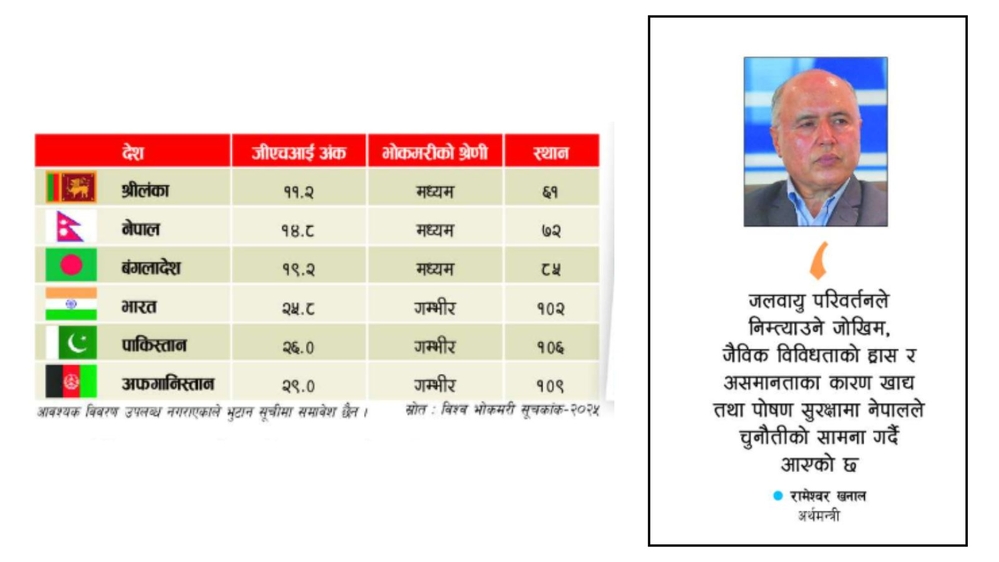
Bangladesh has also improved from ‘critical’ to moderate since 2000. Both Nepal and Bangladesh have reduced child stunting by about 30 percentage points. According to the report, Nepal has made good progress in reducing hunger compared to other South Asian countries except Sri Lanka. However, the report points out that this progress will not be sustainable unless Nepal’s food security situation is strengthened.
The rate of child wasting and stunting is highest in South Asian countries compared to other countries, where 36.4 percent of the world’s undernourished population is also mentioned, the report says. Bhutan was not included in the list due to non-provision of necessary details.
While releasing the report on Tuesday, Federal Affairs and General Administration and Finance Minister Rameshwor Khanal said that the report highlighted the situation and challenges of hunger, food security and nutrition security, especially in developing countries.
He said that although Nepal has made significant progress in hunger and malnutrition, the problem still exists. He believed that malnutrition and the increasing risk of non-communicable diseases, which are major problems of the country, are directly related to changes in Nepal's agricultural structure, production system, food system and consumption.

'Nepal has been facing challenges in food and nutrition security due to the risks posed by climate change, loss of biodiversity and inequality,' Minister Khanal said. 'The government has tried to address the challenges by ensuring local food rights, strengthening food systems, expanding nutrition and social protection programs. Agricultural technology, data-based local initiatives and youth participation in agro-entrepreneurship will help in building a hunger-free Nepal.'
‘Welt Hunger Hilfe Nepal’ Country Director Saqueb Nabi informed that the ‘Global Hunger Report’ has been issued globally for the past 20 years and its main focus is on food insecurity and malnutrition. He said that Nepal is doing commendable work to ensure access to food for the most vulnerable and marginalized communities amidst many challenges such as the impact of climate change, the impact of Covid, biodiversity loss and migration.
Former Member of the National Assembly Dr. Bimala Rai Poudel said that despite progress in reducing hunger through policy reforms, multi-sectoral programs, community-based nutrition projects and gender equality measures, the problem still exists. ‘Even now, one in every four children suffers from the problem of stunting,’ she said, ‘Women’s empowerment is important along with sustainable and coordinated efforts to end hunger and malnutrition.’
Deputy Head of Mission of the German Embassy Benjamin Seidel said that it is necessary to strengthen local food systems, strengthen communities and prioritize nutrition, especially for breastfeeding women and young children. Thakur Bhandari, President of the Community Forest Users Federation Nepal, said that agriculture and forestry sectors should move forward together.
Joint Secretary of the Ministry of Agriculture and Livestock Development Dr. Ramkrishna Shrestha emphasized the need to attract youth to the agricultural sector, promote local food systems, expand indigenous crops and mixed farming, and strengthen collaboration between the private sector and communities. Bharat Bhandari, Executive Director of Li-Bird, said that multi-sectoral collaboration is necessary, giving priority to women, remote communities and vulnerable groups.

